

What Makes a Reliable Thermal Camera Supplier for OEM and Industrial Buyers?
A reliable thermal camera supplier should provide more than an infrared imaging product with attractive specifications. For OEM manufacturers, engineering teams, and professional equipment buyers, supplier reliability depends on technical compatibility, verified sample performance, manufacturing consistency, documented product revisions, and dependable communication throughout the purchasing lifecycle.
The most suitable supplier is not necessarily the company offering the highest detector resolution or lowest initial quotation. It is the partner whose products can meet your application requirements consistently—from engineering evaluation and prototype integration to repeat production orders.
For example, a supplier providing thermal imaging modules for industrial inspection equipment may need to support mechanical integration, electrical compatibility, application testing, and manufacturing traceability.
A drone equipment manufacturer may prioritize compact dimensions, weight, power consumption, optical performance, and video integration. A security system integrator may place greater emphasis on nighttime observation, target detection requirements, optical configuration, and equipment reliability.
These buyers may purchase similar infrared imaging components, but their supplier qualification criteria differ.
The most effective sourcing strategy is to qualify the supplier, the exact product configuration, and the production process separately.
A capable supplier should be able to explain:
-
Which thermal imaging products match your application
-
How the proposed module will integrate into your equipment
-
Which specifications have been verified and under what conditions
-
What technical documentation is available
-
How samples can be evaluated before purchasing larger quantities
-
How product revisions and manufacturing changes are managed
-
Which quality records can support production acceptance
-
What commercial and technical conditions apply to ongoing supply
This guide presents a practical supplier qualification framework for B2B buyers evaluating infrared thermal imaging cores, OEM camera modules, and customized vision solutions.
It also introduces relevant options from the EAGLET thermal imaging product portfolio, helping buyers identify suitable product families before submitting detailed technical requirements.
1. Understand Which Type of Thermal Camera Supplier Your Project Needs
Before evaluating suppliers, determine which part of the thermal imaging system your company intends to purchase.
The term thermal camera supplier may refer to several different business models.
Some companies deliver finished thermal cameras. Others specialize in imaging cores, infrared modules, optical systems, or customized integration services.
These distinctions have a direct effect on product flexibility, engineering responsibility, testing scope, and purchasing cost.
Finished Thermal Camera Suppliers
Finished camera suppliers provide complete products that may include the detector, optics, electronics, housing, display, software interface, and supporting accessories.
These suppliers can be suitable for organizations purchasing thermal inspection equipment for direct use.
However, a complete off-the-shelf camera may offer limited flexibility when the buyer needs to integrate thermal imaging into a proprietary device.
Thermal Imaging Core Suppliers
A thermal imaging core is a component or subsystem responsible for acquiring and processing infrared image information.
Depending on the design, it may include an uncooled infrared detector, image processing electronics, optical components, and communication interfaces.
Core suppliers are particularly relevant to manufacturers developing:
-
OEM thermal imaging cameras
-
Industrial inspection equipment
-
Drone thermal payloads
-
Robotic inspection devices
-
Embedded machine vision systems
-
Professional observation equipment
For these customers, the thermal core is incorporated into a larger product rather than used as an independent finished camera.
Customized Thermal Vision Solution Providers
Some suppliers also support optical selection, electronic interfaces, mechanical adaptation, image processing, and system integration.
This can be valuable when a standard module does not fully satisfy the project's design constraints.
However, customization capabilities vary between companies.
A supplier supporting lens selection may not necessarily provide custom detector design, proprietary firmware development, or complete finished-product certification.
Buyers should request a written scope of work covering the specific engineering services needed.
Manufacturer, Distributor, or System Integrator?
| Supplier type | Typical responsibility | Suitable buyers | Main qualification concern |
|---|---|---|---|
| Finished camera supplier | Complete thermal imaging equipment | Industrial equipment users and project purchasers | Finished-product performance and support |
| Thermal core supplier | Infrared imaging modules and electronic subsystems | OEM manufacturers and product developers | Technical integration and model consistency |
| Distributor | Supply of products from other manufacturers | Purchasing teams requiring access to established products | Authorization, traceability, and technical support |
| System integrator | Combining imaging components into application systems | Industrial and security project owners | System compatibility and project acceptance |
| OEM/ODM solution provider | Application-specific configuration and integration support | Brands developing customized equipment | Engineering scope, design ownership, and validation |
Supplier selection rule: Match the supplier's actual responsibilities to your product development stage. Do not assume that every company advertising thermal cameras can manufacture customized modules or support an embedded OEM project.
2. Define Your Technical Requirements Before Requesting Quotations
An accurate supplier evaluation begins with a requirements document.
Without one, different vendors may recommend products that are difficult to compare.
One proposal may include a camera with a particular lens and analog video output, while another includes a different optical configuration or interface.
Even if the detector resolutions are identical, the systems may not be technically equivalent.
Define the Actual Imaging Task
Start by identifying what the equipment must accomplish.
Possible requirements include:
-
Detecting the presence of a target
-
Observing relative thermal differences
-
Identifying abnormal heating patterns
-
Supporting nighttime visual awareness
-
Providing real-time images to a host system
-
Producing calibrated temperature measurements
These functions require different levels of verification.
Thermal observation should not be confused with quantitative temperature measurement.
An imaging module that displays thermal contrast does not necessarily provide calibrated temperature data suitable for an industrial measurement application.
If temperature measurement is essential, buyers must specifically request radiometric capabilities and corresponding calibration documentation.
Build an Application Requirements Matrix
| Requirement | Information to provide | Why the supplier needs it |
|---|---|---|
| Intended application | Industrial inspection, UAV, robotics, security, or other use | Determines relevant product architecture |
| Target characteristics | Target dimensions, thermal properties, and observation task | Supports imaging performance evaluation |
| Working distance | Minimum and maximum expected distance | Guides optical selection |
| Imaging resolution | Preferred resolution or acceptable range | Identifies potential detector options |
| Field of view | Required observation area | Determines lens compatibility |
| Thermal sensitivity | Required contrast performance | Supports NETD evaluation |
| Frame rate | Required image update frequency | Influences moving-target suitability |
| Video interface | CVBS or another confirmed host-compatible interface | Prevents electronic incompatibility |
| Control interface | Required commands and communication method | Supports system integration |
| Power budget | Voltage range and operating power allowance | Determines electrical compatibility |
| Mechanical envelope | Available space, weight, and mounting restrictions | Determines installation feasibility |
| Environment | Temperature, vibration, humidity, and exposure conditions | Defines validation requirements |
| Measurement function | Observation only or calibrated temperature readings | Determines radiometric requirements |
| Expected volume | Prototype quantity and estimated future orders | Supports supply and commercial planning |
The supplier should understand which requirements are mandatory and which are preferences.
For example, an exact connector specification might be mandatory because the customer's host board is already finalized.
A preferred detector resolution may be negotiable if a different optical configuration can deliver equivalent application performance.
This distinction prevents unnecessary customization and helps avoid purchasing equipment that solves the wrong problem.
3. Use a Five-Stage Thermal Camera Supplier Qualification Process
A structured qualification process allows procurement and engineering teams to compare candidates consistently.
Rather than treating supplier selection as a single purchasing decision, divide it into five approval stages.
| Stage | Qualification objective | Required evidence | Decision |
|---|---|---|---|
| 1. Supplier screening | Verify business and product relevance | Company profile, product portfolio, contact details | Shortlist or reject |
| 2. Technical review | Confirm preliminary application compatibility | Datasheet, interfaces, optical information, integration documentation | Approve sample evaluation |
| 3. Sample validation | Test actual hardware against requirements | Sample identification and test results | Approve or reject configuration |
| 4. Production readiness | Evaluate manufacturing consistency and change control | Quality procedures, revision records, agreed acceptance criteria | Approve pilot production |
| 5. Commercial approval | Confirm sustainable purchasing arrangements | Quotation, delivery terms, warranty, support, change notification | Approve supplier for purchasing |
Stage 1: Supplier Screening
Verify the company's product specialization, available technical contacts, and ability to discuss the intended application.
A genuine supplier evaluation should establish what the company actually supplies rather than relying exclusively on broad website claims.
Stage 2: Technical Review
Request documents for the exact module under consideration.
Confirm resolution, optical configuration, electrical requirements, interfaces, mechanical dimensions, and operating conditions.
Any unclear specification should be resolved before samples are ordered.
Stage 3: Sample Validation
Test the actual imaging hardware using representative targets and intended host electronics.
Document the results, including configurations that failed to meet requirements.
A successful demonstration video is not a substitute for application-specific testing.
Stage 4: Production Readiness
Confirm how the manufacturer controls components, product versions, firmware, testing, and final acceptance.
Where appropriate, request a pilot batch before establishing larger recurring orders.
Stage 5: Commercial Approval
Finalize product identification, quotation scope, purchasing terms, technical support arrangements, and procedures for future changes.
A supplier should pass every critical qualification stage. Strong commercial terms cannot compensate for an imaging module that fails essential integration or performance requirements.
4. How to Verify a Thermal Camera Supplier's Technical Claims
Technical specifications are important, but supplier qualification requires understanding what those specifications actually prove.
Experienced OEM buyers distinguish between a published product parameter, a laboratory test result, and performance demonstrated in the intended application.
Infrared Resolution
Resolution determines the number of thermal detector pixels available.
Common uncooled module configurations include 256 × 192, 384 × 288, and 640 × 512.
Higher resolution provides additional pixels, but usable target detail also depends on optics and viewing geometry.
Ask whether the supplier's proposed detector and lens combination places enough pixels on the target at the intended distance.
NETD and Measurement Conditions
NETD, or Noise Equivalent Temperature Difference, describes thermal sensitivity under defined conditions.
Lower NETD values generally indicate greater sensitivity to small temperature differences when measured under comparable conditions.
However, values measured under different optical and test conditions should not be treated as directly equivalent.
Request the conditions associated with the published NETD value, including relevant temperature and optical settings.
Infrared Wavelength and Detector Technology
Many compact uncooled thermal imaging products operate in the long-wave infrared range.
EAGLET's published imaging cores use VOx uncooled detector technology with an 8–14 μm spectral response.
These characteristics are relevant to thermal imaging architecture, but they do not independently establish performance in every environmental condition.
Target emissivity, atmospheric attenuation, optical transmission, and thermal contrast affect the resulting image.
Lens Configuration
The lens influences field of view, target pixel coverage, and observation distance.
A wide-angle configuration can observe a larger scene but may allocate fewer pixels to a distant target.
A narrower-angle configuration may provide more target detail while reducing coverage.
For supplier evaluation, request the optical specification corresponding to the exact detector and lens combination.
If published focal length, field of view, and IFOV values appear inconsistent, obtain an updated engineering drawing or verified optical specification.
Do not calculate contractual detection performance from unverified figures.
Video Interfaces
Check the actual video output rather than assuming it matches the detector resolution.
For example, a thermal core with a 640 × 512 detector may provide a CVBS analog video signal.
CVBS output is not equivalent to a native 640 × 512 digital video interface.
If your system requires digital image data, verify whether the proposed model supports the required interface or needs additional hardware.
Radiometric Capability
If an application requires numerical temperature measurement, request explicit confirmation of:
-
Radiometric measurement support
-
Temperature measurement range
-
Stated measurement accuracy
-
Calibration conditions
-
Emissivity adjustment capabilities
-
Available temperature data interface
-
Relevant environmental limitations
A thermal imaging supplier should not be considered qualified for a measurement-based application until these requirements have been verified.
5. Technical Documentation: What Should a Professional Supplier Provide?
Technical documents are not merely administrative paperwork.
For embedded imaging products, they help engineers identify integration problems before expensive development work begins.
A supplier qualification package should be appropriate to the product being purchased.
Product Datasheet
The datasheet should identify the model and relevant version information.
It should specify the main imaging, electrical, mechanical, and environmental characteristics applicable to the proposed configuration.
Mechanical Drawings
Engineers may need drawings showing module dimensions, connector placement, mounting points, lens protrusion, and clearance requirements.
Mechanical incompatibilities can affect the final enclosure design and create additional tooling or assembly costs.
Electrical Interface Information
Relevant documentation may include connector definitions, supply requirements, interface electrical characteristics, and control communication instructions.
A simple interface name is not enough when the buyer needs to design a compatible host PCB.
Firmware and Control Documentation
If software commands are part of the integration, the supplier should identify supported functions and the documentation available for the relevant firmware version.
Buyers should not assume that features found in one product family are supported across every module.
Revision Identification
A clear relationship should exist between the sample, specification, firmware, and future production configuration.
For example, a change in firmware or optical components may require the buyer to repeat selected tests.
| Document or record | Purpose | Buyer verification |
|---|---|---|
| Product datasheet | Defines the proposed hardware | Confirm model and revision |
| Mechanical drawing | Supports enclosure design | Check dimensions and mounting |
| Electrical interface guide | Supports circuit integration | Verify voltage and connector details |
| Control protocol | Supports software integration | Confirm required commands |
| Sample configuration record | Identifies evaluated hardware | Record hardware, firmware, and optics |
| Test report | Supports performance claims | Check conditions and acceptance criteria |
| Change notification procedure | Controls future revisions | Confirm approval and communication process |
EAGLET's product and integration support page explains that technical documentation requests should include the exact model and intended application, with documents matched to the confirmed product version.
That model-specific approach is important for avoiding confusion between different product revisions.
6. Why Sample Approval Is Not the Same as Supplier Approval
A working prototype demonstrates that a particular sample can perform a task under specific conditions.
It does not automatically prove that future production units will perform identically.
A complete qualification program should distinguish three levels of approval.
Engineering Sample Approval
The engineering team verifies that the proposed module can perform the intended imaging function and integrate with the host hardware.
Testing should use the expected electrical supply, communication interface, optical arrangement, and representative targets.
Design Configuration Approval
The buyer confirms the specific hardware, optics, firmware, and mechanical configuration that will be used in the product.
This approved configuration becomes the reference for subsequent procurement.
Production Approval
The purchasing and quality teams assess whether the supplier can provide products consistently against the approved requirements.
This may involve pilot production, inspection records, and agreed acceptance procedures.
The central question is not only whether the first sample works. It is whether future units can be supplied and verified against the same approved configuration.
Recommended Sample Acceptance Matrix
| Test category | Recommended verification | Example acceptance approach |
|---|---|---|
| Product identification | Record model, hardware, and firmware | Match the approved sample configuration |
| Startup behavior | Test within intended electrical conditions | Meet agreed startup requirements |
| Image output | Connect to actual host equipment | Stable and compatible output |
| Imaging performance | Use representative targets and distances | Meet project-specific detection or observation criteria |
| Optical configuration | Confirm coverage and target detail | Meet approved field-of-view requirements |
| Power consumption | Measure relevant operating modes | Remain within the system power budget |
| Control interface | Execute required commands | Functions operate as documented |
| Extended operation | Run for an agreed evaluation period | No unacceptable performance degradation |
| Environmental operation | Test relevant conditions | Meet project-specific acceptance criteria |
| Repeatability | Compare approved units under controlled conditions | Remain within agreed variation limits |
These are proposed testing categories, not claims that every supplier performs identical procedures.
Use Representative Test Conditions
A thermal camera should be evaluated under conditions that resemble its intended deployment.
For an industrial application, this may mean observing equipment under relevant operating loads.
For a drone application, it may require evaluating the complete payload's power, vibration, imaging, and communication behavior.
For security use, evaluation may include day-to-night changes, target distances, and different thermal backgrounds.
Testing only a stationary laboratory target may leave important operational uncertainties unresolved.
Establish a Golden Sample
After approval, the engineering team can designate a controlled reference configuration, sometimes called a golden sample.
The record should include the exact module, optical configuration, hardware and firmware versions, and approved test conditions.
A golden sample supports comparison, but it does not replace documented acceptance limits or calibrated measurement methods.
7. The Most Overlooked Supplier Risk: Product Revision and Change Control
For OEM buyers purchasing thermal imaging modules over multiple production cycles, uncontrolled product changes can create expensive integration problems.
A component may retain the same commercial product name while its internal hardware, optical configuration, or firmware changes.
Even an apparently minor modification may affect the customer's finished system.
Why Changes Matter
Consider a hypothetical industrial equipment manufacturer that has approved a thermal core for integration into its monitoring device.
The host circuit, enclosure, and application software are designed around that module.
If the supplier changes the connector arrangement, the existing PCB may no longer be compatible.
If the optical configuration changes, the camera may observe a different area.
If firmware behavior changes, previously validated commands or startup sequences may respond differently.
Any of these events can trigger engineering rework or production delays.
What a Change Control Agreement Should Cover
Buyers should discuss:
-
How the supplier identifies hardware revisions
-
How firmware versions are recorded
-
Whether optical components may be substituted
-
Which changes require prior notification
-
How revised products are validated
-
Whether the customer must approve certain changes
-
How existing inventory is identified
-
What happens when a component becomes unavailable
Define the Difference Between Minor and Critical Changes
Not every manufacturing change requires full product requalification.
However, a change affecting electrical compatibility, optical behavior, image processing, mounting dimensions, or a mandatory performance requirement may require additional verification.
A practical change control process should connect the type of change to an appropriate review and testing response.
For long-term OEM production, documented configuration control can be more valuable than a small initial unit-price discount.
8. How to Assess Manufacturing Quality and Traceability
Manufacturing capability should be evaluated through relevant evidence rather than marketing statements alone.
A product portfolio or factory photograph does not prove that all production units meet the same acceptance criteria.
For a professional infrared camera supplier, ask how manufacturing and inspection responsibilities are organized.
Incoming Component Control
Thermal imaging systems may contain detectors, lenses, electronic assemblies, connectors, and mechanical parts.
The supplier should be able to explain how important incoming components are identified and checked.
Where component substitutions could affect performance, their approval and traceability procedures are particularly relevant.
Assembly and Inspection
Depending on the module design, assembly consistency can affect optical alignment, connector reliability, and mechanical integrity.
The buyer should understand which product characteristics are inspected during production and which are evaluated through final testing.
Performance Verification
A reasonable production acceptance plan may include checks for electrical operation, image output, interface behavior, and relevant imaging defects.
The specific tests should reflect the agreed product requirements.
A supplier may use automated equipment, manual procedures, or both.
The purchasing decision should depend on the effectiveness and evidence of the process, not simply the number of machines described in a presentation.
Quality Management Certification
ISO 9001:2015, Quality Management Systems — Requirements, provides an established framework for organizational quality management.
If ISO 9001 certification is required for procurement, request the certificate and confirm its issuing body, validity, covered organization, and scope.
Certification should not be assumed merely because a supplier mentions quality control.
Likewise, a quality management certificate does not establish the detector performance or environmental compliance of an individual thermal camera.
Traceability and Batch Records
For recurring supply, useful traceability information may include:
-
Product model and approved revision
-
Manufacturing batch or serial identification
-
Critical configuration information
-
Inspection status
-
Applicable firmware version
-
Records relevant to agreed acceptance criteria
Not every application requires the same traceability depth.
A critical industrial monitoring project may need more comprehensive records than a simple observation device.
Buyers should define these requirements before production begins.
9. How to Evaluate OEM and ODM Support Without Increasing Project Risk
OEM and ODM services can be valuable when standard imaging hardware does not meet the application requirements.
However, customization introduces additional responsibilities that should be clarified before development starts.
Standard Product Integration
The buyer selects an existing module and incorporates it into a proprietary product.
This can reduce development complexity when the available module already meets the requirements.
The supplier's main contribution may be product documentation, configuration guidance, and technical support.
Optical Configuration
A project may need a particular lens or field of view.
Optical changes should be evaluated alongside detector resolution, expected target size, installation geometry, and available space.
The final optical specification should form part of the approved configuration.
Electrical and Mechanical Adaptation
Projects may require adjustments to mounting, cable arrangements, or system-level electronic connections.
The feasibility and cost of these changes depend on the actual hardware architecture.
Do not assume that every interface can be modified or every housing can be redesigned economically.
Software and Processing Integration
Depending on the module, a project may involve command control, video conversion, or image processing integration.
For such work, buyers should clarify which software functions are available and who is responsible for each development task.
Define Engineering Deliverables
Before committing to customized development, agree on:
| Project element | Questions to resolve |
|---|---|
| Technical scope | What exactly will be modified or developed? |
| Design responsibility | Which party owns each engineering task? |
| Deliverables | What hardware, drawings, documents, or software will be supplied? |
| Prototype approval | How will the design be tested and accepted? |
| Intellectual property | Which rights belong to each party? |
| Change requests | How will additional requirements be evaluated? |
| Production transfer | How will the approved design move into manufacturing? |
| Ongoing support | What happens when changes are needed later? |
EAGLET describes an application-oriented approach covering imaging cores, optics, electronics, image processing, and system integration.
Learn more about these business directions on the EAGLET company and technology page.
The precise customization scope for an individual project should be confirmed through technical discussion.
10. Total Cost of Ownership: Compare More Than the Supplier's Unit Price
A supplier's quotation is only one part of the purchasing decision.
For professional equipment manufacturers, total sourcing cost includes the resources needed to integrate, validate, purchase, and maintain the imaging subsystem.
A lower initial price can become less attractive if significant engineering modifications or recurring supply problems follow.
Direct Hardware Cost
This includes the quoted module and any required optical or electronic accessories.
Confirm whether the quotation covers the exact lens, control electronics, connectors, cables, and other required items.
A lower-priced proposal may exclude components included in another supplier's offer.
Integration Cost
The host product may require additional electronics, mechanical changes, or software development.
For example, an analog video output may require conversion when the host system accepts only a specific digital input.
The resulting additional components and engineering effort should be considered in the total cost.
Validation Cost
Testing can involve engineering labor, fixtures, calibration equipment where required, and repeated evaluations after design changes.
A supplier providing clear and accurate integration documentation may reduce avoidable engineering work.
Manufacturing and Lifecycle Cost
Long-term considerations include revision management, component availability, quality issues, and the cost of maintaining approved production configurations.
Logistics and Commercial Risk
Importing imaging hardware may involve freight, packaging, customs documentation, applicable duties, and destination-specific compliance considerations.
The correct requirements depend on the product, destination, end use, and transaction.
Buyers should confirm these conditions rather than assume that every thermal imaging product is subject to identical import or export rules.
Total Cost Comparison
| Cost element | Why it matters |
|---|---|
| Unit hardware price | Determines direct component expenditure |
| Required accessories | Prevents incomplete quotation comparisons |
| Custom engineering | Adds development expenditure |
| Interface adaptation | May require additional hardware or software |
| Testing and qualification | Determines validation resources |
| Quality issues | May lead to rework or replacement |
| Shipping and customs | Affects delivered cost |
| Supply changes | May require additional engineering approval |
| Support arrangements | Affects long-term maintenance responsibilities |
The most appropriate purchasing decision balances price with product suitability, engineering cost, and supply reliability.
11. MOQ, Lead Time, Warranty, and Supply Continuity: What Should Buyers Ask?
Commercial terms should be confirmed for the exact product configuration and anticipated order volume.
Do not assume that a supplier's standard commercial terms apply to all customized modules.
Minimum Order Quantity
MOQ may differ between standard products and custom configurations.
A custom optical assembly or mechanical modification may involve additional component sourcing requirements.
Buyers should request separate information for engineering samples, pilot orders, and recurring production.
Production Lead Time
Lead time may depend on component availability, product configuration, order size, and production scheduling.
Ask the supplier to distinguish between sample preparation, engineering development, pilot production, and repeat orders.
A quoted lead time should be connected to an agreed set of conditions.
Warranty and Technical Support
Clarify what the warranty covers and how defective or nonconforming units are handled.
For embedded products, technical support may involve diagnosis of interfaces, documentation, or product revisions.
The responsibilities of the supplier and buyer should be documented.
Forecasting and Long-Term Availability
Recurring OEM production benefits from communication about expected purchasing volumes.
A supplier may be better able to plan component sourcing when the buyer provides a realistic forecast.
However, a forecast is not necessarily a binding purchase commitment unless the agreement explicitly states otherwise.
Business Continuity Questions
Ask how the supplier handles component shortages, discontinued materials, production interruptions, and changes to critical configurations.
Where supply continuity is essential, establish how much advance notification is required and what alternatives can be evaluated.
12. What Should Industrial, UAV, and Security Buyers Prioritize?
Different applications require different supplier qualification priorities.
A universal supplier score is rarely sufficient without application-specific evaluation.
Industrial Inspection Equipment
For industrial inspection devices, prioritize imaging repeatability, interface compatibility, environmental suitability, and documentation.
If numerical temperature readings are required, confirm radiometric capabilities and measurement validation.
For electrical or mechanical condition monitoring, the inspection procedure must account for target characteristics and operating conditions.
EAGLET provides further application information through its industrial inspection solutions.
EV Charging and Energy Infrastructure
For energy equipment, evaluate the intended observation or measurement function, operating environment, electrical integration, and installation requirements.
The system should be assessed under representative equipment conditions.
Thermal images may help identify unusual heating patterns, but a calibrated temperature alarm system requires additional verification.
Explore EAGLET's new energy and EV charging solutions.
UAV and Low-Altitude Systems
UAV buyers should focus on the complete payload rather than only the thermal detector.
Relevant considerations include module weight, power demand, optical coverage, mounting, vibration, communication interfaces, and end-to-end video latency.
A published imaging latency value does not guarantee the latency of the entire wireless video system.
Review EAGLET's UAV and low-altitude imaging applications.
Security and Night Observation
Security system buyers should evaluate target size, viewing distance, thermal contrast, lens selection, and operating conditions.
Thermal imaging can support observation in darkness without visible illumination.
However, adverse weather, atmospheric attenuation, and low target contrast may reduce effective detection performance.
Explore EAGLET's security and night patrol solutions.
13. Comparing EAGLET Thermal Imaging Cores for Supplier Evaluation
A supplier qualification process should be based on exact product models rather than general company-level performance claims.
EAGLET currently publishes several VOx uncooled thermal imaging core products with different resolution and integration configurations.
These products can provide starting points for OEM buyers developing industrial inspection devices, robotic systems, security equipment, and customized infrared products.
Published Product Comparison
| Product | Infrared resolution | Published NETD | Power consumption | Integration consideration |
|---|---|---|---|---|
| T-C Series | 256×192 / 384×288 / 640×512 | ≤35 mK | ≤0.5 W | Multiple resolution options; published CVBS and UART interfaces |
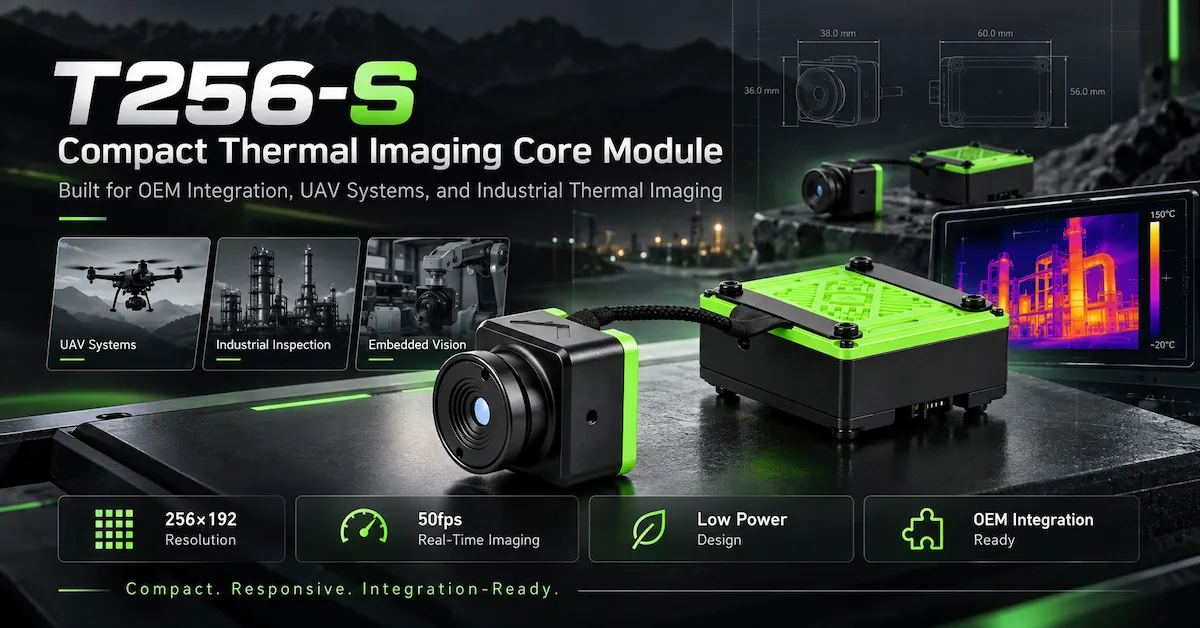
| T256-S | 256×192 | ≤50 mK | <1.5 W | Compact design and 50 fps imaging |
| T384-I | 384×288 | ≤50 mK | <1.5 W | Intermediate resolution for embedded applications |
| T640-S | 640×512 | ≤50 mK | <1.5 W | Higher-resolution option with separate lens and controller dimensions |
| T640-I | 640×512 | ≤50 mK | <1.5 W | Higher-resolution module with compact integrated dimensions |
The figures above are based on EAGLET's published product information. Actual performance, test conditions, revision, and configuration should be confirmed during technical qualification.
When to Consider the T-C Series
The T-C Series offers several infrared resolutions and published low-power specifications.
Its technical information includes CVBS video output and UART control.
This may make it a relevant candidate when embedded integration and power consumption are major concerns.
Buyers should confirm the exact configuration, optical arrangement, and electrical details before selecting a version.
When to Consider T256-S or T384-I
The T256-S may be worth evaluating for compact embedded applications where its detector resolution and optical configuration meet the imaging task.
The T384-I provides an intermediate resolution option for projects requiring a different balance of target detail, integration constraints, and overall system requirements.
Neither option should be selected solely on the basis of resolution.
Sample testing should demonstrate adequate performance with the intended target and installation geometry.
When to Consider T640-S or T640-I
The T640-S and T640-I use 640 × 512 infrared detectors.
They are potential candidates for applications where greater target detail is needed.
However, their mechanical characteristics and integration architecture differ.
Buyers should confirm the exact dimensions, interface specifications, lens configuration, and approved product version.
Supplier evaluation takeaway: EAGLET's published specifications provide a useful basis for initial product shortlisting. Final qualification should rely on model-specific technical documents and application testing rather than company-wide marketing figures.
14. A Practical Thermal Camera Supplier Scorecard for Procurement Teams
A weighted scorecard can help B2B buyers compare potential suppliers consistently.
The following framework is designed for OEM imaging projects.
| Evaluation area | Suggested weight | What to assess |
|---|---|---|
| Technical compatibility | 25% | Imaging requirements, optics, interfaces, power, mechanical fit |
| Sample validation | 20% | Actual test results and acceptance evidence |
| Quality and change management | 20% | Production inspection, traceability, configuration control |
| Supply and commercial conditions | 20% | Quotation completeness, forecast support, lead time, warranty |
| Engineering communication | 15% | Documentation, technical responses, integration support |
These weightings are an illustrative purchasing tool and should be adjusted to the specific application.
Assign each supplier a rating from 1 to 5 for each category.
The weighted result can support a comparison, but mandatory technical requirements should remain separate.
For example, a supplier whose product cannot connect to the required host interface should not be approved merely because it has attractive pricing and strong commercial communication.
Recommended Approval Categories
Approved: The supplier and product configuration satisfy mandatory requirements and have completed the required qualification process.
Conditionally Approved: The supplier appears suitable, but specified documents, tests, or commercial agreements remain outstanding.
Not Approved: Critical requirements cannot be met, or important technical and commercial risks remain unresolved.
This approach supports decisions that are understandable to engineering, purchasing, quality, and project management teams.
15. Warning Signs When Evaluating a Thermal Imaging Supplier
Early warning signs should be examined before a supplier is approved for recurring orders.
Product Specifications Cannot Be Connected to an Exact Model
General claims about high sensitivity or high resolution are not enough.
Ask which specification applies to the exact proposed product configuration.
The Supplier Cannot Explain Interface Requirements
An embedded module supplier should be able to clarify supported video and control interfaces.
Unclear communication about electrical compatibility can create significant engineering risk.
Sample and Production Configurations Are Not Controlled
If the supplier cannot explain how future deliveries will match the approved sample, the buyer may face unexpected changes.
Quality Claims Lack Supporting Evidence
Statements about testing, certification, and manufacturing reliability should be supported by relevant documentation.
Quotations Exclude Important Components
Confirm the inclusion of lenses, boards, connectors, cables, or customization work when comparing offers.
Commercial Conditions Remain Ambiguous
Unclear purchasing terms, warranties, change procedures, and delivery responsibilities can lead to disputes later.
Performance Claims Ignore Operating Conditions
Thermal image quality and effective detection capability depend on the complete system and its environment.
A supplier that cannot explain these limitations may not provide sufficient technical guidance.
16. How to Prepare an RFQ That Produces a Useful Technical Proposal
A strong RFQ gives the supplier enough information to recommend a realistic solution.
For OEM purchasing, the goal is not simply to obtain the lowest price.
It is to receive a proposal that can be evaluated against the intended application, development responsibilities, and future supply requirements.
Essential RFQ Information
| Item | Information to include |
|---|---|
| Project description | What equipment are you developing? |
| Application | Where and how will thermal imaging be used? |
| Imaging function | Observation, detection, or calibrated temperature measurement |
| Resolution | Preferred detector resolution or acceptable alternatives |
| Working distance | Target distance and relevant target dimensions |
| Optical requirement | Required field of view or lens constraints |
| Host interface | Required video and control connections |
| Power | Available voltage and power budget |
| Mechanical | Installation envelope and weight restrictions |
| Environment | Expected operating conditions |
| Customization | Any required optical, electrical, mechanical, or software changes |
| Order plan | Sample quantity, pilot quantity, and expected recurring demand |
| Documentation | Required drawings, interface guides, and test evidence |
| Commercial requirements | Quotation scope, lead time, warranty, and change control expectations |
Example RFQ Email for an OEM Thermal Imaging Project
Subject: Thermal Imaging Core Supplier Inquiry — OEM Integration and Production
Dear EAGLET Team,
We are evaluating thermal imaging suppliers for an OEM equipment development project.
Our intended application is an embedded infrared imaging system for professional industrial use.
We would like to identify a suitable thermal imaging core based on the required resolution, field of view, video interface, electrical compatibility, mechanical dimensions, and operating environment.
Please advise which available product configurations may be appropriate for our requirements.
We would also appreciate information regarding model-specific technical documentation, sample evaluation, available customization options, product revision management, and commercial conditions for potential recurring orders.
Our team can provide detailed technical requirements and expected purchasing quantities for further review.
We look forward to discussing the project with your engineering and sales teams.
Best regards,
OEM Procurement and Engineering Team
A clear inquiry allows both parties to identify potential technical or commercial mismatches before resources are committed.
You can submit a project-specific request through the EAGLET contact and quotation page.
17. Frequently Asked Questions About Thermal Camera Suppliers
1. How do I find a reliable thermal camera supplier for OEM production?
Start by identifying suppliers whose actual product portfolio matches your application.
Request model-specific technical documents and confirm that the supplier can explain important electrical, optical, and mechanical requirements.
Evaluate an appropriate sample in your intended system.
Before recurring purchases, agree on configuration control, quality acceptance, commercial terms, and responsibilities for technical support.
The strongest supplier is not necessarily the lowest-cost option. It is the one that can consistently deliver the approved product configuration.
2. What is the difference between a thermal camera supplier and a manufacturer?
A manufacturer may develop or produce the imaging hardware directly, while a supplier may be a manufacturer, distributor, or system integrator.
The distinction matters when the buyer requires product customization, technical documentation, or direct engineering communication.
A distributor can be suitable for standard product purchasing, but OEM development may require access to the original manufacturer's technical team.
Verify each company's actual responsibilities rather than relying only on its business description.
3. What specifications should I compare before ordering thermal imaging samples?
Compare detector resolution, thermal sensitivity, spectral response, optical configuration, frame rate, electrical requirements, interfaces, dimensions, and operating environment.
For applications requiring quantitative temperature readings, include radiometric measurement and calibration requirements.
Do not compare individual specifications without considering the intended task.
An imaging core must be evaluated as part of the final system.
4. How can I verify whether a thermal imaging supplier provides accurate technical information?
Ask for the datasheet and supporting technical documents for the exact model and configuration.
Check whether key values include relevant test conditions.
Where specifications appear inconsistent, request clarification before ordering.
Use representative sample testing to confirm performance that is critical to the project.
Supplier claims should be supported by evidence appropriate to their importance in the purchasing decision.
5. Should I buy a standard thermal imaging module or request customization?
A standard module is generally preferable when it already satisfies the required imaging, electrical, optical, and mechanical conditions.
Customization may be justified when important application requirements cannot be met by existing configurations.
However, additional engineering work can increase cost and qualification effort.
Before requesting customization, define which changes are essential and which requirements can remain flexible.
6. What is the most important quality control requirement for repeat orders?
There is no single universal requirement, but consistent identification and control of the approved product configuration are fundamental.
Buyers should understand how the supplier manages important components, firmware, optics, inspection, and production revisions.
The agreed acceptance criteria must also be practical to verify.
Without configuration control, later deliveries may differ from the samples used during product development.
7. Can thermal imaging suppliers provide calibrated temperature measurement modules?
Some thermal imaging products support radiometric measurement, but this capability should not be assumed.
A thermal image showing differences in heat patterns does not automatically provide calibrated temperature readings.
Buyers requiring temperature measurements must confirm the measurement range, accuracy, calibration, and output data supported by the exact product.
The intended operating conditions should be considered during validation.
8. How should I compare prices between thermal camera suppliers?
Compare equivalent product configurations and quotation scopes.
Include necessary optics, interfaces, accessories, development costs, testing, logistics, and support requirements.
Ask whether different order quantities affect the pricing structure.
For OEM development, total integration and lifecycle cost may be more important than a small difference in initial unit price.
9. What documents should I request before placing a bulk order?
Documentation should match the product and application.
Common requirements may include a confirmed datasheet, approved model configuration, mechanical drawings, interface documentation, agreed acceptance criteria, and commercial terms.
Where appropriate, buyers may also request quality records, revision control information, and evidence of required certifications.
The exact document package should be agreed before production approval.
10. Why is product revision control important when sourcing thermal imaging modules?
A change in optics, firmware, electronics, or connectors may affect compatibility with the buyer's finished equipment.
Without notification and verification, such changes can lead to redesign, software problems, or production disruption.
A documented change process helps both parties identify potentially significant modifications and determine whether additional testing is necessary.
11. Can a thermal camera supplier support UAV and robotics applications?
Suppliers offering compact embedded thermal imaging products may support these application directions.
However, the suitability of a particular module depends on payload weight, electrical requirements, mechanical installation, optical performance, and system interfaces.
For UAVs, the complete video and communication chain may also require evaluation.
A supplier should recommend a configuration based on the actual platform rather than general application labels.
12. How do I request a quotation from EAGLET?
Start by describing the intended thermal imaging application and the equipment being developed.
Include target resolution, working distance, lens requirements, interfaces, power conditions, operating environment, and expected purchasing quantities.
If you are evaluating a specific model, identify it in your inquiry.
EAGLET provides an online project inquiry process through its Contact Us page, where your requirements can be reviewed to identify a potential product or customization route.
Conclusion
Choosing the right thermal camera supplier requires a structured evaluation of technical compatibility, sample performance, manufacturing quality, configuration control, and long-term supply conditions. For OEM buyers, reliable repeatability and integration support are just as important as initial imaging specifications and pricing.
EAGLET offers infrared thermal imaging cores and integration-oriented solutions for industrial equipment, UAVs, robotics, and security applications. If your team is evaluating thermal imaging modules for a new product or recurring production, contact EAGLET to discuss your application, review suitable product options, and request a technical quotation.