


Dual Mode Two Way Radio for mixed-network field communication
A Dual Mode Two Way Radio helps teams solve a common problem: one group needs quick, push-to-talk coordination on a private radio channel, while another needs the flexibility of public network dispatch when coverage, distance, or site layout changes. This type of device combines 4G POC connectivity with analog radio communication, so users can keep one handheld unit instead of carrying separate devices for different communication tasks. For security, logistics, construction, warehousing, and field inspection, that can simplify operations and reduce handoff errors between networks.
Product overview
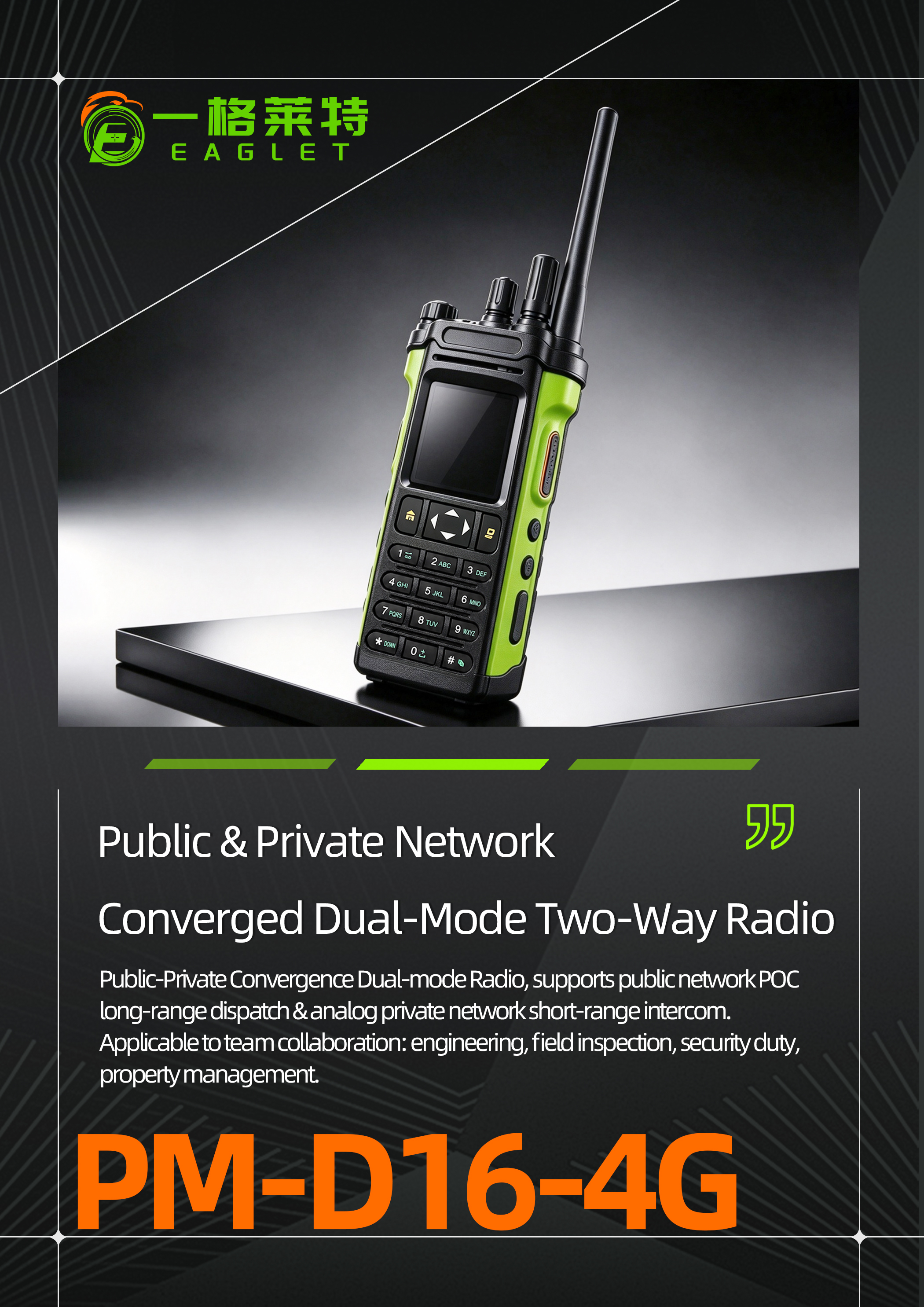
The supplied product is a handheld converged radio shown as an EAGLET PM-D16-4G. It is described as a Public & Private Network Converged Dual-Mode Two-Way Radio with repeater capability. Based on the visible design and product notes, it supports public network POC long-range dispatch and analog private network short-range intercom. The front layout includes a display, navigation keys, an alphanumeric keypad, top control knobs, and side push-to-talk controls, which supports one-handed operation in fast-paced work environments.
The visible housing appears to be a rugged rectangular enclosure with rounded edges, a matte black front, bright green side panels, and a long external antenna. The form factor is portable rather than vehicle-mounted, making it suitable for personnel who move between rooms, floors, zones, or outdoor work areas.
Key specifications and visible capabilities
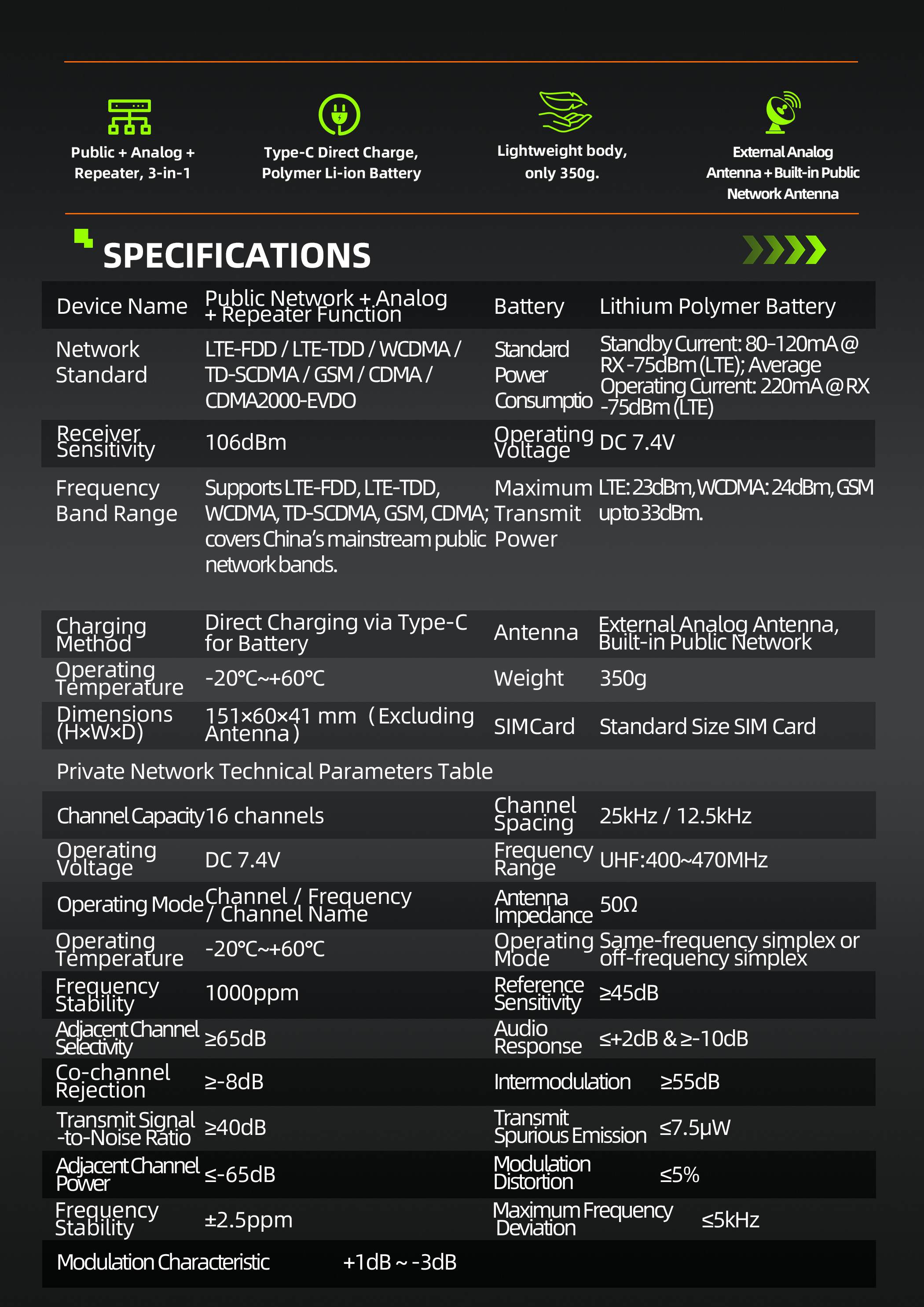
From the provided data, the unit is a handheld radio weighing 350 g and measuring 151 × 60 × 41 mm excluding the antenna. It operates at DC 7.4 V and uses a lithium polymer battery. Charging is listed as Type-C direct charging. The specified temperature range is -20°C to +60°C.
For private network use, the notes list 16 channels, 25 kHz / 12.5 kHz spacing, UHF 400–470 MHz, and 50Ω antenna impedance. Public network support is listed across LTE-FDD, LTE-TDD, WCDMA, TD-SCDMA, GSM, CDMA, and CDMA2000-EVDO. Receiver sensitivity is stated as 106 dBm. The product notes also mention SIM card support and a Type-C charging port.
Visible selling points include the dual-mode design, repeater function, external analog antenna, and physical keypad. Because internal architecture, exact transmit power, battery capacity, and certification details are not supplied, those should be confirmed before procurement if they matter to your deployment.
Materials and finish options
The image suggests a molded plastic outer shell with a matte or satin finish, rather than a glossy consumer-style surface. The front face is shown in black, with bright green side panels that improve visibility and help the device stand out in a busy work bag or control desk. The antenna appears to be a black plastic or rubberized component. Those observations are visible cues, not full material confirmation.
For buyers, finish matters for more than appearance. A matte shell usually hides handling marks better than high-gloss housing, and a physical keypad is often preferred where gloved operation or direct channel entry is required. If your project needs a different enclosure color, labeling, or branding, those are the kinds of customization points worth discussing during sourcing.
Manufacturing and assembly focus
This product belongs to electronic communication equipment assembly. Typical production involves injection-molded enclosure parts, PCB integration, antenna installation, keypad and display assembly, and final unit testing. In a device like this, mechanical fit, connector alignment, button travel, and RF assembly consistency are important because the product sits at the intersection of radio performance and handheld durability.
For B2B buyers, the manufacturing question is not only how the case looks, but how the unit is assembled for repeated field use. A clean keypad layout, stable antenna mount, and accessible charging interface all affect daily operation.
Application scenarios
The supplied notes point to security duty, logistics, warehousing, engineering, field inspection, property management, construction, event coordination, and industrial operations. In these environments, the value of a 4G POC Two-way Radio is the ability to support dispatch over public networks when users are spread across a wide area, while analog communication can still be used for local, short-range coordination inside a site or building.
An Analog UHF Walkie Talkie function can be useful in places where a private channel is already established or where teams need an immediate local fallback. The repeater note suggests additional deployment flexibility, though the exact repeater implementation should be verified directly with the supplier.
Quality control points buyers should ask about
Before ordering, confirm the items that are not visible in the photo or notes: exact battery capacity, transmit power, real-world talk distance, waterproof or dustproof rating, drop resistance, charging accessory package, and any region or carrier restrictions on the public network side. For larger deployments, ask how channel programming, SIM provisioning, and firmware updates are handled.
Also check whether the device is intended for indoor dispatch, outdoor patrol, or mixed use. A radio designed for a warehouse may have different expectations than one used on a construction site or in security patrol duty.
Customization guidance
If you are sourcing for a fleet, customization usually centers on branding, keypad language, channel configuration, accessory bundling, and packaging. Buyers often request logo printing, label changes, programmed channel lists, or a matched charger and belt clip package. If your team works in mixed conditions, it is also worth discussing antenna options, firmware settings, and how the public-private network switching behaves in daily use.
How to decide if this model fits your project
This Dual Mode Two Way Radio is a practical choice when your team needs one handheld device for both public-network dispatch and private analog communication. It is especially relevant if you want physical controls, a direct-entry keypad, and a compact form factor that can be carried through shifts. If your work requires only one narrow-band radio function, a simpler model may be enough. If your operation needs flexible communication across multiple sites or network types, this converged format is worth evaluating.
Request a quotation or technical confirmation
If you need a deployment-ready communication device, send your required channel plan, region, accessory list, and branding needs. We can help you review whether this Public Private Network Converged Radio configuration matches your workflow, and confirm the details that must be verified before procurement.