


Dual-Channel Multispectral Fusion Binoculars for Precision Observation
Field observation in challenging tactical, maritime, and conservation environments routinely strains conventional single-spectrum optics. Standard digital night vision requires ambient illumination or active infrared beams that wash out over reflective surfaces, while pure thermal imagers can miss critical structural lines, target identification cues, and physical barriers like glass. Equipping field teams with multispectral fusion binoculars addresses this operational blind spot by aligning long-wave infrared radiation with high-sensitivity optical channels inside a single handheld chassis. This combined architecture enables observers to detect subtle heat signatures against dense foliage and instantly verify target boundaries without swapping devices.
Product Overview and Optical Architecture
The unit features an asymmetric twin-barrel geometry mounted on a centralized bridge platform. Unlike conventional analog binoculars that transmit photons directly through optical prisms, this platform operates as an electro-optical digital sensor suite. Visual data captured across discrete spectral bands is processed digitally and rendered in real time through dual eyepiece viewfinders fitted with flexible rubber eyecups.
The objective arrangement visually segregates the optical tasks across two dedicated optical barrels:
- Visible and Low-Light Digital Channel: One barrel utilizes an optical glass objective treated with broadband anti-reflective coatings. This channel collects ambient visible and near-infrared light to preserve true-to-life environmental contrast, background textures, and identifiable target markings.
- Thermal Infrared Channel: The companion barrel incorporates a dedicated thermal objective lens, typically manufactured from specialized infrared-transmitting materials such as diamond-turned germanium, optimized for detecting target thermal emissions regardless of zero-lux conditions.
- Integrated Auxiliary Sensor Suite: Positioned adjacent to the primary optics are secondary aperture windows configured to support active modules. When ordered as a thermal binocular with laser ranging, these apertures house the forward-facing laser emitter and receiver optics, delivering instant distance metrics to targets within the field of view.
Key Capabilities and Operational Modes
Operating as thermal & visible light binoculars, the internal processing engine allows users to cycle through multiple viewing palettes depending on atmospheric interference, background clutter, and ambient lighting.
Spectral Fusion and Overlay Modes
Operators can choose between standalone thermal imaging, high-resolution low-light imaging, or a fused composite image. In composite mode, the edge details and contrast from the visible sensor are layered onto the thermal heatmap, ensuring that wire fences, tree limbs, and identifying features remain sharp without masking hot target silhouettes.
Target Identification and Spatial Ranging
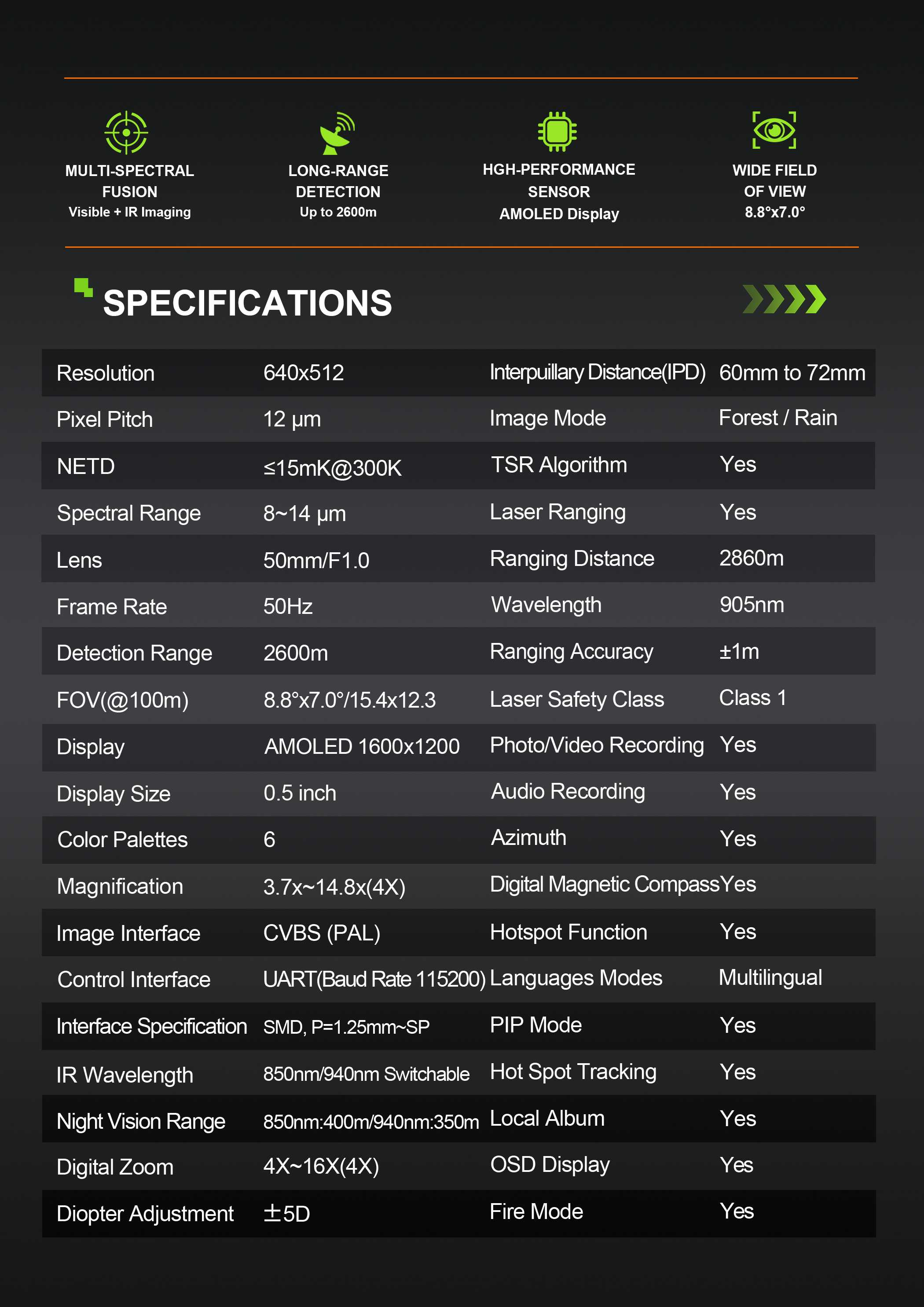
For operations requiring accurate geographic localization, the configuration serves as a thermal binocular with laser ranging to calculate precise target offsets. Firmware options also accommodate dynamic tracking routines found in hotspot tracking thermal binoculars, which automatically position crosshairs over the highest thermal delta visible in the frame to prevent fleeting targets from slipping into background noise.
Electronic Recording and User Controls
The bridge interface is designed around an array of sealed, tactile pushbuttons and knurled adjustment wheels, engineered for blind operation with gloved hands. A dedicated capture control labeled REC supports on-board visual recording. The digital viewing format provides high-eyepoint relief with individual diopter correction rings on each barrel to accommodate variable operator vision without image distortion.
Materials, Housing, and Mechanical Construction
Durability in harsh field conditions dictates every structural material selection:
- Armor Overmold: The outer chassis features a matte black, non-reflective protective overmold with stippled side panels to prevent slippage in wet or humid conditions.
- Internal Chassis: Beneath the rubber armor, the optomechanical assemblies are anchored to a rigid frame—typically lightweight cast aluminum or structural engineering polymer—to isolate optical alignment from field vibration and mechanical drops.
- Interface Sealing: All physical switches, rotatable diopter collars, battery latches, and port access covers incorporate elastomeric gaskets to minimize moisture and dust penetration. (Note: Specific ingress protection levels, such as IP66 or IP67 ratings, depend on the final assembly specifications requested by the procurement team.)
- Access Compartments: A secured side bay provides access for battery cells or connectivity ports, accompanied by a lateral textured grille protecting the internal acoustic components.
Optoelectronic Manufacturing and Alignment Workflow
Producing reliable night vision thermal binoculars requires rigorous assembly standards that bridge precision optical machining and surface-mount electronics assembly.
1. Optics Fabrication: Glass optical elements are ground, polished, and layered with anti-reflective coatings, while infrared lens elements undergo single-point diamond turning to achieve precise surface geometries.
2. Boresight Calibration: Because two disparate optical axes capture the same scene, physical and digital boresighting aligns the optical centers of both channels. Technicians calibrate optical convergence across working focal distances to eliminate digital parallax error during sensor fusion.
3. Module Hermetic Sealing: Optical chambers are assembled in dust-controlled cleanrooms, purged of ambient moisture, and backfilled with dry nitrogen to prevent internal fogging across wide thermal swings.
4. Burn-In and Calibration: Sensor cores undergo Non-Uniformity Correction (NUC) and thermal chamber testing to stabilize sensor response across industrial temperature variations.
Application Scenarios
The versatility of multispectral fusion binoculars makes them suited for several institutional and commercial applications:
- Search and Rescue Operations: Ground search crews can use hotspot tracking thermal binoculars to locate lost individuals through thick brush or smoke, switching to optical mode to assess terrain obstacles before navigating steep ravines.
- Perimeter and Border Monitoring: Static and mobile patrols deploy thermal & visible light binoculars to identify unauthorized intrusions across wide facility perimeters where thermal signatures reveal movement and optical feeds verify intent.
- Wildlife Surveys and Ecological Research: Biologists track nocturnal animal behavior without intrusive white light, recording thermal interactions directly to local storage for post-field evaluation.
- Maritime Night Navigation: Vessel operators scan waterways for unlit channel markers, floating debris, and small craft that blend into wave clutter under basic radar sweeps.
Quality Control and Verification Testing
Each production batch undergoes multi-stage functional and environmental verification before release:
- Optical Collimation and Focus Check: Eyepieces and objective focus mechanisms are evaluated on optical collimators to confirm smooth travel, zero backlash, and sharp focal planes.
- Parallax Alignment Audit: Digital fusion registration is verified against calibrated thermal and optical targets to guarantee overlay alignment.
- Thermal Core Sensitivity Audit: Core detector response is checked across standardized temperature targets to confirm signal clarity and eliminate dead pixel clusters.
- Laser Optical Centering: For units configured with laser rangefinder modules, laser projection axes are aligned to the display center reticle on specialized sensor test benches.
OEM and Customization Guidance
B2B distributors and enterprise clients can configure these electro-optical platforms according to regional regulatory constraints and operational mission profiles:
- Sensor Engine Options: Selection of thermal core resolution tiers, pixel pitch, and refresh rates depending on target classification requirements.
- Rangefinding Integration: Inclusion of 905 nm or eye-safe 1535 nm laser rangefinder modules matched to designated detection ranges.
- Firmware Customization: Tailored on-screen display (OSD) reticles, color palettes (White Hot, Black Hot, Ironbow, Visible Highlight), interface language localization, and specific standby battery-saving protocols.
- Housing Branding: Custom accent color rings (such as the standard green anodized trim), custom laser-etched serial numbering, and proprietary partner badging.
Buyer Decision Factors
When selecting multispectral equipment, procurement managers must evaluate several technical trade-offs:
- Sensor Complement Balance: Higher resolution thermal arrays yield longer detection ranges but require higher processing power and larger objective optics, affecting unit balance.
- Rangefinding Wavelength: Standard commercial rangefinding diodes offer cost efficiency, while specialized 1535 nm modules deliver covert operation and enhanced atmospheric penetration.
- Export Regulations: Electro-optical equipment containing high-performance uncooled or cooled thermal cores may be subject to regional export control classifications. Buyers should clarify local import compliance requirements early in the specification stage.
- Power Architecture: Evaluation of battery chemistry, whether field-swappable standard commercial cells or proprietary internal packs with external USB-C power bank pass-through, dictates field endurance.
Inquire for Technical Specifications and Production Scheduling
Our engineering team assists OEM partners and commercial optics distributors in defining optimal sensor integration, mechanical armor layouts, and custom firmware configurations. Contact our technical sales department to request optical interface control documents (ICDs), discuss minimum order quantities, or schedule a technical review for your customized night vision thermal binoculars project.