

Enclosed Reflex Optics for Professional and Commercial Platforms
Target acquisition speed and sight reliability often degrade when open reflex sights encounter environmental debris, moisture, or lint on reciprocating handgun slides. The RDS-FX-RA | EAGLET Red Dot Sight addresses this vulnerability through a sealed, enclosed-housing architecture. By encasing the optical path between two window elements, the optic prevents dirt, rain, and carbon build-up from interrupting the internal LED emitter path. This architecture delivers consistent point-of-aim visibility for OEM integrators, defense contractors, and commercial firearms distributors seeking dependable sighting hardware.
Product Overview and Mechanical Layout
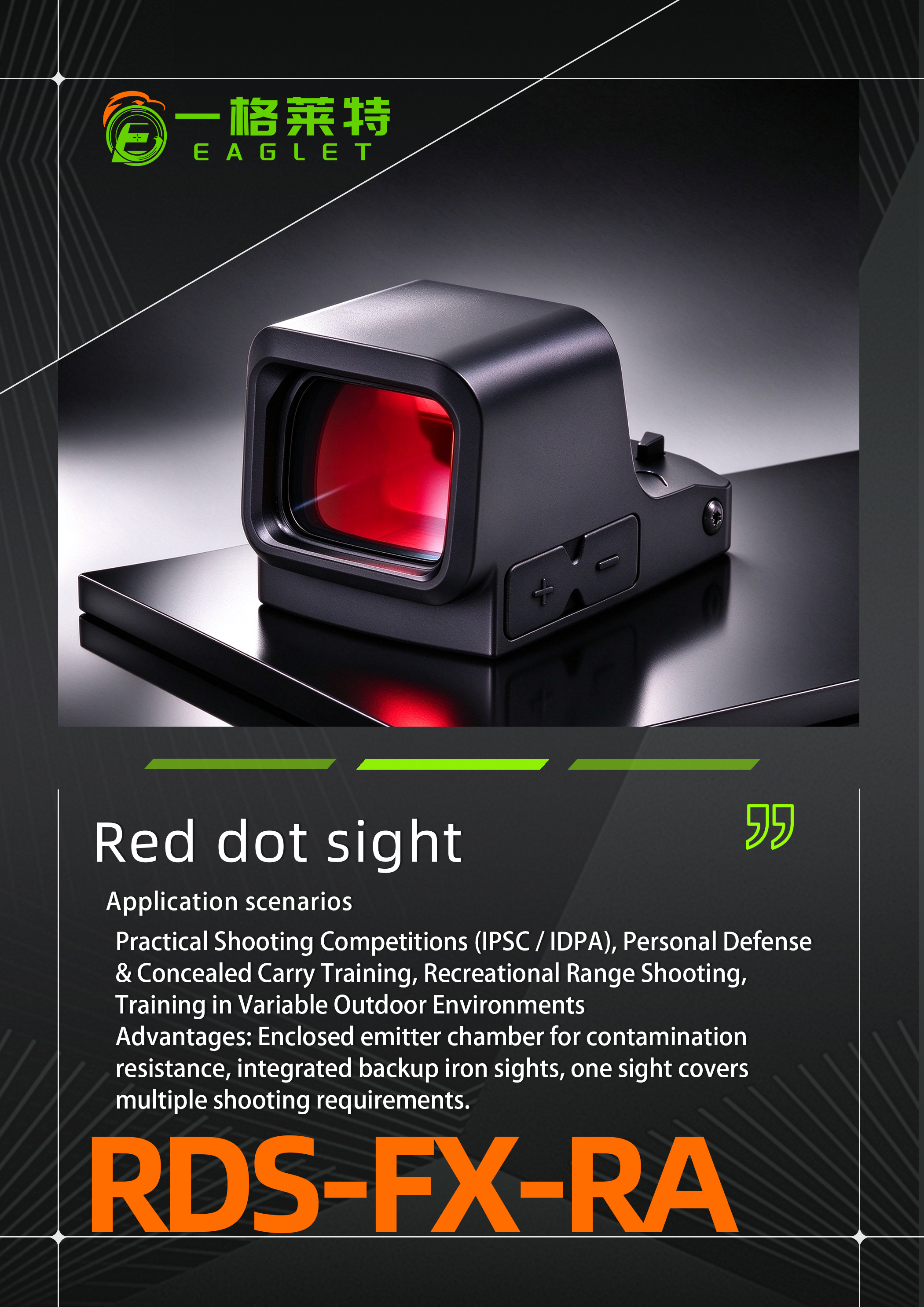
The RDS-FX-RA configuration represents a compact, enclosed-emitter reflex sight engineered primarily for handgun slide integration while remaining adaptable to carbine, shotgun, and personal defense weapon (PDW) rails. Unlike legacy open-emitter systems prone to lens-well blockage, the housing isolates both the emitter diode and reflective internal geometry behind treated optical glass.
Physical inspection indicates a multi-part metal housing with clean junction lines and a non-reflective matte black surface finish, consistent with precision-machined aluminum alloy. Two low-profile adjustment turrets sit on the top and side of the body, offering tool-driven windage and elevation zeroing. Lateral tactile buttons marked with positive and negative indicators govern illumination output, providing manual control over reticle intensity under varying ambient conditions.
Key Specifications and Technical Capabilities
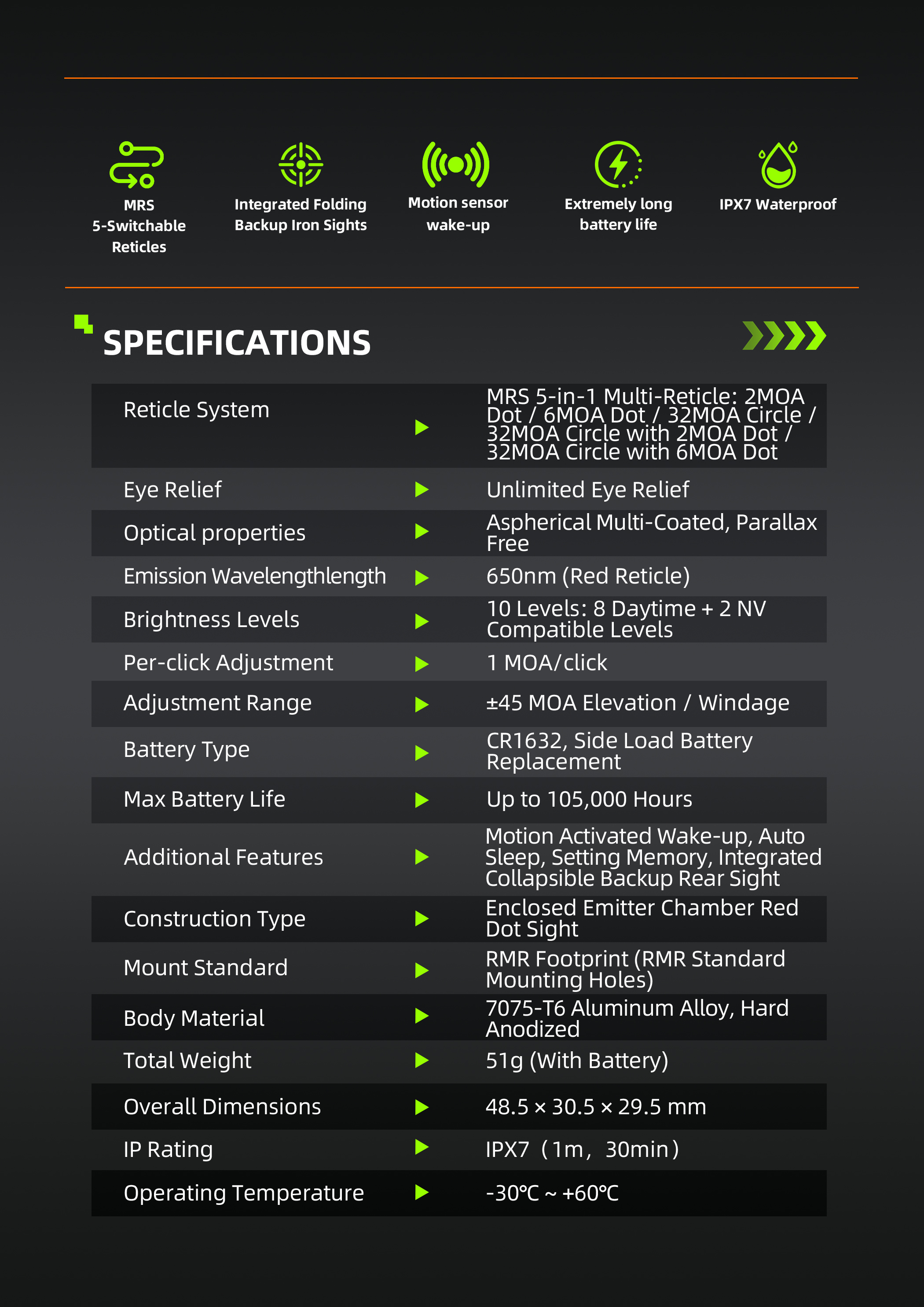
Modern procurement teams prioritize modularity, mechanical stability, and rapid target alignment. Depending on the client specification and base configuration, the sight integrates several platform-standard characteristics:
- Housing Format: Fully enclosed emitter chamber sealed with front and rear glass lenses to shield optoelectronics from external fouling.
- Footprint Interface: Adaptable geometry suitable for an RMR Footprint Reflex Sight footprint or dedicated slide-adapter plates, maintaining a low deck height for co-witnessing setups.
- Optical Assembly: Multi-coated objective lens featuring an anti-reflective, wavelength-selective dielectric coating visible as a rich red tint to maximize dot clarity and reticle brightness.
- Aiming Configurations: Engineering compatibility with an MRS 5-in-1 Multi-Reticle Sight matrix, supporting dynamic switching between single-dot precision and rapid-acquisition circle-dot profiles.
- Eye Box Characteristics: Configured as an Unlimited Eye Relief Multi-Reticle Sight, allowing parallax-suppressed, both-eyes-open operation across diverse shooting stances.
- Power Conservation: Circuit design ready for motion-activated power states, operating as a responsive Shake Awake Red Dot Sight to conserve cell longevity during holstered standby.
- Mechanical Redundancy: Low-profile sight deck geometry permitting use alongside standard suppressor-height sights or an Integrated Folding Backup Iron Sights Optic system.
Materials and Surface Treatment Options
Optical housings in this class require high structural rigidity to endure the violent acceleration and deceleration cycles of semi-automatic slides. Visual examination indicates a CNC-machined metal housing, presumably fabricated from aerospace-grade 6061-T6 or 7075-T6 aluminum alloys. Surfaces receive a matte, wear-resistant conversion layer, typically Type III hardcoat anodizing, to eliminate glare and resist corrosion from solvent exposure and environmental sweat.
For custom manufacturing runs, finish variations can include protective Cerakote coatings in tactical palettes (such as Flat Dark Earth, Ranger Green, or Sniper Grey) applied over base-anodized aluminum to satisfy specific military, law enforcement, or civilian retail catalog requirements.
Manufacturing and Optical Assembly Process
Production follows strict optomechanical tolerances to eliminate parallax drift under intense recoil forces:
- Chassis Machining: Multi-axis CNC milling centers produce the outer shell, turret seats, and lens housings from solid billet, maintaining tight dimensional consistency.
- Optical Coating: Lens blanks undergo vacuum-deposited thin-film coatings to achieve precise transmission curves that reflect the illuminated reticle while passing natural target-spectrum light.
- Cleanroom Integration: Emitter diodes, control circuitry, and optical elements are assembled in dust-controlled cleanrooms to prevent internal contamination on interior lens surfaces.
- Hermetic Sealing: O-ring gaskets and structural bonding adhesives seal the front window, rear aperture, and lateral control interfaces, followed by internal purging to prevent internal fogging across wide temperature swings.
Application Scenarios
The enclosed format makes the RDS-FX-RA platform suitable across several primary operational roles:
- Concealed Carry and Duty Handguns: Resists body oils, clothing lint, and rain that commonly disable open reflex emitters in everyday defensive deployment.
- Competitive Action Shooting: Delivers rapid target transitions in dynamic practical shooting formats where rapid sight alignment is essential.
- Long-Gun Offset or Primary Aiming: Functions either as an ultra-compact primary optic on lightweight pistol-caliber carbines or mounted at a 45-degree cant alongside high-magnification LPVOs.
Quality Control and Environmental Testing Standards
To ensure field reliability, production units are subjected to rigorous factory qualification protocols before delivery:
- Recoil Shock Testing: Simulated multi-axis shock testing replicating repeated thousands of G-force cycles representative of sustained 9mm, .40 S&W, and .45 ACP live-fire strings.
- Ingress Protection Auditing: Immersion checks and moisture-chamber exposure verify housing hermeticity against liquid ingress and internal lens fogging.
- Zero-Retention Verification: Optical collimator inspections evaluate click tracking, turret repeatability, and point-of-aim stability before and after impact cycles.
B2B Customization and Procurement Guidance
Commercial buyers, firearm manufacturers, and private-label distributors can adapt this baseline architecture to match their product portfolios. Customization scopes include:
- Mounting Interface: Tailoring baseline footprints to match native slide cuts (such as standard RMR patterns or mini-footprint direct-to-slide layouts) or supplying bundled Picatinny rail clamps.
- Reticle Logic: Selecting between fixed 2 MOA dots, 32 MOA ring combinations, or custom firmware supporting multi-reticle switching functionality.
- Branding and Packaging: High-resolution laser engraving, custom-colored anodized turret collars, retail-ready packaging, and customized operator manuals.
Commercial Sourcing and Technical Inquiries
As commercial firearm channels increasingly transition to enclosed-emitter technology, reliable optics manufacturing remains critical for market differentiation. Contact our technical sales team to request mechanical CAD drawings, discuss MOQ guidelines for private-label production, or order evaluation samples of the RDS-FX-RA platform for factory qualification testing.