




Virtual UAV Swarm Simulator for Drone Testing and Deception Scenarios
The Virtual UAV Swarm Simulator is designed for teams that need to study how a system responds when multiple drone-like targets appear at once. Instead of relying on live aircraft for every exercise, buyers can use a controlled platform to create virtual targets, test response workflows, and evaluate counter-UAS readiness in a repeatable way. For security groups, training units, and RF test environments, this helps solve a common problem: how to simulate complex UAV behavior without the cost, risk, and scheduling limits of repeated field flights.
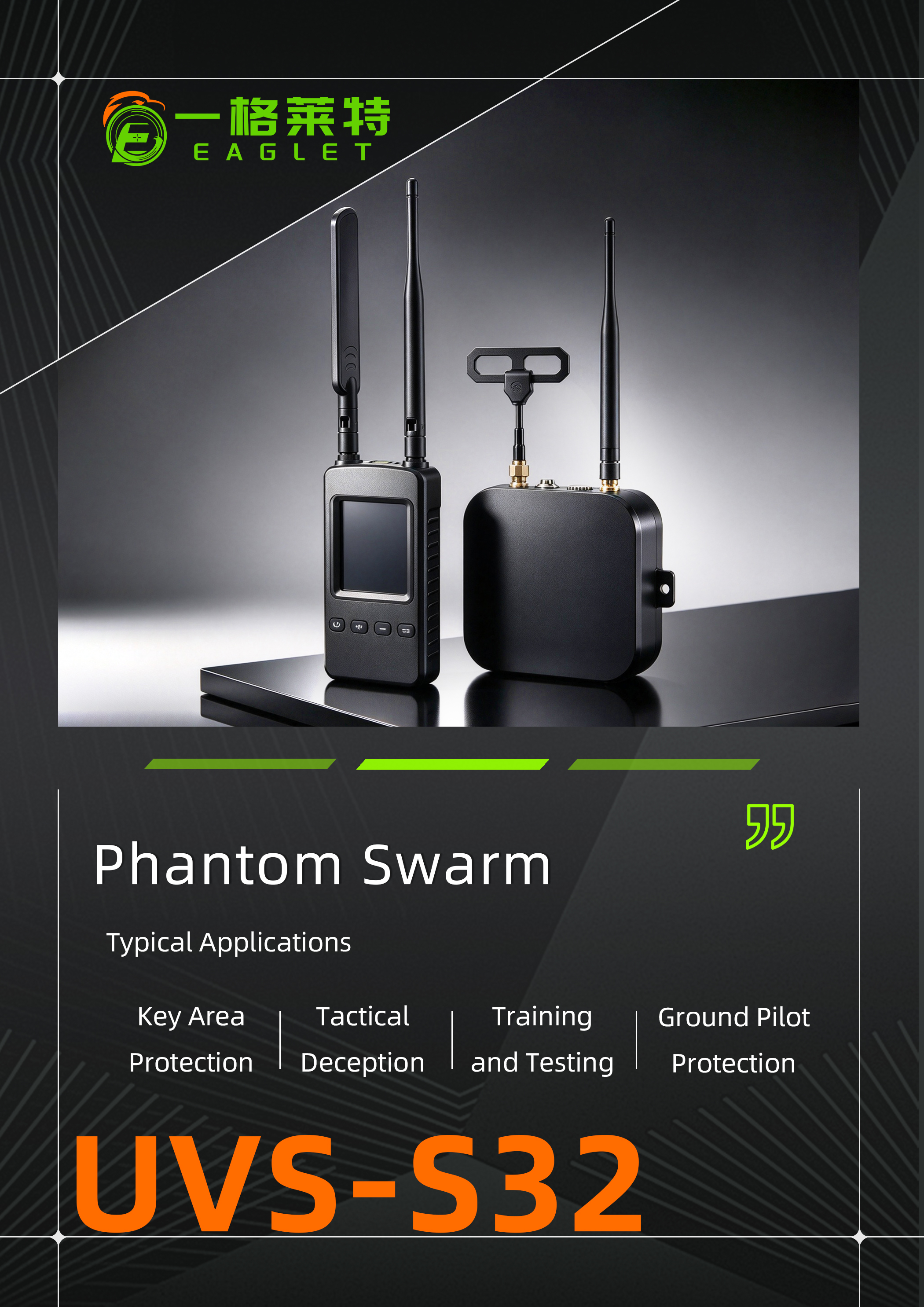
The UVS-S32 Phantom Swarm is presented as a compact virtual target generation system with a strong focus on deception, training, and protection scenarios. Based on the supplied material, it appears to combine RF signal generation, antenna hardware, battery power, and a user interface into a portable unit. The visible product images show dual black enclosures with external antennas, one unit including a front display and physical buttons. Another illustration shows a radar-like antenna graphic and software panels tied to swarm generation and threat response. Because the exact internal function is not fully confirmed, the page should be read as a product reference for a virtual drone-simulation and RF support platform rather than a claim about a specific jamming or spoofing mechanism.
Product Overview
UVS-S32 Phantom Swarm is described as a virtual drone swarm system or virtual target generator. Its role is to create multiple UAV-like signals or representations that can support airspace deception protection, anti-drone combat training, defense system countermeasure testing, and tactical exercise evaluation. The available information also references ground pilot protection, key area protection, and training and testing use cases. In practical terms, that means operators can rehearse responses to a swarm event, assess detection pipelines, and examine how equipment behaves when several targets are introduced at once.
Visible Hardware Features
The visible enclosure is compact and portable, with a dark matte finish that suggests an industrial electronics build. The unit includes an antenna arrangement, and one version shows a screen with button controls on the front panel. Another version shows a top-mounted antenna and a small accessory that may function as a handle or antenna bracket. The product image points to a field-ready format that is easier to deploy than a rack-mounted test bench.
Key Specifications and Capabilities
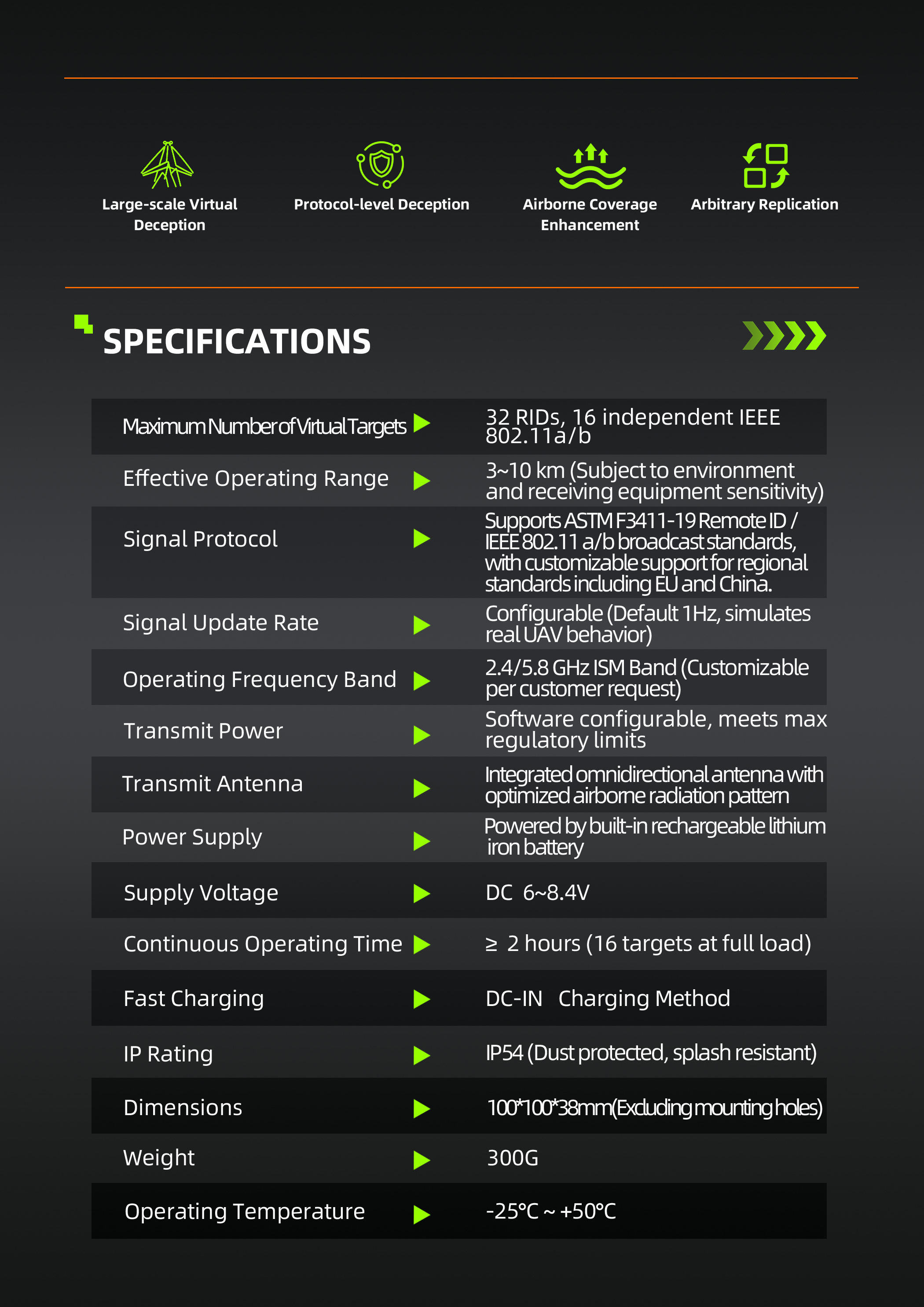
The supplied specification set highlights several measurable points. The system is said to support up to 32 Remote ID virtual targets or 16 independent IEEE 802.11 a/b targets, with a configurable update rate and a default of 1 Hz. It is listed for the 2.4/5.8 GHz ISM band, with custom frequency support available on request. The transmit power is software configurable up to regulatory limits, which is important for buyers who need to match a test plan or local operating constraint.
Other listed values include a built-in rechargeable lithium iron battery, DC 6–8.4 V supply input, and DC-IN charging. Continuous operation is stated as at least 2 hours at full load with 16 targets. The product also shows an IP54 rating, dimensions of 100 × 100 × 38 mm excluding mounting holes, weight of 300 g, and operating temperature from -25°C to +50°C. These figures make the unit look suitable for portable field work, lab verification, and short-duration outdoor tests.
Materials and Finish Options
The exact material is not confirmed, but the appearance suggests a black plastic or coated metal housing with a matte industrial finish. The antennas are black whip-style units, and some connectors appear metallic. For buyers planning integration into a vehicle, bench fixture, or mission case, finish and enclosure style matter because they affect handling, visibility, and how the device fits into existing test equipment.
Manufacturing and Assembly
From the available data, this product fits the category of electronic assembly with embedded RF circuitry, battery integration, and antenna design. It may also include software-defined control for signal generation and target management. That makes the likely manufacturing path a combination of PCB assembly, enclosure integration, antenna matching, battery packaging, and final system calibration. If a customer needs a custom configuration, the important discussion points are signal bands, target count, power control, interface behavior, and field deployment method.
Application Scenarios
The UVS-S32 Phantom Swarm is positioned for key area protection, tactical deception, training and testing, and ground pilot protection. The broader infographic language also connects it to airspace deception protection, anti-drone combat training, defense system countermeasure and test, tactical competition exercise, and target damage assessment. These scenarios suggest use in security exercises, laboratory validation, response rehearsals, and controlled demonstrations where a Large Scale Virtual Target Generator is more practical than live swarm deployment.
Related Use Cases
In RF simulation work, a 2.4G 5.8G ISM Band Signal Simulator can help teams explore receiver behavior under changing conditions. In counter-UAS programs, a Drone Tactical Deception Equipment setup may be used to validate detection logic, workflow timing, or operator reaction. For protocol-oriented testing, the mention of Remote ID and IEEE 802.11 a/b makes this relevant to broadcast-emulation environments where standard-based signal patterns are important.
Quality Control and Buyer Decision Factors
When evaluating a device in this category, buyers usually look at protocol support, number of virtual targets, battery life, environmental tolerance, and how easy it is to configure in the field. The stated IP54 rating, compact size, and battery operation are useful indicators for portability. If the unit will be used in a research lab or defense training environment, buyers should also confirm integration requirements, RF compliance scope, and whether the software allows controlled updates to target behavior. Because the exact mission function is not fully disclosed in the source material, it is wise to request a clear specification sheet before purchase.
Customization Guidance
For custom projects, ask whether frequency support can be adjusted, whether the target count can be changed, and what interface options are available for external control. It is also useful to confirm mounting options, charging workflow, antenna configuration, and any enclosure changes needed for your deployment environment. If you are planning a system-level integration, define the test scenario first; then match the device settings to the airspace, protocol, and duration you need to simulate.
Request a Quote or Technical Discussion
If your team needs a Virtual UAV Swarm Simulator for controlled testing, threat simulation, or training support, share your target protocols, deployment conditions, and desired virtual target count. That will make it easier to confirm whether UVS-S32 Phantom Swarm matches your application and what configuration would be appropriate for your project.