

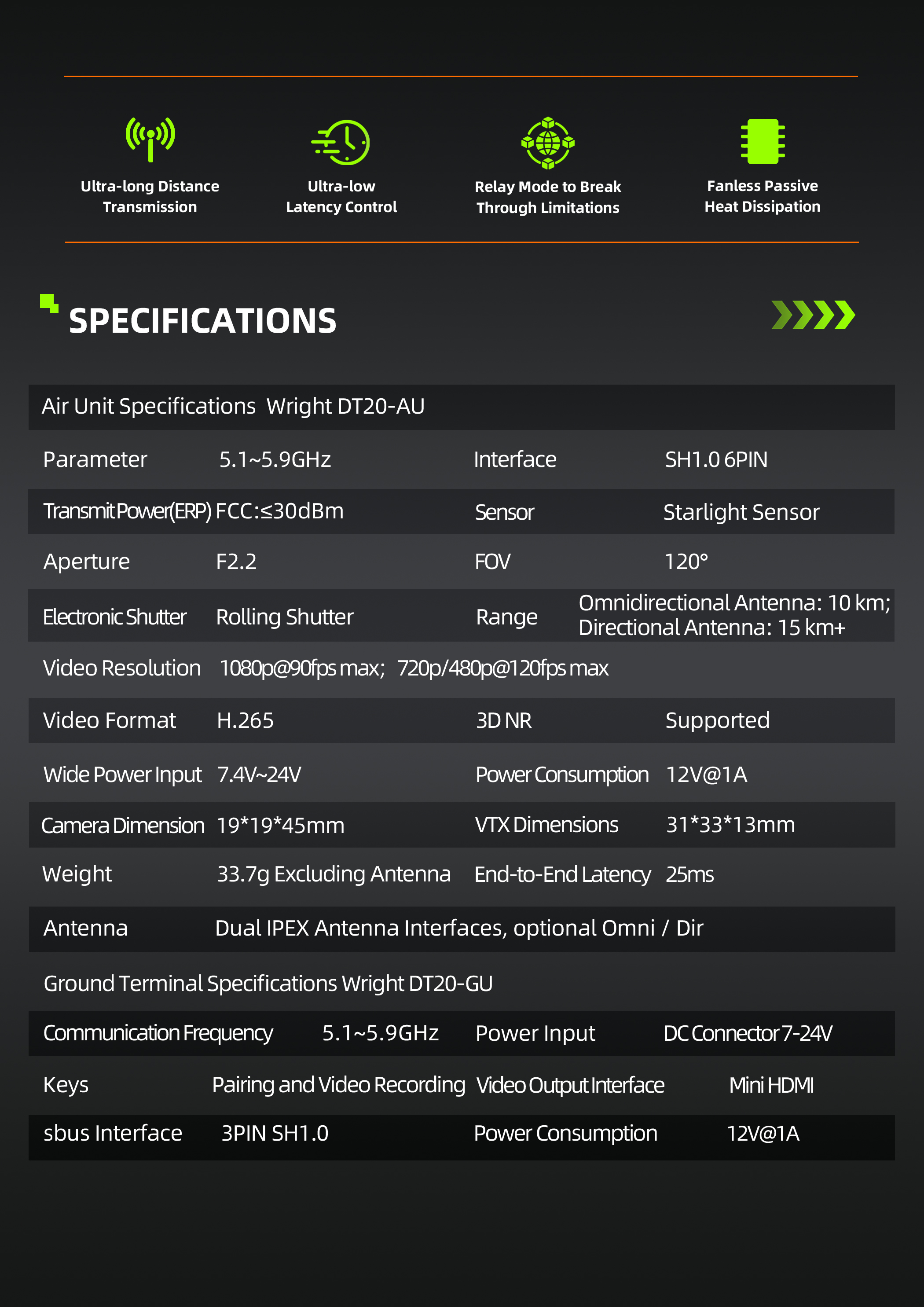
| Feature | Description |
|---|---|
| Ultra-long Distance Transmission | Long-range video link |
| Ultra-low Latency Control | End-to-end real-time control |
| Relay Mode to Break Through Limitations | Extend range via relay |
| Fanless Passive Heat Dissipation | No fan, silent cooling |
| HD Image Quality | High-definition camera |
| Lightweight Compact | Small form factor |
| Wide Voltage Compatible | 7.4V–24V input |
High Definition Video Transmission for UAV and FPV Links
High Definition Video Transmission is the core requirement for drone builders, inspection teams, and FPV users who need a clear live image without losing control confidence. When a video link is unstable, the operator sees delay, noise, or signal breaks that make flying harder and increase the risk of missed details. This kind of wireless video transmission module is designed to move camera footage from an airborne platform to a ground station with a compact hardware layout, external antenna connections, and a separate camera-side unit for flexible integration.
| Parameter | Value | Parameter | Value |
|---|---|---|---|
| Communication Frequency | 5.1~5.9GHz | Power Input | DC Connector 7–24V |
| Keys | Pairing and Video Recording | Video Output Interface | Mini HDMI |
| SBUS Interface | 3PIN SH1.0 | Power Consumption | 12V@1A |
Product Overview
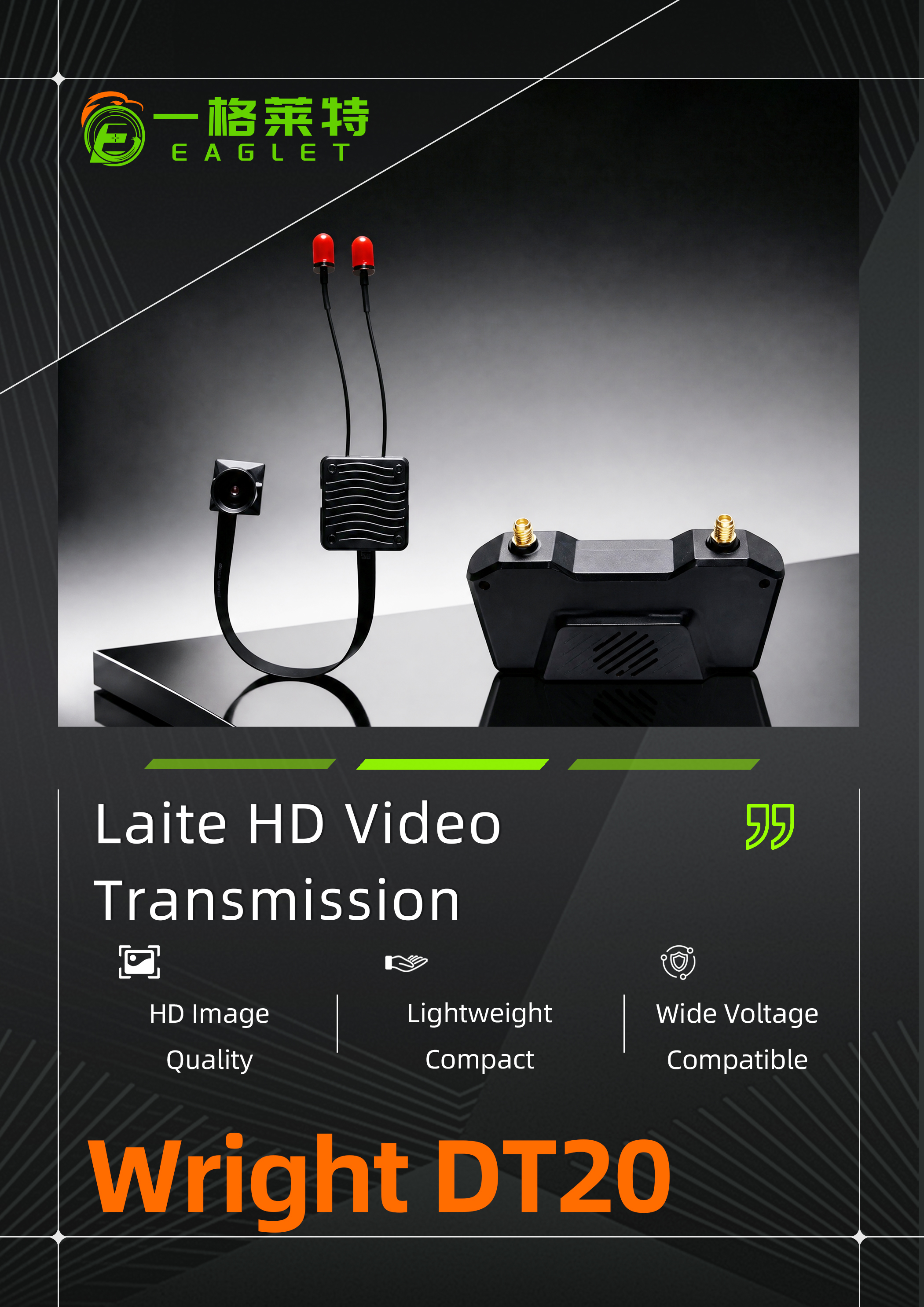
This system appears to be a two-part wireless video/data transmission kit with an airborne transmitter module and a ground receiver module. The visible structure suggests a practical setup for UAVs, FPV drones, robotics, or other remote-viewing applications where real-time video and telemetry are important. The airborne side includes a small camera-like optic and a compact ribbed module with two antenna leads, while the ground side uses a larger enclosure with two brass-colored antenna connectors and a vented front section.
Because only the visible product is provided, the exact brand, band, protocol, and performance figures are not stated here. Still, the overall architecture is consistent with a plug-and-play style video link intended to simplify installation and reduce wiring complexity.
Air Unit — Wright DT20-AU
| Parameter | Value | Parameter | Value |
|---|---|---|---|
| Frequency | 5.1~5.9GHz | Interface | SH1.0 6PIN |
| Transmit Power (ERP) | FCC: ≤30dBm | Sensor | Starlight Sensor |
| Aperture | F2.2 | FOV | 120° |
| Electronic Shutter | Rolling Shutter | Range | Omnidirectional Antenna: 10 km; Directional Antenna: 15 km+ |
| Video Resolution | 1080p@90fps max; 720p/480p@120fps max | — | — |
| Video Format | H.265 | 3D NR | Supported |
| Wide Power Input | 7.4V~24V | Power Consumption | 12V@1A |
| Camera Dimension | 19×19×45 mm | VTX Dimensions | 31×33×13 mm |
| Weight | 33.7g (Excluding Antenna) | End-to-End Latency | 25ms |
| Antenna | Dual IPEX Antenna Interfaces, optional Omni / Dir | — | — |
Key Capabilities and Visible Features
Compact modular layout
The transmitter-side assembly is small and light-looking, which matters for airborne use where every gram affects flight time and handling. The cable routing is short and flexible, helping reduce strain on the camera lead and keeping installation tidy.
External antenna interface
The receiver unit shows two threaded antenna ports, and the airborne module has two upright antenna leads with red caps. That visible antenna arrangement points to a design focused on maintaining a stable wireless path and improving setup flexibility.
Separate air and ground roles
Clearly separated airborne and ground modules are useful for buyers who want a system that fits a drone-to-base-station workflow. This structure also supports cleaner integration with cameras, monitors, controllers, or logging equipment.
Materials, Housing, and Finish
The housings appear to be made from black molded plastic or coated composite material with a matte to semi-gloss finish. The receiver’s connector hardware is brass- or gold-colored metal, which is typical for threaded RF-style interfaces. The overall geometry uses rounded edges, molded ribs, and vented sections, all of which are common in electronic assemblies that need practical handling and basic heat management.
Red plastic caps on the antenna tops add visual identification and may serve as protective elements, though the exact function should be confirmed before use. As with any RF product, buyers should verify connector type, cable compatibility, and mounting method during integration.
Manufacturing and Assembly Considerations
From a production standpoint, this type of wireless video transmission hardware usually combines injection-molded enclosures, PCB-based electronics, RF connectors, and flexible cable assemblies. For OEM or customization projects, enclosure shape, connector placement, antenna lead length, and cable termination are all important details. If the product is being sourced for a drone or robotics platform, mechanical fit and vibration resistance often matter as much as the signal path itself.
Typical Application Scenarios
This product category is suited to FPV drone flying, aerial imaging, UAV inspection, remote observation, field robotics, and any workflow that needs live video plus optional telemetry. It can also fit test rigs or machine-to-ground monitoring systems where operators need a fast visual feed without running a physical cable.
For users comparing wireless options, High-Definition Image Transmission is often chosen when the image must stay readable during movement, turns, or distance changes. Buyers should confirm whether their system needs low latency, longer range, ecosystem compatibility, or a specific camera input format before selecting hardware.
Quality Control and Buyer Decision Factors
When evaluating a module like this, focus on connector quality, housing fit, cable strain relief, antenna mounting, and the clarity of installation documentation. In RF products, stable assembly and consistent connector engagement are important indicators of build quality. If you are sourcing for a commercial build, ask for interface drawings, pin definitions, supported power input, and compatibility notes rather than assuming the system will match an existing platform.
Customization is often valuable for drone and robotics buyers. Common requests include cable length changes, enclosure marking, connector adaptation, and mounting-hole revisions. If you need a variant for a specific platform, it is best to confirm dimensions, antenna layout, and interface requirements before finalizing the order.
Request a Suitable Configuration
If you are comparing wireless video modules for UAVs, FPV systems, or remote monitoring, share your platform, installation space, and interface needs. A suitable configuration can then be matched to your use case, whether the priority is compact size, stable connection, or easier integration into an existing airborne and ground setup.