



GNSS-AJ12 is an L1/L2/L5 Tri-Band GPS Anti-Jamming Module
GNSS-AJ12 is an L1/L2/L5 Tri-Band GPS Anti-Jamming Module designed for navigation systems that must keep working when RF interference appears. In UAVs, airborne vehicles, fixed installations, and other GNSS-dependent platforms, the common failure point is not the receiver itself but the environment around it: broadband noise, narrowband carriers, pulse interference, or swept-frequency jamming can quickly degrade positioning. This module is built to help reduce that risk by protecting satellite-navigation reception across three bands and giving the system a more stable signal path.
Product overview
This product is a compact anti-interference GNSS terminal that combines navigation reception and jamming suppression in one enclosure. The visible hardware presents as a low-profile rectangular module with a metal housing, external connectors, and a clean industrial finish. That type of package is practical for embedded integration because it can be mounted into space-limited equipment racks, airborne platforms, vehicle systems, or protected communication units without adding unnecessary bulk.
From the provided specifications, GNSS-AJ12 is intended to receive GPS L1/L2/L5 signals and support protected positioning in environments where interference may be intentional or accidental. It is also described as a multi-GNSS navigation module with anti-jamming capability, which makes it relevant for buyers comparing a Tri-Band GPS Anti-Jamming Module against standard antenna or receiver options.
Key capabilities and specifications
Anti-jamming performance
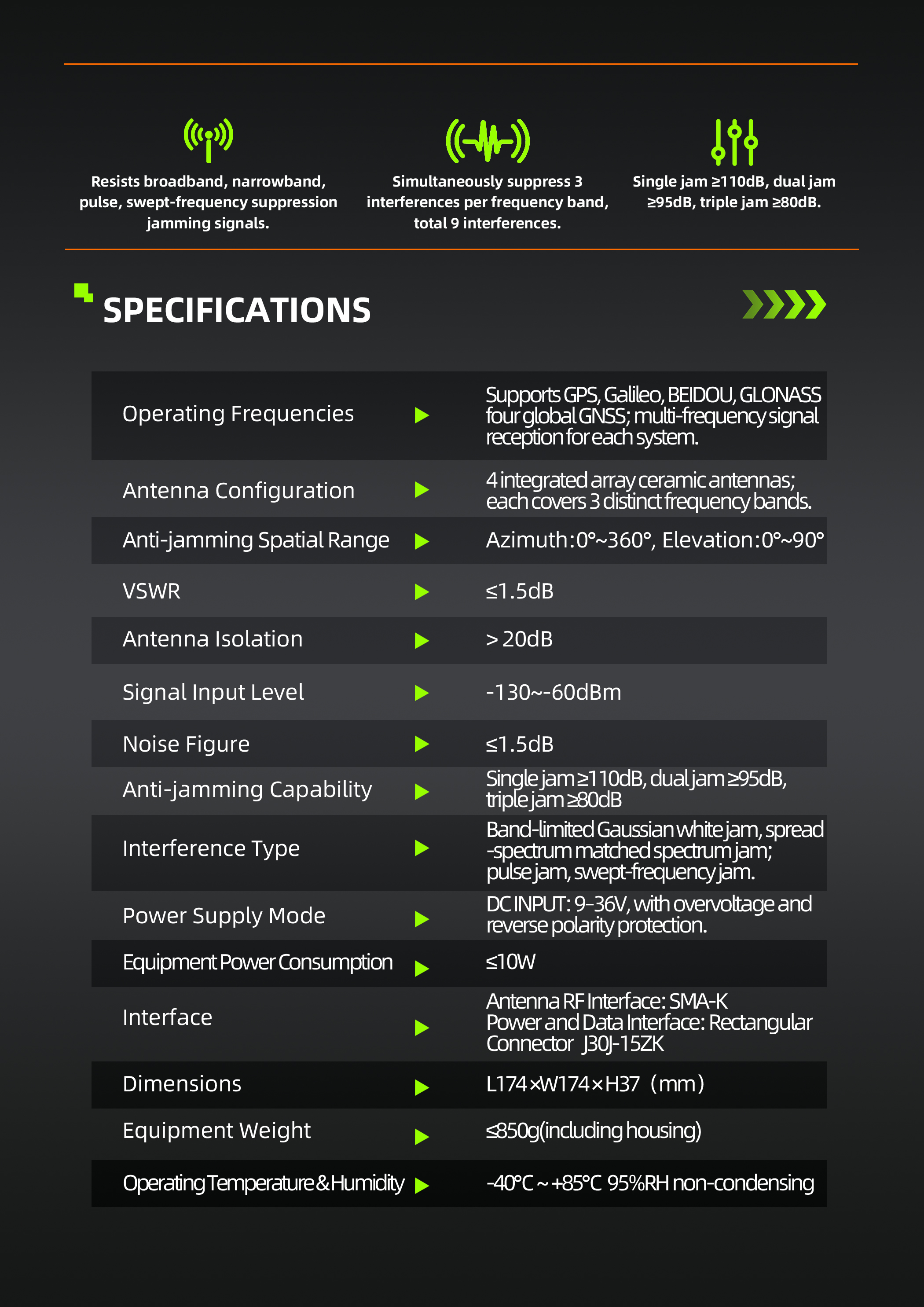
The listed performance targets include resistance to broadband, narrowband, pulse, and swept-frequency interference. The module is also described as suppressing up to 3 interferences per frequency band, for a total of 9 interferences. For system integrators, that matters because the real challenge is rarely a single clean jammer; interference often arrives in mixed forms and can vary during operation.
Additional stated values include single jam ≥110 dB, dual jam ≥95 dB, and triple jam ≥80 dB, along with an anti-jamming spatial range of azimuth 0°–360° and elevation 0°–90°. These figures should be treated as supplied product claims and verified against the final datasheet before procurement.
Electrical and mechanical data
Reported power input is DC 9–36V with overvoltage and reverse-polarity protection, and power consumption is listed at ≤10W. The module dimensions are given as L174 × W174 × H37 mm, with weight ≤850 g including housing. Environmental operating range is stated as -40°C to +85°C and 95% RH non-condensing.
Other visible or specified items include VSWR ≤1.5, antenna isolation >20 dB, signal input level -130 to -60 dBm, and noise figure ≤1.5 dB. Interface details provided include an SMA-K RF antenna interface and a J30J-15ZK power/data connector.
Materials and finish options
The visible enclosure appears to use a compact industrial housing style, while the exact material grade is not supplied. The product image suggests a structured, rigid body with a flat top cover and connectorized front edge. In general, GNSS anti-jam hardware like this is commonly built around metal or mixed-material housings to support shielding, connector retention, and equipment protection, but buyers should confirm the actual enclosure material and surface treatment from the manufacturer.
The image also shows ceramic array antenna elements in the related product description. Those elements are important in RF design because antenna material and layout influence band support, matching, and interference behavior. If you need a specific finish, connector plating, or enclosure treatment for a harsh environment, those requirements should be discussed during customization.
Manufacturing and integration approach
As an RF and electronics assembly, this type of product typically combines antenna array integration, internal signal-processing hardware, connector installation, and enclosure assembly. The visible screw-access points and connector cutouts indicate a build intended for serviceability and secure external connections. For buyers, that usually means easier integration into a larger navigation subsystem and a clearer path for cable routing, power delivery, and RF interface management.
If your application uses a UAV Anti-jamming Receiver or an Airborne Vehicle Navigation Anti-jamming Unit, the integration questions usually center on connector compatibility, mounting clearance, cable strain relief, thermal limits, and whether the output format matches the host system. Those points should be confirmed before deployment.
Application scenarios
GNSS-AJ12 fits platforms that need resilient positioning in difficult RF conditions. Typical use cases include UAV navigation, airborne systems, vehicle-mounted positioning, communication infrastructure, and other protected satellite navigation terminals. In defense-adjacent or mission-critical systems, an Anti-interference GNSS Terminal can help reduce downtime and improve continuity when the RF spectrum is crowded or contested.
For a GPS Anti-jam Antenna Array installation, the main advantage is not just signal reception but signal continuity under interference. That can be important when a platform must maintain course, time synchronization, or location awareness even if one portion of the band is disturbed.
Quality control and buyer decision factors
When evaluating this module, buyers should focus on band support, connector compatibility, environmental range, power budget, and the verified anti-jamming method. It is also worth checking antenna isolation, input sensitivity, and how the system behaves under multi-source interference. If the module will be used on a mobile platform, vibration tolerance and enclosure sealing should be reviewed as well, since those details are not supplied here.
Because several internal details are not visible, procurement teams should request the final mechanical drawing, electrical interface definition, and test documentation before release to production. That will help avoid surprises during integration.
Customization guidance
Customization is often needed for GNSS hardware. Common requests include connector changes, harness adaptation, enclosure labeling, mounting revisions, cable length adjustments, and interface matching for the host receiver. If you are sourcing for a Multi-GNSS Navigation Module platform, define the supported constellations, required output protocol, installation space, and operating temperature at the start of the project.
For systems intended as an Airborne Vehicle Navigation Anti-jamming Unit, coordination between antenna placement and platform structure is especially important. Nearby metal, rotors, radomes, or RF emitters can affect performance and should be considered during the design review.
Request technical support
If you are comparing protected GNSS hardware for a new platform or replacement project, GNSS-AJ12 is a practical reference point for tri-band anti-jamming navigation. Share your band requirements, interface needs, and installation constraints, and the next step can be a more accurate mechanical and electrical fit check.