

AI Tracking Module Series Overview
The AI Tracking Module Series is designed to solve a common integration problem in UAV and embedded vision projects: how to detect, lock, and follow moving targets without building a full custom vision stack from scratch. For drone payload teams, robotics developers, and inspection system integrators, this type of module combines camera sensing, onboard AI processing, and a compact mechanical form factor so target tracking can be added to a platform with less development effort.
Based on the provided product data, the series is positioned as a camera-based intelligent tracking module for drone platforms and other onboard computer-vision systems. It supports multi-target recognition and real-time detection and tracking, with visible configurations that include EO-only variants and a dual EO + thermal version. The modular layout, separate camera head, and stacked electronics board make it suitable for applications where size, mounting flexibility, and integration speed matter.
Product Structure and Key Capabilities
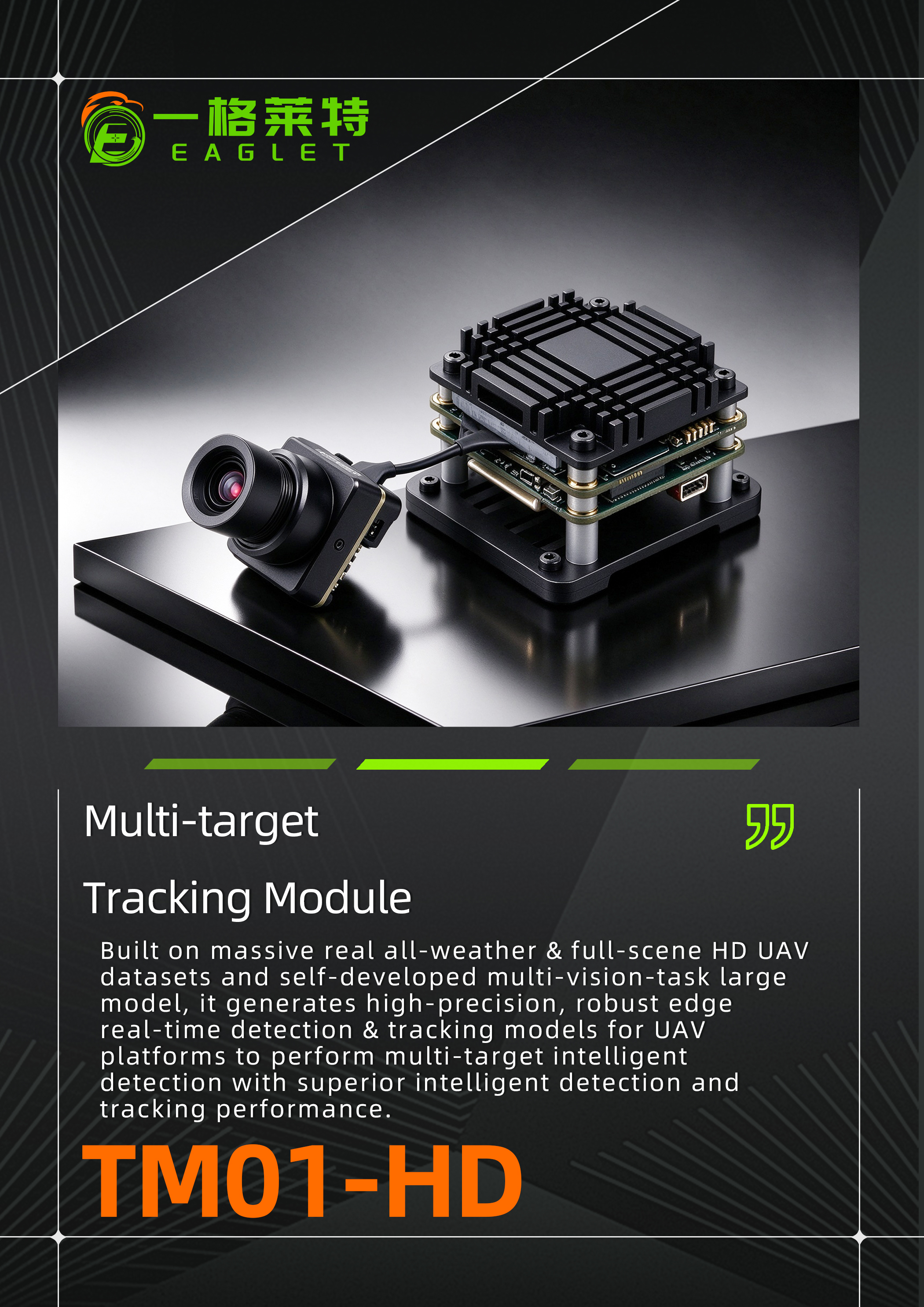
The visible hardware architecture is compact and practical. A small external camera head is connected by cable to a main processing unit built as a layered PCB assembly. The main body uses a square base with corner mounting points, exposed connectors, and a finned top housing that likely helps with heat dissipation. While exact internal parts cannot be verified from the image alone, the form factor clearly reflects a design intended for embedded deployment rather than bench-top use.
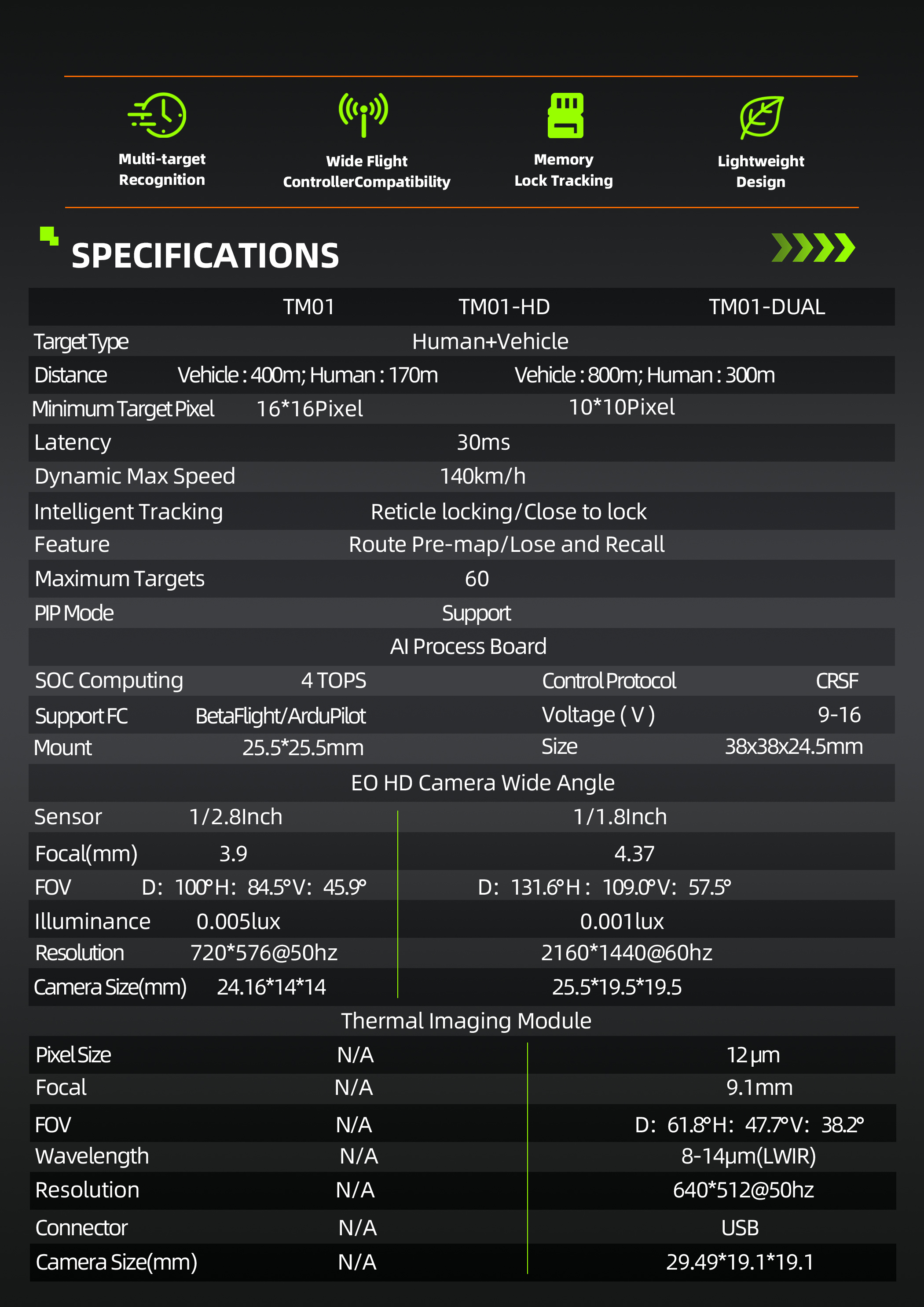
From the supplied specifications, the module family includes features such as AI process board computing, CRSF control protocol support, and compatibility with BetaFlight and ArduPilot flight controllers. Reported performance values include low latency around 30 ms, a dynamic maximum speed of 140 km/h, and support for up to 60 targets in one configuration. These figures should be treated as supplier-provided claims, but they are useful reference points for buyers comparing payload options.
Visible and Supplied Specification Highlights
- Compact module with separate camera head and electronics unit
- Stacked PCB layout with mounting-friendly base plate
- AI-assisted multi-target tracking
- Support for drone flight controller integration
- EO and EO + thermal variant options shown in the provided data
- Lightweight, integration-oriented design
Materials, Housing, and Finish
The visible exterior uses a matte black industrial finish with black-coated or anodized metal-like surfaces, while the electronics section shows green solder mask PCBs and metallic standoffs/connectors. Because the product is shown through supplied visual data and a spec sheet, the exact enclosure material cannot be confirmed. Still, the overall appearance suggests a ruggedized embedded assembly rather than a decorative consumer camera.
For buyers evaluating a Lightweight AI Perception Payload, this kind of finish and construction is important. It helps the module fit into UAV frames, inspection rigs, and robotics systems where vibration resistance, wiring access, and compact stacking are practical concerns.
Manufacturing and Assembly Approach
The product appears to belong to the embedded electronics assembly category. The camera head, processing board, cable interconnect, and mounting hardware indicate a system assembled from standard electronic subcomponents rather than a single monolithic housing. The boards are likely produced through conventional PCB fabrication and SMT assembly, while the visible enclosure components may be CNC-machined or injection-molded. That said, the exact process is not confirmed from the image alone.
For procurement teams, this distinction matters. A modular assembly often makes it easier to adapt interfaces, revise mounting geometry, or support different sensor combinations. It also fits projects that may evolve from prototype to small batch production.
Application Scenarios
The supplied use cases point to UAV surveillance, inspection, search and rescue, autonomous tracking, and multi-object detection. In practice, the same architecture can also support robotics vision, automation, and industrial sensing where a compact intelligent camera is needed.
A buyer looking for a UAV Multi-target Tracking Module may be interested in the ability to monitor moving vehicles or people while the platform is in motion. The data also suggests a UAV Human Vehicle Recognition Module use case, with target recognition distances listed for human and vehicle detection in certain models. If the project requires broader scene understanding, the module may also fit as an Edge AI Vision Detection Unit in an onboard processing workflow.
Typical Integration Scenarios
- UAV payload integration
- Robotics perception and navigation
- Industrial inspection and quality control
- Security observation or target monitoring
- Prototype development for computer vision systems
Customization and Variant Selection
The data shows multiple variants, including TM01, TM01-HD, and TM01-DUAL. The dual version appears to combine EO and thermal sensing, while the other versions appear to be EO-based. Buyers should choose based on the sensing stack they need, available power and mounting space, and the flight controller environment.
Important selection factors include camera type, integration protocol, target tracking behavior, mechanical envelope, and system latency. If the payload will be used in fast-moving UAV scenes, the Low Latency Visual Tracking Module capability becomes more important. If the application requires combined visual and thermal awareness, the dual-sensor version is the more relevant starting point.
This series may also be relevant to teams seeking a Drone Intelligent Target Tracking System with direct flight controller compatibility and onboard AI inference rather than a purely software-based toolchain.
Quality Control and Buyer Decision Factors
When evaluating this type of module, buyers usually focus on integration reliability rather than decorative design. Key factors include connector robustness, thermal management, cable strain relief, board stacking stability, and how well the camera head can be positioned on the final platform. Because the exact sensor and housing details are not fully disclosed, buyers should request confirmation of interface type, power requirements, weight, and environmental suitability before locking the design.
Quality control for a module like this typically centers on assembly consistency, connector alignment, PCB workmanship, and functional verification of tracking behavior. If the product will be used in production systems, it is worth asking for documentation on the electrical interface, firmware support, and mechanical drawings.
Request Integration Support
If you are comparing embedded tracking hardware for UAVs, robotics, or inspection equipment, the AI Tracking Module Series offers a compact reference design for real-time visual tracking and AI-assisted detection. Share your platform requirements, mounting constraints, and target use case, and request the available variant data, interface details, and integration guidance before moving into sample evaluation.