

UAV Multi-target Tracking Module Overview
The UAV Multi-target Tracking Module is designed for aerial platforms that need to detect, follow, and manage more than one moving object at the same time. For buyers working on drone inspection, surveillance, or autonomous flight, the common problem is simple: a single camera feed is not enough when targets change speed, split apart, or move across a busy scene. This module combines onboard vision capture with edge processing so the system can identify targets in real time and support tracking workflows without relying entirely on a distant computer.
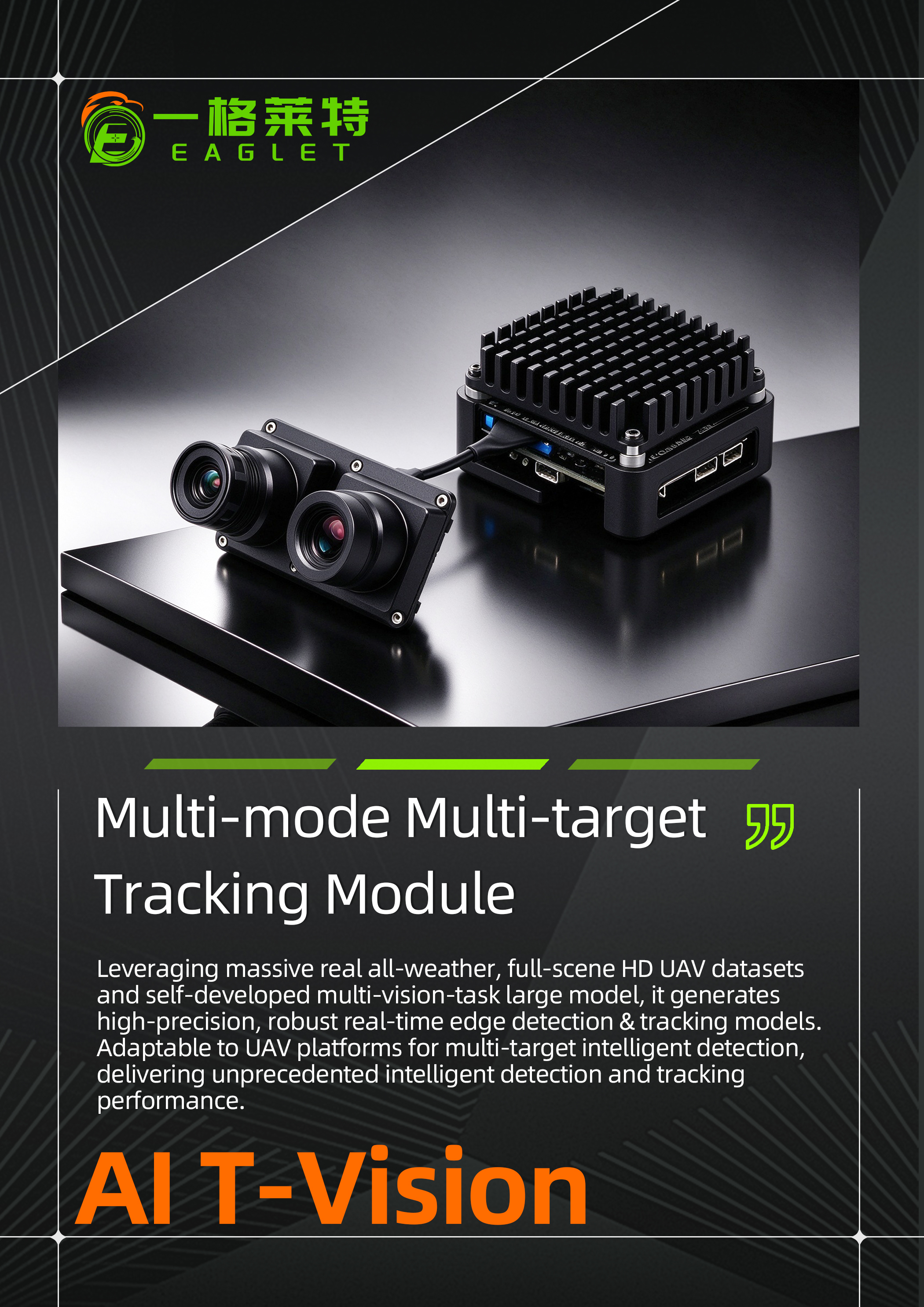
From the visible hardware and supplied product data, this is an embedded AI vision payload built around a modular camera-and-compute architecture. The system appears suitable for UAV integration, robotics, and field machine-vision tasks where compact size, low latency, and stable image processing matter more than decorative housing or consumer-style packaging.
Product Structure and Visible Design
The module is built as a separated sensing and processing package. One section is a dual-lens camera head mounted on a compact rectangular plate, while the other section is a finned control enclosure that likely houses the onboard processor or embedded controller. A cable links the two units, which is a practical arrangement for drone payloads and other remote-sensor installations.
Visible construction details suggest industrial hardware rather than a general-purpose camera. The housing appears matte black, with metal or coated aluminum surfaces, and the processor enclosure uses a ribbed heatsink for passive cooling. That cooling layout is important in edge AI systems because onboard inference generates heat, especially during continuous detection and tracking.
Key visible hardware elements
• Dual-camera or dual-lens sensor head
• Separate processing enclosure with heatsink fins
• Braided connecting cable
• Compact rectangular footprint
• Side or front I/O opening(s) visible on the main unit
Core Capabilities
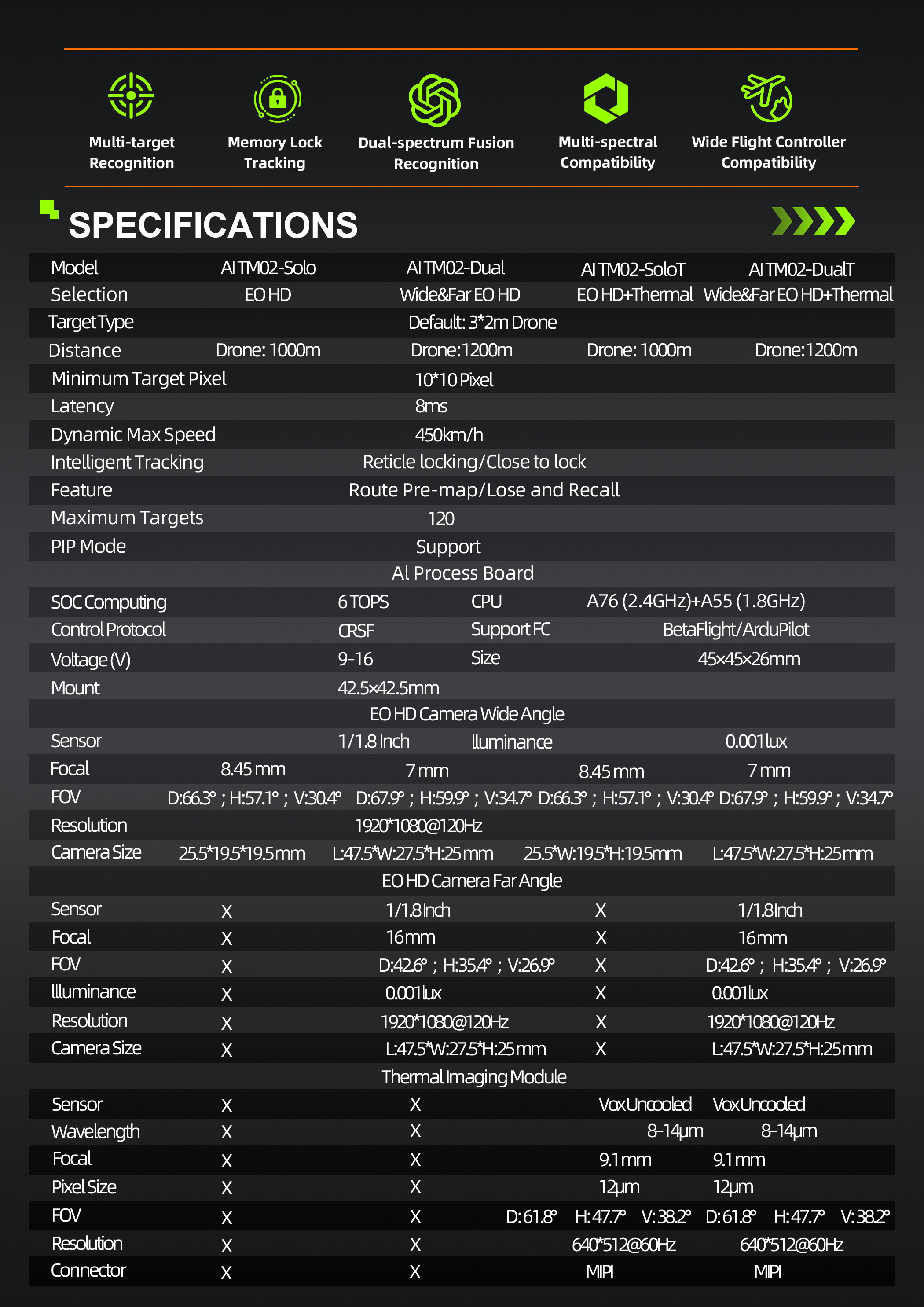
This product family is positioned as a Multi-mode UAV Intelligent Tracking System with support for target recognition, multi-object tracking, and real-time visual perception. The provided data also references an AI T-Vision concept and a multi-target intelligent detection workflow. Based on the supplied specifications, the system is intended to process moving scenes quickly enough for UAV control and target lock-on behavior.
Reported functional data include support for up to 120 targets, a minimum target size of 10×10 pixels, and 8 ms latency. The product information also lists dynamic speed handling up to 450 km/h and 6 TOPS of AI compute. These values are useful for buyers evaluating whether the module can handle fast-moving aerial or ground targets in a cluttered environment.
Embedded performance indicators provided
• Maximum targets: 120
• Minimum target pixel: 10×10 px
• Latency: 8 ms
• Dynamic max speed: 450 km/h
• AI computing: 6 TOPS
• CPU: A76 2.4 GHz + A55 1.8 GHz
• Control protocol: CRSF
• Flight controller support: BetaFlight, ArduPilot
• Supply voltage: 9–16 V
• Size: 45×45×26 mm
• Mount: 42.5×42.5 mm
Camera and Sensor Configuration
The supplied data describes multiple imaging options. For visible-light use, there are EO HD camera variants in both wide-angle and far-angle formats. The wide-angle version is listed with a 1/1.8" sensor, 8.45 mm focal length, and 1920×1080 at 120 Hz. The far-angle version uses a 1/1.8" sensor with a 16 mm focal length and the same 1920×1080 at 120 Hz output. A thermal version is also listed, using a Vox uncooled thermal module in the 8–14 µm band with 640×512 at 60 Hz.
These options matter because tracking tasks often require more than one view. A wider lens helps with reacquisition and scene awareness, while a longer focal length supports finer target separation at distance. Thermal imaging can add another layer of detection in low-light or contrast-challenged conditions. Buyers choosing between variants should match the optics to their flight altitude, target size, and operating environment.
Listed camera variants
• AITM02-Solo: EO HD
• AITM02-Dual: Wide & Far EO HD
• AITM02-SoloT: EO HD + Thermal
• AITM02-DualT: Wide & Far EO HD + Thermal
Materials, Finish, and Thermal Design
The visible finish is industrial black, with a matte or semi-matte appearance. The camera barrels are cylindrical and appear to be made from black plastic or metal. The processor enclosure uses a ribbed aluminum heatsink, which is a practical choice for heat dissipation in a compact payload. While the exact enclosure material is not confirmed, the overall build reads as rugged and modular.
For UAV integration, this type of construction offers a balance between structural stiffness and serviceability. Separate sensor and compute sections can simplify placement on a drone frame and may help reduce thermal coupling between optics and processor components.
Manufacturing and System Integration
Based on the category, this product belongs to embedded vision hardware assembly. Typical manufacturing for a module like this would involve camera module assembly, PCB integration, cable harnessing, thermal interface design, enclosure machining or molding, and firmware-level system validation. Exact internal chipset and sensor construction are not provided, so those details should be confirmed during procurement.
Integration usually centers on the flight controller and the control protocol. The supplied data indicates CRSF support and compatibility with BetaFlight and ArduPilot, which is relevant for UAV builders who need a tracking payload that can work with existing control stacks.
Application Scenarios
This UAV Multi-target Tracking Module fits workflows where visual identification and continuous tracking are both required. Common use cases include aerial surveillance, inspection of moving assets, autonomous navigation, robotics research, perimeter monitoring, and industrial machine-vision setups. The dual-view or dual-spectrum style architecture is especially useful when the operator needs to switch between scene context and target detail.
For UAV operators, a lightweight AI perception payload can reduce the need for ground-side processing and help maintain tracking behavior even when the communication link is limited. For robotics and inspection systems, low latency visual tracking hardware can improve responsiveness when objects enter and leave frame quickly.
Quality Control and Buyer Considerations
Because several specifications are only partially visible or provided as product data, buyers should verify the exact configuration before order placement. Important decision factors include the camera variant, the intended lens pairing, compute performance requirements, power budget, mounting space, and software compatibility. If the module will be used outdoors or in demanding field conditions, request confirmation of environmental ratings, connector details, weight, and operating temperature range.
When comparing options, it is also useful to check whether the module is meant for stereo-style sensing, EO/thermal fusion, or another imaging mode. The visible dual-lens design suggests multi-camera sensing, but the exact optical arrangement should be confirmed by the supplier if your application depends on depth estimation, thermal overlay, or precise target separation.
Customization Guidance
For integration projects, customization may include camera selection, cable routing, mounting interface adjustments, firmware tuning, and communication mapping to the drone flight controller. If your use case needs a Dual-spectrum Fusion AI Vision Board or a Real-time Drone Recognition Module, define the tracking scene, target size, and frame-rate needs early so the supplier can match the sensor stack to the mission profile.
Some buyers will prefer wide-and-far EO pairing for flexible tracking, while others may prioritize a Thermal module for night work or contrast-limited scenes. If you need an Edge AI Object Detection Unit for a robot or UAV platform, confirm whether the onboard compute load fits your model complexity and how target handoff behaves when objects move between overlapping fields of view.
Request Specifications or Integration Support
If you are evaluating this module for a drone payload, robotics platform, or industrial vision project, share your target scene, preferred camera mode, and flight controller requirements. We can help you narrow the configuration and discuss integration details before deployment.