


Ad Hoc Network Handheld Terminal Overview
The Ad Hoc Network Handheld Terminal is designed for teams that need dependable voice and basic data communication when normal network coverage is limited or unavailable. It solves a common field problem: keeping staff connected without relying on a fixed base station or complicated infrastructure. For security patrols, warehouse crews, construction sites, and emergency coordination, this type of handheld radio helps people call, group coordinate, and share status in real time.
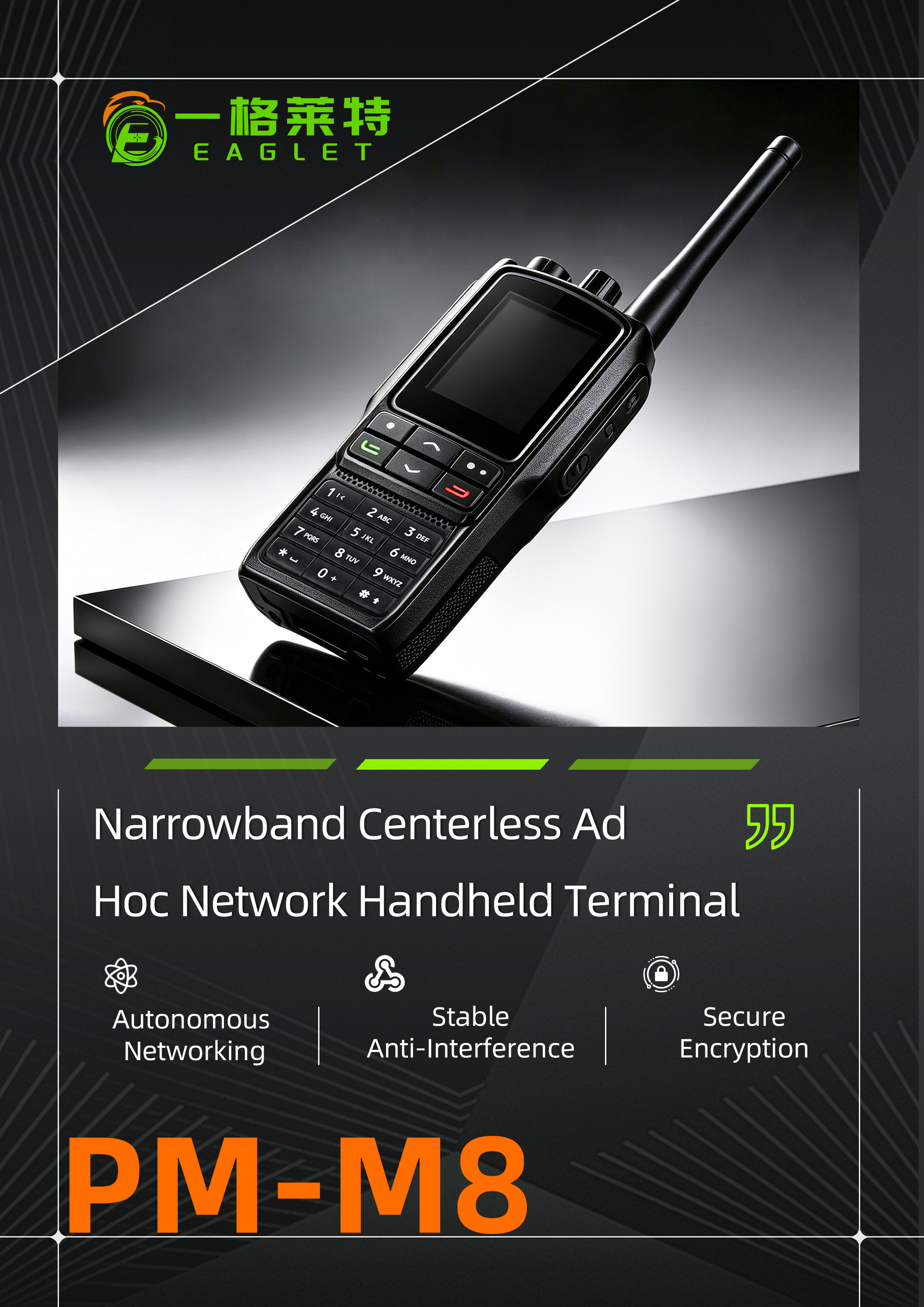
Based on the supplied product information, the PM-M8 from EAGLET / 一格莱特 is a portable two-way radio style device with a front display, physical keypad, long antenna, and menu-driven operation. The visible interface suggests a practical terminal for push-to-talk communication and channel or group management. Marketing claims shown on the product include autonomous networking, stable anti-interference, and secure encryption; these are useful reference points, but they should be treated as stated features rather than independently verified performance data.
Product Structure and Visible Features
The unit appears to use a black molded housing with a matte industrial finish and textured grip areas on the side. The form factor is compact and handheld, with a rectangular body, rounded edges, and a large external antenna for portable radio use. A backlit display sits on the front panel, along with a full numeric keypad and multiple control keys for menu navigation, calling, and confirmation.
The visible button layout is especially useful for users who need direct input in the field. A full 12-key numeric pad can support channel entry, group selection, or text input if the device is configured for those functions. Side buttons and a top rotary knob/button cluster add quick access to common radio actions. The display shows Chinese-language menu text, and the supplied data also indicates bilingual Chinese/English switching on the product family.
Communication Capabilities
Ad hoc and self-organizing networking
This handheld terminal is positioned as a centerless self-organizing radio, meaning teams can form a local communication network after power-on without depending on a traditional base station. That makes it suitable for temporary job sites, disaster response, outdoor projects, and other locations where infrastructure is missing or unstable.
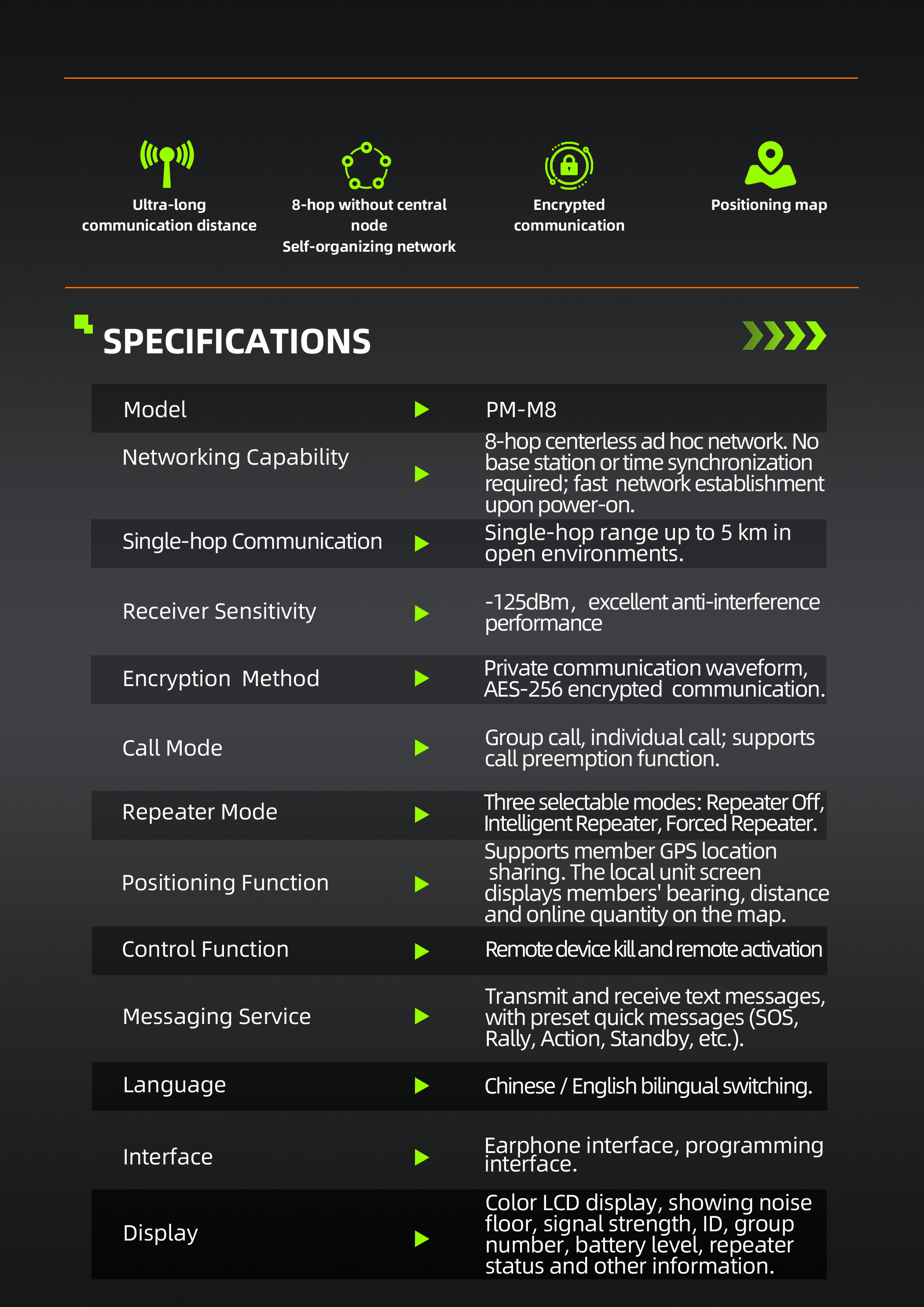
The supplied data also mentions an 8-hop ad hoc network structure. In practical terms, this kind of architecture is intended to extend communication across multiple users or nodes within a local network. Because the actual radio standard is not stated, buyers should confirm operating band, channel behavior, and interoperability requirements before deployment.
Security and call control
One stated feature is AES256 encrypted walkie talkie communication. Encryption is often a key buying factor for security teams, utility crews, and private operations that want to reduce casual eavesdropping. The product data also references group call, individual call, and call preemption, which are useful for dispatch-style workflows where urgent traffic may need priority.
Additional messaging functions include text messages and preset quick messages such as SOS, Rally, Action, and Standby. Those preset prompts can reduce typing during fast-paced operations and help standardize team responses.
Status Display, Positioning, and Repeater Modes
The color LCD is described as showing noise floor, signal strength, ID, group number, battery level, repeater status, and other operating data. That kind of status screen helps supervisors and users verify connection conditions at a glance. The supplied information also mentions a map and positioning function that can display member bearing, distance, and online count on the local screen. Whether GPS is built in or position data is shared through connected devices is not confirmed, so that point should be checked during specification review.
Repeater options are listed as Repeater Off, Intelligent Repeater, and Forced Repeater. For buyers, this matters because field communication requirements often change from one site to another. A selectable repeater mode can help support broader coverage or different network layouts, but the real result depends on frequency, environment, antenna setup, and system configuration.
Materials, Finish, and Manufacturing Notes
The housing appears to be an injection-molded plastic or composite shell with integrated textured grip areas. The finish is matte black, with a small glossy bezel around the screen. Internal construction is not visible, but devices in this class are typically assembled from RF electronics, audio components, display modules, keypad membranes, and antenna interfaces. Exact material grade, sealing, and ruggedness standard are not provided, so those should not be assumed from the photo alone.
Typical Application Scenarios
This type of narrowband mesh two-way radio is often selected for security teams, warehouses, logistics yards, factory floors, construction projects, utilities, event staff, and emergency support crews. It is especially useful when teams move across a site and need quick voice coordination without mobile network dependence. If the worksite includes temporary structures, underground areas, or remote zones, a portable ad hoc terminal can simplify communication planning.
Buyer Decision Factors
When evaluating an Ad Hoc Network Handheld Terminal, buyers should confirm the operating band, channel capacity, battery runtime, charging method, audio performance, supported languages, and any compatibility needs with existing radios. If encryption is important, the exact security method and key management process should be reviewed carefully. For harsher environments, ask for the protection rating and any drop or environmental test documentation if available.
It is also worth checking whether the device supports voice only or additional functions such as text, positioning, or remote activation. The supplied data mentions remote device kill and remote activation, but those functions should be validated during procurement because availability may vary by configuration or firmware.
Customization and Procurement Guidance
For B2B projects, customization may involve language settings, keypad layout, group configuration, firmware options, labeling, and accessory matching such as earphones or programming interfaces. Since the visible product includes an earphone interface and a programming interface, integration into a fleet workflow may be possible, but buyers should confirm the connector type and accessory compatibility before ordering.
If you are comparing a Centerless Self-organizing Radio against conventional handheld radios, focus on coverage method, network formation behavior, security requirements, and how easily the device can be managed across multiple users. For operations that need off-grid coordination, the right handheld terminal can reduce downtime and improve message clarity across the team.
Request a Specification Review
If you are sourcing the PM-M8 or evaluating an AES256 Encrypted Walkie Talkie for a field project, request the detailed spec sheet, configuration options, and accessory list before purchase. A clear technical review will help confirm whether this Ad Hoc Network Handheld Terminal fits your communication environment, user workflow, and security requirements.