
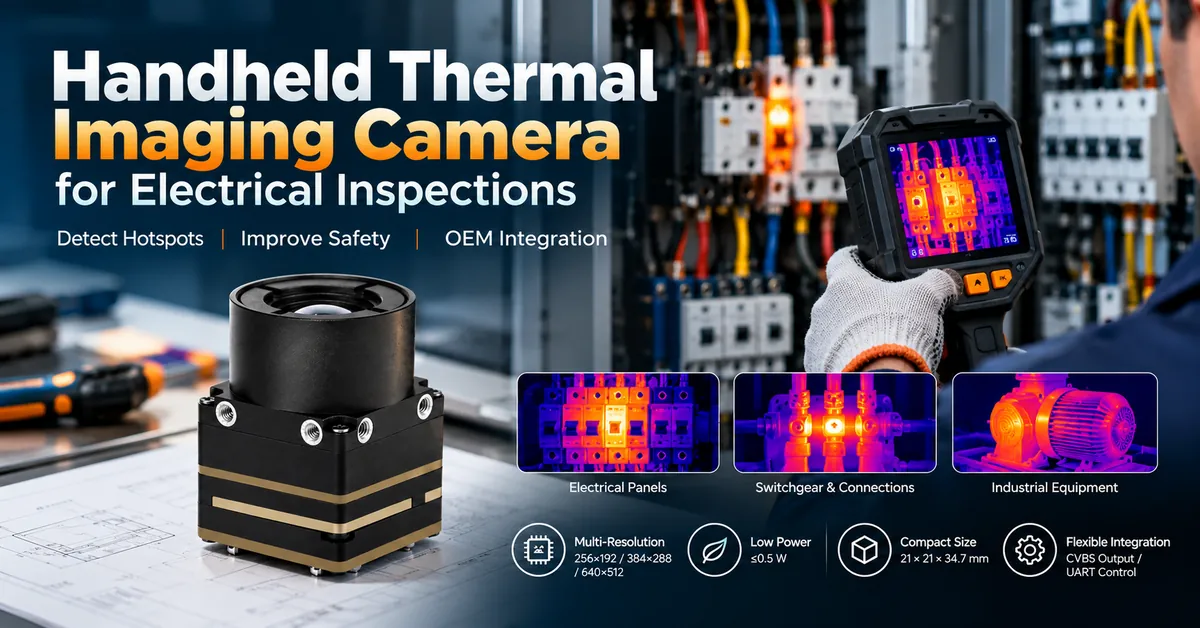
A handheld thermal imaging camera can help electrical maintenance teams identify unusual heating patterns, document equipment conditions, and prioritize further inspection. However, an effective electrical inspection camera must do more than display a colorful thermal image. Its measurement capabilities, optical performance, data recording, and safety-related design must match the intended inspection workflow.
For equipment manufacturers and OEM purchasing teams, the key challenge is selecting infrared imaging technology that supports a reliable finished product without introducing unnecessary development costs or unsupported temperature accuracy claims.
EAGLET offers uncooled LWIR thermal imaging cores for integration into customized infrared equipment, including compact and higher-resolution configurations.
Quick Answer: For electrical inspections, choose a handheld thermal camera based on the smallest component to be examined, working distance, required temperature measurement capability, and inspection documentation needs. If calibrated temperature readings are essential, verify radiometric data output and calibration separately. A thermal imaging core that provides video alone is not automatically a complete temperature-measuring instrument.
1. What Is a Handheld Thermal Imaging Camera for Electrical Inspection?
A handheld thermal imaging camera is a portable infrared imaging instrument that allows technicians to observe surface thermal patterns without physical contact with the inspected object.
Unlike a traditional visible-light camera, an infrared camera detects thermal radiation and converts it into an image representing the scene's infrared characteristics.
For electrical inspection, potential applications include examining:
-
Electrical distribution panels and accessible components
-
Circuit breakers and electrical connections
-
Motor control centers and industrial control cabinets
-
Power distribution equipment
-
EV charging infrastructure
-
Industrial machinery and electrical drive systems
The purpose is to recognize thermal conditions that may warrant further investigation.
For example, an unusual hot region around a connection may be associated with excessive resistance, loading differences, or other operating conditions. Thermal images alone do not establish the root cause.
Handheld thermal camera vs. embedded thermal imaging core
OEM buyers should distinguish finished inspection equipment from its core imaging components.
| Product category | Main characteristics | Target buyer |
|---|---|---|
| Finished handheld thermal camera | Integrated optics, display, controls, power, and inspection functions | Maintenance personnel and field inspectors |
| Radiometric inspection camera | Supports calibrated temperature measurement within defined conditions | Professional thermographers and industrial inspection teams |
| Embedded thermal imaging core | Supplies infrared imaging capability for integration into another device | OEM manufacturers and product developers |
EAGLET's currently published T-C, T256-S, T384-I, and T640-I products belong to the embedded thermal imaging core category.
They are potential components for customized handheld devices, rather than complete battery-powered electrical inspection cameras.
This distinction is important when comparing suppliers and requesting quotations.
2. Who Needs a Professional Handheld Thermal Imaging Solution?
The requirements of a handheld thermal camera vary according to the customer and inspection task.
Electrical maintenance equipment manufacturers may develop portable thermal instruments for technicians inspecting switchgear, distribution systems, and industrial electrical assets.
Industrial tool brands may need customized equipment featuring their own display interface, image storage, inspection workflow, and product branding.
System integrators may incorporate infrared imaging into mobile diagnostic equipment or specialized field-service instruments.
Industrial inspection equipment distributors may evaluate available solutions based on image quality, product reliability, service requirements, and repeatable technical specifications.
R&D teams may use embedded thermal cores to develop application-specific inspection products.
An OEM module-based solution is less suitable for an organization that only wants a ready-to-use handheld camera and does not intend to develop or integrate equipment.
For an OEM project, the objective is to select the right imaging foundation and specify the additional functions that will make the finished device useful to field technicians.
3. Common Electrical Inspection Applications and Buyer Requirements
A handheld thermal imaging camera may be used across several electrical maintenance environments.
| Inspection application | Main observation objective | Key equipment requirement |
|---|---|---|
| Distribution panels | Identify unusual heating around accessible electrical components | Suitable FOV, safe viewing access |
| Electrical connections | Compare heat patterns between comparable connections | Adequate spatial detail and repeatability |
| Motor control centers | Investigate thermal anomalies under operating load | Consistent imaging and inspection records |
| EV charging equipment | Observe heating around accessible connectors and power components | Appropriate optics and environmental protection |
| Industrial electrical machinery | Compare surface thermal behavior during maintenance | Repeatable procedures and contextual data |
Electrical distribution equipment
Power distribution components may exhibit temperature differences caused by load, contact resistance, ambient conditions, or equipment characteristics.
Infrared inspection helps technicians document these differences for qualified assessment.
However, a thermal image must be interpreted alongside electrical load, component type, and operating conditions.
EV charging equipment
Handheld thermal equipment can support inspection workflows involving charging connectors, power electronics, and accessible distribution components.
The final device may require suitable environmental protection and measurement functions depending on the application.
EAGLET provides broader application information through its new energy and EV charging solutions.
Industrial machinery
Thermal imaging can also provide information about motors, drives, and machinery-related electrical equipment.
For these applications, buyers can explore EAGLET's industrial inspection solutions.
The central purchasing requirement is repeatable, interpretable thermal information—not merely an attractive display image.
4. Thermal Visualization vs. Accurate Temperature Measurement
One of the most important decisions in handheld thermal imaging camera development is whether the product needs qualitative imaging or quantitative temperature measurement.
These functions are related but technically different.
| Requirement | Qualitative thermal imaging | Radiometric temperature measurement |
|---|---|---|
| Primary purpose | Visualize relative thermal patterns | Estimate surface temperatures |
| Main output | Thermal image or video | Calibrated temperature data and images |
| Thermal contrast | Important | Important |
| Temperature calibration | Not necessarily required for image display | Required for specified measurement performance |
| Emissivity compensation | Relevant to interpretation | Important for quantitative measurement |
| Reporting | Images and observations | Images plus measured values and measurement conditions |
| Typical buyer | Embedded imaging OEM | Professional inspection equipment OEM |
Why NETD does not establish temperature accuracy
NETD stands for Noise Equivalent Temperature Difference.
It describes thermal sensitivity under defined testing conditions and helps characterize the ability to distinguish small temperature differences in an image.
A module with a published NETD of ≤50 mK does not automatically provide absolute temperature measurement accuracy of ±0.05°C.
Those specifications represent different performance characteristics.
For a handheld infrared camera that must display calibrated temperatures, OEM engineers should verify:
-
Available radiometric data output
-
Specified temperature measurement range
-
Measurement accuracy and its test conditions
-
Calibration method and traceability
-
Emissivity adjustment capabilities
-
Reflected-temperature compensation
-
Measurement behavior under changing ambient conditions
EAGLET's currently published thermal core information primarily specifies detector and image-output characteristics.
OEM buyers should confirm radiometric measurement support for the exact model and revision rather than assuming it is included.
Reflections and emissivity in electrical inspections
Shiny metallic surfaces can reflect surrounding infrared radiation, potentially misleading the operator.
Different surface materials also have different emissivity characteristics.
A bright region in a thermal image therefore does not necessarily represent the object's true surface temperature.
These limitations become particularly important when inspection reports contain measured temperature values or maintenance thresholds.
5. Technical Specifications That Matter for Handheld Electrical Inspection
A reliable handheld thermal imaging camera should be designed around the inspection task and the information the operator needs.
| Technical specification | Purchasing consideration |
|---|---|
| Infrared resolution | Can the camera show sufficient detail on the smallest inspection target? |
| Detector technology | Is the thermal sensor appropriate for the intended equipment architecture? |
| Spectral response | Are the optical system and sensor suitable for the target application? |
| NETD | Is the thermal sensitivity adequate under comparable test conditions? |
| Field of view | Can the operator inspect the target at a safe and practical distance? |
| Focus performance | Are relevant details sufficiently resolved throughout the working range? |
| Frame rate | Does the image update smoothly during handheld operation? |
| Video/data output | Can the host record the required image and measurement information? |
| Operating environment | Will the finished product meet its specified working conditions? |
| Calibration | Is the required measurement capability supported by evidence? |
Resolution should match the smallest inspection target
A higher-resolution detector can provide more native pixels across a target when the field of view is comparable.
However, a camera with a wide lens may deliver fewer pixels on a small connection than a lower-resolution camera using a more suitable optical configuration.
For electrical inspection, determine the smallest component or thermal feature that must be observed and the practical viewing distance before finalizing detector resolution.
Why handheld optical design matters
Electrical panels contain closely spaced components, often in restricted spaces.
A wide field of view may make it easier to examine an entire assembly, but individual connectors may occupy relatively few pixels.
A narrower field of view can provide more target detail while reducing coverage.
The correct choice depends on inspection distance, operator access, component size, and reporting requirements.
6. EAGLET Thermal Imaging Core Comparison for Handheld OEM Equipment
EAGLET provides several uncooled VOx thermal imaging cores that can be evaluated for customized handheld inspection products.
The published models differ in detector resolution, configuration, and integration requirements.
| EAGLET model | Resolution | Published NETD | Published power | OEM evaluation focus |
|---|---|---|---|---|
| T-C Series | 256×192 / 384×288 / 640×512 | ≤35 mK* | ≤0.5 W* | Compact multi-resolution architecture |
| T256-S | 256×192 | ≤50 mK | <1.5 W | Compact inspection tools |
| T384-I | 384×288 | ≤50 mK | <1.5 W | Additional native spatial detail |
| T640-I | 640×512 | ≤50 mK | <1.5 W | Higher-resolution professional equipment |
The published T-C figures are series-level specifications. Confirm values for the exact variant. NETD figures should not be directly ranked without comparable test conditions.
T-C Series: Flexible thermal imaging platform
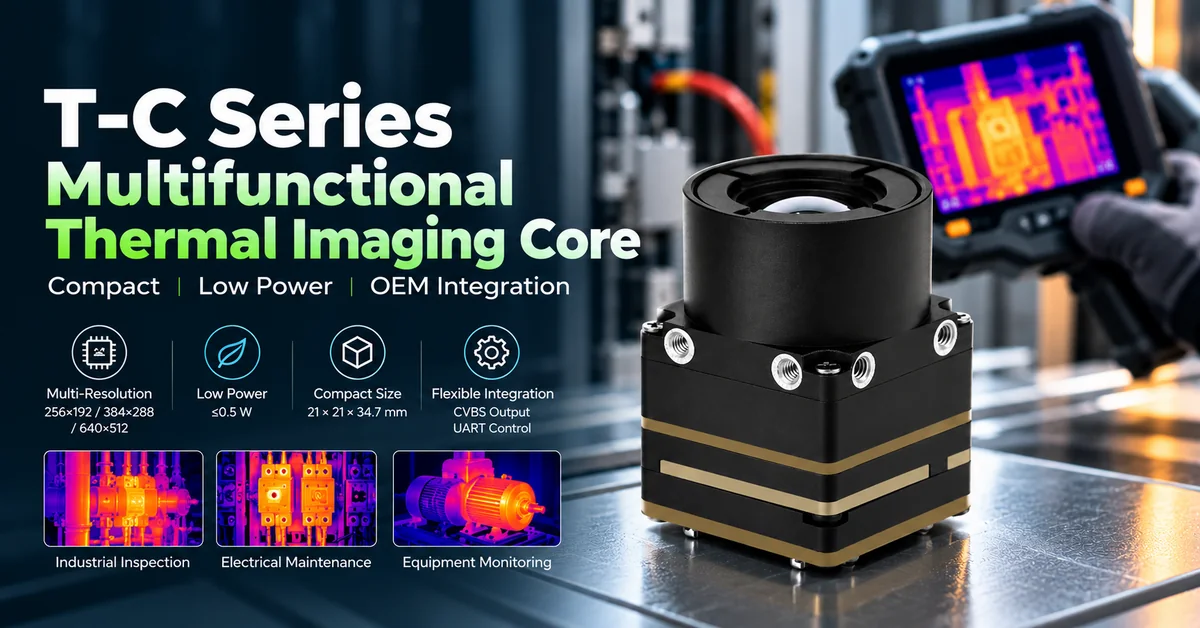
The T-C Series supports 256×192, 384×288, and 640×512 configurations.
Published specifications include uncooled VOx detection, 8–14 μm spectral response, 12 μm pixel pitch, CVBS video output, and UART control.
Its compact design and published low-power characteristics make it worth evaluating for embedded thermal imaging products.
T256-S: Compact OEM infrared imaging
The T256-S uses a 256×192 infrared detector with 50 fps imaging and published power consumption below 1.5 W.
It is positioned for compact imaging equipment, including handheld thermal devices and professional inspection tools.
For OEM buyers developing accessible electrical inspection products, it may be a practical starting point if actual image tests demonstrate sufficient target detail.
T384-I: More spatial detail
The T384-I provides a 384×288 detector, 50 Hz imaging, and an integrated mechanical configuration.
It may suit handheld systems requiring additional native image information, subject to lens and display selection.
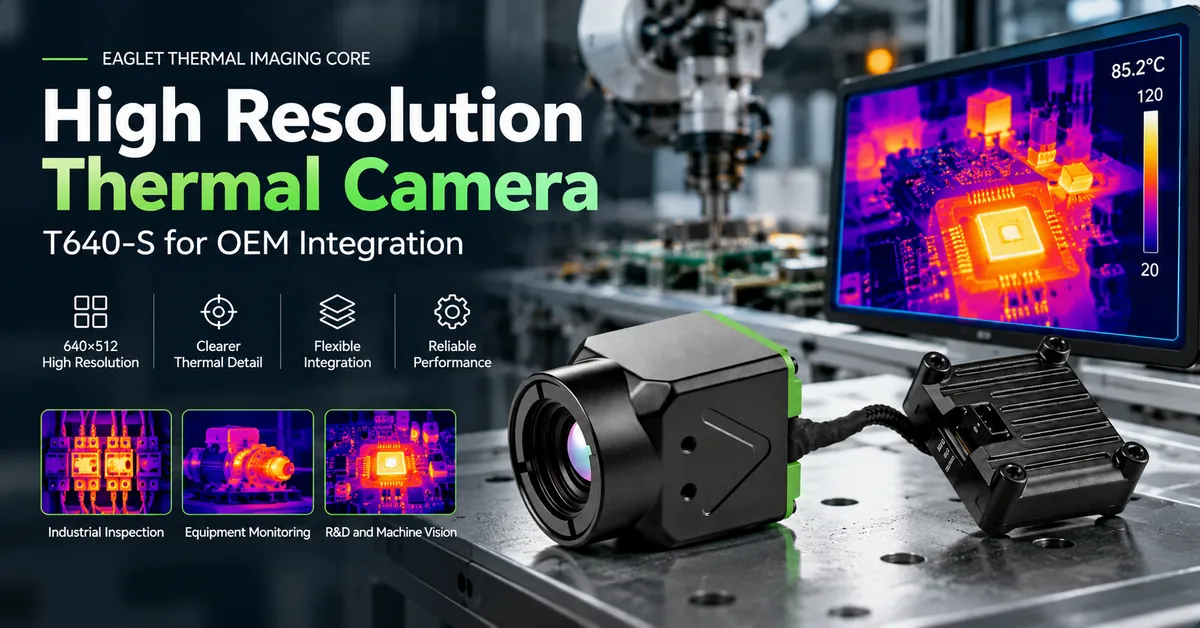
T640-I: Higher-resolution imaging
The T640-I offers a 640×512 detector and an integrated structure.
Its additional pixels may benefit professional equipment where inspection targets require more spatial detail.
However, higher resolution does not independently establish better temperature measurement accuracy.
Recommended approach: Compare candidate modules using the same representative electrical targets, inspection distances, optical coverage, and host processing requirements.
7. What Components Must an OEM Handheld Camera Include?
A thermal imaging core alone cannot provide the complete field inspection workflow.
A finished handheld camera typically requires several additional subsystems.
Imaging and optical assembly
The selected thermal core, LWIR-compatible optics, mechanical mounting, and protective optical components must work together.
Ordinary glass is generally unsuitable as a transparent optical window for the 8–14 μm LWIR spectrum used by these modules.
Electronics and image processing
A host processor may be required to acquire the camera output, manage the display, save images, and implement user controls.
The listed EAGLET cores use CVBS (PAL) video output.
CVBS imaging should not be confused with native digital radiometric temperature data or built-in industrial communication functionality.
Inspection reporting software
A professional handheld inspection camera may need:
-
Image capture and storage
-
Asset identification
-
Time and date records
-
Visible-light image association, if equipped
-
Operator notes
-
Thermal image annotations
-
Exportable inspection reports
-
Temperature values when supported by calibrated hardware
These features must be designed and verified at the system level. They should not be assumed to be included in the imaging core.
Housing and operator interface
A finished product also needs practical controls, a readable display, and a suitable enclosure.
The designer must consider safe handling, environmental resistance, mechanical reliability, and appropriate market requirements.
8. A Practical Electrical Thermography Inspection Workflow
The value of a handheld thermal imaging camera depends heavily on how it is used.
ASTM E1934-99a(2024), Standard Guide for Examining Electrical and Mechanical Equipment with Infrared Thermography, addresses qualitative and quantitative infrared examinations, documentation, and the responsibilities of involved personnel.
ISO 18434-1:2008, Condition Monitoring and Diagnostics of Machines — Thermography — Part 1: General Procedures, provides guidance on inspection methods, interpretation, assessment, and reporting.
These standards offer useful background for developing inspection workflows; they do not certify a particular product.
Step 1: Establish the inspection objective
Identify the equipment and the thermal conditions that require investigation.
Determine whether the task involves general anomaly visualization, comparison with similar components, or quantitative temperature measurement.
Step 2: Establish electrical safety requirements
Perform inspections under the facility's approved electrical safety procedures.
Electrical thermography does not eliminate shock, arc-flash, or other energized-equipment hazards.
Only appropriately qualified personnel should perform tasks involving exposed energized equipment, following applicable regulations, risk assessments, and required protective measures.
A thermal camera must never be used as justification to bypass electrical isolation or safe-access procedures.
Step 3: Confirm operating conditions
Record relevant equipment load, operating state, ambient conditions, and inspection distance.
Comparisons between components are most meaningful when the operating conditions are reasonably comparable.
Step 4: Capture representative images
Use a suitable viewing angle and ensure that the target occupies enough of the image for the intended interpretation.
Avoid drawing conclusions from reflected infrared radiation or poorly resolved targets.
Step 5: Evaluate thermal anomalies
Compare thermal patterns with appropriate references, previous inspections, and equipment operating conditions.
Do not treat every warm area as a confirmed electrical fault.
Step 6: Document and communicate findings
Save relevant images, identify the inspected asset, record operating conditions, and document any observed anomaly.
Where appropriate, recommend further assessment by qualified maintenance personnel.
The inspection process should be repeatable so that future results can be compared.
9. What Should a Professional Thermal Inspection Report Contain?
Inspection reporting is an important product-differentiation opportunity for OEM handheld camera manufacturers.
A useful report should make observations traceable and understandable.
| Reporting field | Why it matters |
|---|---|
| Equipment / asset ID | Identifies the inspected object |
| Inspection date and time | Supports traceability |
| Inspection location | Connects findings to the correct asset |
| Inspector identification | Establishes responsibility |
| Thermal image | Documents observed heat distribution |
| Visible-light reference | Helps locate components, if available |
| Operating conditions | Supports interpretation |
| Emissivity and measurement settings | Relevant when quantitative measurements are made |
| Temperature values | Included only with validated radiometric capability |
| Observation notes | Explains what was seen |
| Follow-up action | Supports maintenance planning |
A colorized image without asset identification or operating context may have limited value for professional maintenance documentation.
For OEM buyers, the key question is not merely whether a camera can save pictures.
It is whether the finished instrument can preserve sufficient evidence for a meaningful inspection report.
10. Quality Control and Acceptance Testing for OEM Handheld Thermal Cameras
Before volume purchasing, equipment manufacturers should establish written acceptance criteria covering both thermal imaging performance and finished-device functions.
| Verification area | Recommended acceptance evidence |
|---|---|
| Thermal image quality | Representative target images, uniformity and stability checks |
| Optical performance | Verified field of view, focus and target coverage |
| Video acquisition | Confirmed host compatibility and stable output |
| Temperature measurement | Calibration evidence and accuracy testing, if required |
| Image storage | Reliable capture, timestamping and retrieval |
| Reporting functions | Correct data export and asset association |
| Electrical performance | Startup and supply-voltage testing |
| Mechanical assembly | Mounting, alignment and connector integrity |
| Environmental suitability | Testing against defined operating conditions |
| Production consistency | Agreed sample inspection and revision records |
Why radiometric validation deserves separate attention
If the finished handheld camera will display numerical temperatures, test the measurement function using appropriate reference sources and controlled conditions.
Where relevant, verification should consider instrument stability, environmental conditions, emissivity, reflected temperature, and measurement uncertainty.
A visually appealing thermal image does not substitute for measurement calibration.
Supplier documentation to request
Before approving a thermal core for OEM integration, request the exact product datasheet revision, electrical interface information, mechanical drawings, optical configuration, and available test documentation.
Buyers should separately confirm applicable certifications and conformity requirements for the finished product.
No particular certification should be assumed from a module's published resolution or NETD.
11. OEM Procurement Costs, MOQ, and Lead-Time Considerations
A professional handheld thermal imaging camera involves several cost categories beyond the infrared detector.
These may include the thermal core, optics, display, processing electronics, battery system, enclosure tooling, firmware, calibration, reporting software, validation, and production testing.
For example, adding calibrated temperature measurement can introduce requirements for radiometric data access, calibration processes, measurement verification, and ongoing quality control.
Similarly, customized reporting features may require additional software development.
What should purchasing teams compare?
Evaluate suppliers based on total project requirements rather than thermal core unit price alone.
A complete quotation should identify:
-
Selected thermal core and optical configuration
-
Sample pricing and sample availability
-
Minimum order quantity
-
Expected production volumes
-
Non-recurring engineering charges
-
Software and interface development responsibilities
-
Quality-control and acceptance requirements
-
Production lead time
-
Warranty and technical support arrangements
These terms must be confirmed for the actual project.
EAGLET's public product pages do not establish universal MOQ, prices, development times, or production delivery commitments for every configuration.
12. How EAGLET Can Support Handheld Thermal Camera OEM Development
EAGLET provides infrared thermal imaging cores for OEM manufacturers, professional equipment developers, and system integrators.
Its published product portfolio includes compact and higher-resolution uncooled LWIR modules that can form the imaging foundation of customized thermal vision products.
The company's technical support page invites buyers to discuss model selection, optical requirements, video interfaces, power, operating conditions, and integration documentation.
For a handheld electrical inspection project, an effective development approach is:
-
Define the inspection tasks and target users.
-
Determine whether thermal visualization or calibrated measurement is required.
-
Select candidate thermal cores and optics.
-
Confirm host video and data integration requirements.
-
Define the inspection reporting workflow.
-
Build and evaluate representative prototypes.
-
Agree on acceptance criteria and production requirements.
The actual customization scope should be confirmed through technical review.
Request a Handheld Thermal Camera OEM Quotation
Developing a handheld thermal inspection instrument for an industrial tool brand or professional equipment range?
Share your requirements with EAGLET, including the following:
| RFQ information | Example requirement |
|---|---|
| Intended application | Electrical distribution inspection |
| Target buyer | Industrial maintenance teams |
| Required resolution | 256×192, 384×288 or 640×512 |
| Target dimensions | Smallest component requiring inspection |
| Working distance | Expected field inspection range |
| Measurement capability | Thermal video only or calibrated temperature data |
| Display and reporting | Image capture, asset information and export functions |
| Electrical requirements | Host interface and power constraints |
| Mechanical requirements | Enclosure dimensions and installation constraints |
| Purchase requirements | Samples, expected volume and project schedule |
Explore EAGLET thermal imaging core options and contact EAGLET for an OEM technical discussion.
A detailed RFQ helps determine which imaging functions are already supported and which require additional engineering.
13. Frequently Asked Questions About Handheld Thermal Imaging Cameras
1. What is a handheld thermal imaging camera used for?
A handheld thermal imaging camera helps technicians observe thermal patterns during electrical, mechanical, and facility inspections. It supports condition assessment but does not independently identify every equipment fault.
2. Can a handheld thermal camera identify loose electrical connections?
It may reveal abnormal heating associated with increased electrical resistance, but a thermal image alone cannot confirm a loose connection. Qualified personnel must assess the finding using appropriate procedures and supporting information.
3. Can a handheld thermal imaging camera measure exact temperatures?
Only if it includes suitable calibrated radiometric measurement capabilities. A thermal core with video output alone does not establish absolute temperature measurement accuracy.
4. What resolution is suitable for electrical inspection?
The required resolution depends on component size, working distance, field of view, and the needed level of detail. Higher resolution may help with smaller targets, but optical selection remains critical.
5. What is the difference between NETD and temperature accuracy?
NETD describes thermal sensitivity under specified conditions. Temperature accuracy describes how closely a measurement represents the actual surface temperature within defined uncertainty and calibration limits.
6. Can EAGLET thermal cores be integrated into handheld inspection cameras?
EAGLET offers compact thermal imaging cores suitable for OEM evaluation. The finished camera requires additional integration of controls, display, processing, power and any measurement or reporting features.
7. Does the EAGLET T256-S include a screen or inspection software?
The T256-S is an embedded thermal imaging core, not a finished handheld inspection instrument. Screen, reporting software, battery and user-interface functionality require system-level development.
8. What should an OEM buyer check before ordering samples?
Confirm the exact module revision, resolution, optical configuration, output interface, power requirements, available technical documents, and sample acceptance criteria.
9. Are EAGLET thermal imaging cores certified for electrical inspection?
A core's published specifications do not prove certification of a complete electrical inspection instrument. Applicable product certifications and measurement verification must be checked for the final device and target market.
10. How can OEM manufacturers request pricing and customization information?
Provide the application, target equipment, imaging requirements, data and reporting functions, expected sample quantity, and purchasing forecast. EAGLET can review suitable module options and discuss project-specific technical and commercial requirements.
Conclusion
Choosing a handheld thermal imaging camera for electrical inspection requires more than comparing detector resolution, thermal sensitivity, or product appearance.
For professional inspection equipment, the most important considerations are target visibility, measurement capability, safe operating procedures, inspection documentation, and repeatable performance.
A camera designed for qualitative thermal visualization may have different electronics and calibration requirements from one intended to generate quantitative temperature reports.
For OEM equipment manufacturers, EAGLET's T-C Series, T256-S, T384-I, and T640-I provide potential uncooled LWIR imaging foundations for customized handheld thermal products. Final suitability depends on the required optics, interfaces, measurement functions, mechanical design, and validated integration performance.
The best purchasing strategy is to define the inspection workflow first, select a suitable thermal imaging core, establish measurable acceptance criteria, and verify the complete product before production.
Planning a handheld thermal imaging camera for your industrial equipment portfolio? Contact EAGLET to discuss your inspection requirements, available thermal imaging cores, OEM integration needs, and project-specific quotation.