
A professional thermal imaging camera must deliver dependable infrared images under the conditions in which the finished equipment actually operates. High detector resolution and thermal sensitivity are important, but they cannot compensate for an unsuitable enclosure, unstable power supply, contaminated optical window, or incompatible video interface.
For OEM manufacturers developing industrial inspection systems, outdoor observation equipment, and mobile thermal vision products, reliability must be designed and tested across the complete imaging system.
EAGLET provides uncooled LWIR thermal imaging cores for professional equipment manufacturers and system integrators. Its product range includes compact and high-resolution configurations suitable for evaluation in customized infrared imaging systems.
Quick Answer: A professional thermal imaging camera should be selected according to its intended environment, optical requirements, electrical compatibility, imaging stability, and service life. For demanding applications, buyers should verify the complete device's environmental protection, image performance, mechanical reliability, and maintenance requirements before approving OEM production.
1. What Makes a Thermal Imaging Camera Professional-Grade?
A professional thermal imaging camera is an infrared imaging system designed to meet defined operational and performance requirements in commercial, industrial, or specialized applications.
Professional-grade suitability is not determined by detector resolution alone.
Instead, it depends on whether the equipment can consistently perform its intended task under specified conditions.
Five factors are particularly important:
-
Imaging performance: Adequate resolution, thermal sensitivity, optical coverage, and image stability.
-
Environmental suitability: Protection against expected temperature changes, dust, moisture, and mechanical stress.
-
System integration: Reliable electrical supply, compatible interfaces, and appropriate processing hardware.
-
Operational consistency: Repeatable imaging performance throughout the intended duty cycle.
-
Serviceability: Accessible documentation, replacement arrangements, revision control, and maintenance planning.
A professional infrared camera used inside a controlled laboratory has different requirements from one installed on an outdoor inspection robot.
The correct purchasing specification should reflect those differences.
Complete thermal cameras vs. thermal imaging cores
| Product category | Main characteristics | Suitable buyers |
|---|---|---|
| Complete professional thermal camera | Integrated imaging, housing, controls, and application functions | Industrial end users and equipment distributors |
| Embedded thermal imaging core | Infrared sensor, optics, and supporting imaging electronics | OEM manufacturers and product developers |
| Customized thermal imaging system | Thermal core integrated with application-specific hardware and software | System integrators and specialized equipment manufacturers |
EAGLET's principal published thermal imaging products are embedded cores.
They provide a starting point for developing a professional camera, but do not automatically include a weatherproof enclosure, display, battery, Ethernet interface, or calibrated temperature measurement.
2. Which Professional Applications Require Additional Reliability?
Environmental requirements depend on where and how the camera will operate.
| Application | Operating conditions | Primary reliability concern |
|---|---|---|
| Industrial machinery inspection | Dust, vibration, changing equipment temperatures | Image stability and mounting reliability |
| Outdoor infrastructure monitoring | Rain, humidity, sunlight, temperature fluctuations | Enclosure sealing and optical protection |
| Mobile inspection robots | Vibration, shock, limited installation space | Mechanical integrity and electrical connections |
| UAV thermal imaging | Payload movement, temperature variation, power limitations | Weight, power stability, and imaging continuity |
| Professional security monitoring | Extended operation, outdoor exposure, limited access | Long-term operation and maintenance |
| Portable inspection equipment | Frequent handling, changing environments | Housing durability and reliable operation |
Industrial inspection equipment
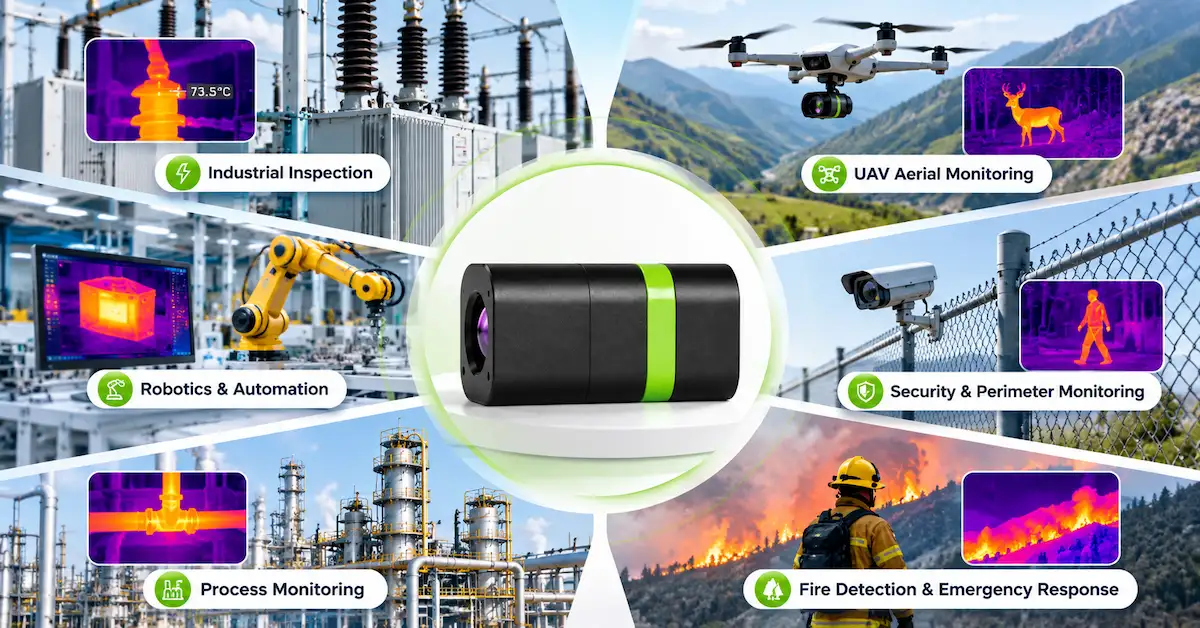
Professional thermal cameras can help operators observe abnormal thermal patterns around machinery, electrical equipment, and production systems.
For these applications, image consistency is important because maintenance personnel may compare observations across different operating conditions.
EAGLET discusses related requirements in its industrial inspection solutions.
Outdoor monitoring systems
Outdoor cameras must handle environmental exposure that may not exist in indoor applications.
Rain, dust, condensation, solar heating, and rapid temperature changes can affect the enclosure, optics, and internal electronics.
A thermal core's published operating-temperature range does not establish the environmental protection of the finished camera.
Robotics and mobile equipment
Robotic platforms introduce vibration, electrical noise, cable movement, and installation restrictions.
Even when the thermal detector produces suitable images, an unreliable connector or unstable power rail can compromise the system.
The camera should therefore be evaluated as part of the complete mobile platform.
3. Essential Specifications for a Professional Thermal Imaging Camera
A technical specification should connect sensor performance to the working conditions of the final product.
| Technical parameter | What it describes | Procurement consideration |
|---|---|---|
| Detector resolution | Native infrared pixel count | Required spatial detail |
| Detector technology | Infrared sensing architecture | Integration and thermal management |
| Spectral response | Operating infrared wavelength range | Optical and environmental compatibility |
| NETD | Thermal sensitivity under defined conditions | Ability to observe small thermal differences |
| Frame rate | Imaging update frequency | Suitability for dynamic applications |
| Optical FOV | Angular scene coverage | Target visibility and installation position |
| Power consumption | Electrical demand | Supply design and thermal load |
| Video interface | Imaging output format | Host processing compatibility |
| Operating temperature | Published module temperature range | Environmental design limits |
| Mechanical dimensions | Module size and arrangement | Mounting and enclosure design |
Why image quality must be evaluated over time
A professional thermal imaging camera may operate for extended periods rather than only during short demonstrations.
Image quality can be affected by internal temperature changes, optical contamination, processing behavior, and environmental conditions.
OEM engineers should evaluate whether the camera continues to provide useful thermal information after startup, during sustained operation, and following temperature changes.
They should also determine whether any image correction or calibration events affect the intended workflow.
Why NETD alone is insufficient
NETD, or Noise Equivalent Temperature Difference, characterizes thermal sensitivity under specified conditions.
A lower NETD may indicate an ability to distinguish smaller temperature differences when measurement conditions are comparable.
However, NETD does not establish:
-
Absolute temperature measurement accuracy
-
Environmental protection
-
Long-term operational reliability
-
Mechanical durability
-
Complete-system image latency
Buyers should avoid selecting a professional camera based on a single attractive specification.
4. EAGLET Thermal Imaging Cores for Professional OEM Equipment
EAGLET offers several uncooled vanadium oxide (VOx) infrared imaging modules operating in the 8–14 μm long-wave infrared spectrum.
The following products provide different integration options for professional equipment development.
| Model | Resolution | Published power | Published operating temperature | Main integration consideration |
|---|---|---|---|---|
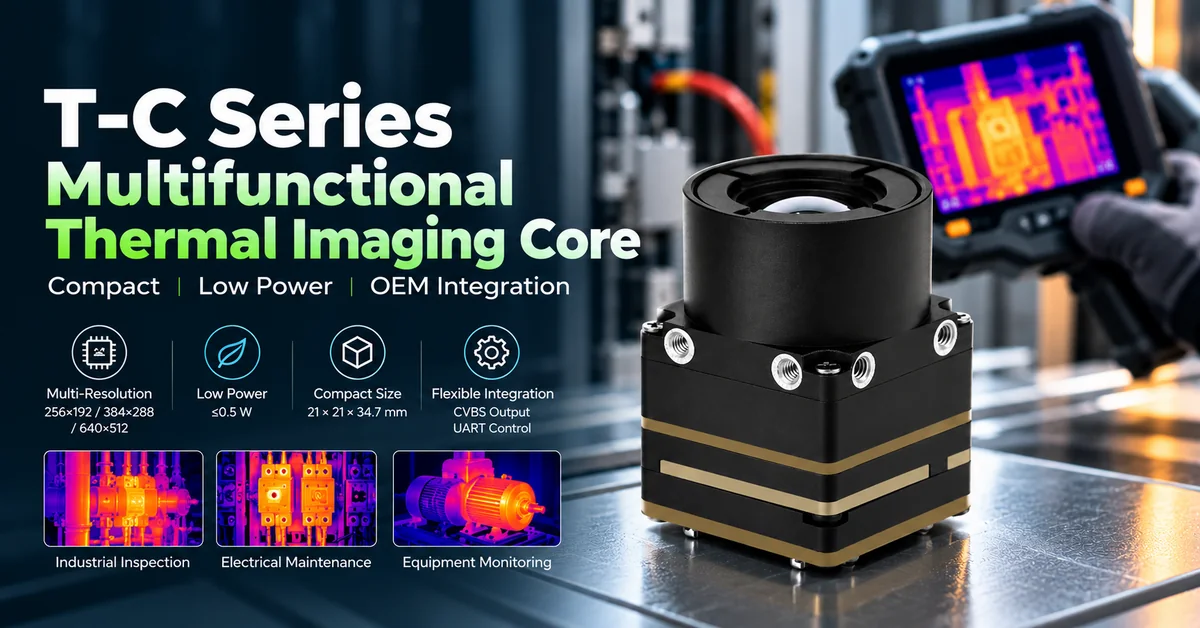
| T-C Series | 256×192 / 384×288 / 640×512 | ≤0.5 W* | -40°C to +60°C* | Compact, multiple resolution options |
| T256-S | 256×192 | <1.5 W | -20°C to +60°C | Compact embedded integration |
| T384-I | 384×288 | <1.5 W | -20°C to +60°C | Integrated medium-resolution module |
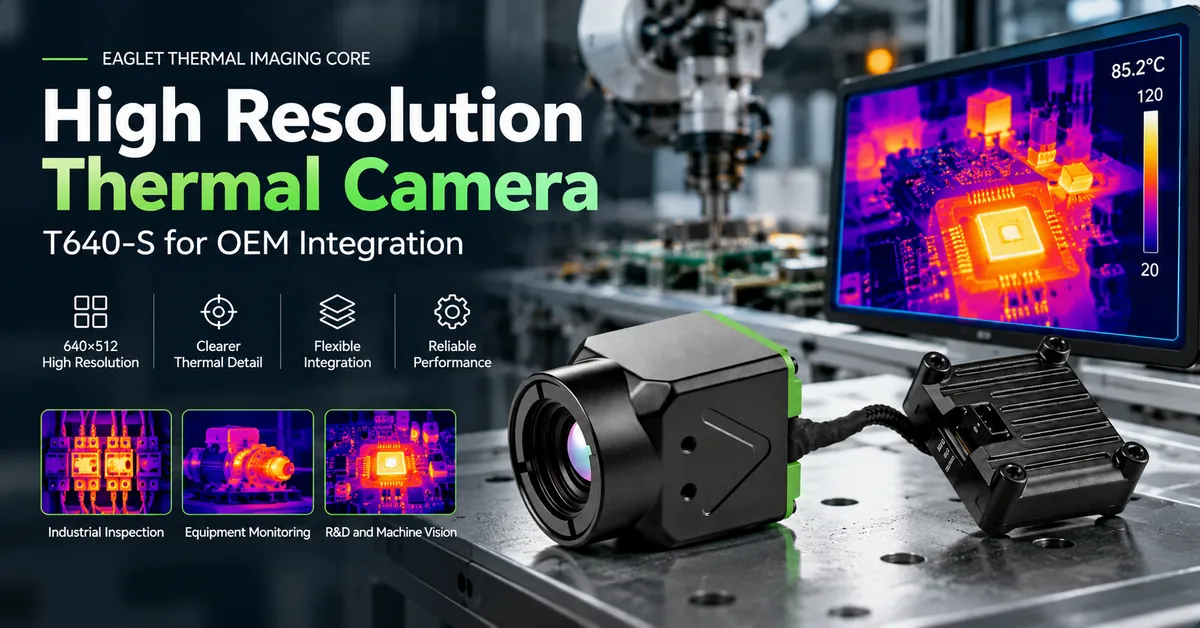
| T640-S | 640×512 | <1.5 W | -20°C to +60°C | Separate optical and controller assemblies |
| T640-I | 640×512 | <1.5 W | -20°C to +60°C | Compact integrated high-resolution module |
The T-C Series values are published at the family level. Confirm their applicability to the exact resolution, optics, and hardware revision.
These products use CVBS (PAL) video output. The T-C Series additionally lists UART control.
T-C Series: Compact integration and flexible resolution
The T-C Series provides 256×192, 384×288, and 640×512 configurations.
Its published compact dimensions, low power consumption, and control interface make it worth evaluating for space-constrained professional equipment.
However, buyers should confirm the electrical and operating specifications of the exact configuration.
T384-I: Integrated professional thermal imaging
The T384-I offers 384×288 resolution in a published 35×26×49 mm configuration.
It can be considered for industrial and embedded thermal vision equipment where an integrated module arrangement is preferred.
T640-S: High-resolution imaging with separate components
The T640-S provides 640×512 thermal imaging with separately specified optical and controller assemblies.
This mechanical arrangement may be useful when installation space requires different placement of imaging and processing components.
T640-I: Integrated high-resolution thermal core
The T640-I also offers 640×512 resolution, with published dimensions of 35×26×44 mm.
It may suit professional imaging products where the mechanical design benefits from an integrated configuration.
Selection principle: The best model is not necessarily the one with the highest pixel count. It is the configuration that meets the required optical, electrical, mechanical, and environmental conditions with acceptable integration risk.
5. Environmental Protection: Designing a Reliable Camera Enclosure
A thermal imaging core installed in a controlled environment may not need the same protection as an outdoor camera.
For outdoor or demanding industrial equipment, the enclosure becomes part of the imaging system.
Dust and water protection
Dust can contaminate optical surfaces, while moisture can affect electrical components and image visibility.
An appropriate housing should protect the electronics while maintaining a suitable optical path.
IEC 60529, Degrees of Protection Provided by Enclosures (IP Code), provides a framework for classifying enclosure protection against access, solid objects, and water.
However, an IP rating applies to the relevant tested enclosure or assembly, not automatically to a thermal core installed inside it.
If the finished product requires IP54, IP65, or another protection classification, the complete design should be evaluated accordingly.
Optical window selection
The optical window must transmit the wavelengths detected by the thermal sensor.
EAGLET's listed cores operate across the 8–14 μm LWIR spectrum.
Ordinary visible-light glass is generally unsuitable for transmitting these wavelengths.
Suitable infrared optical materials must be evaluated for spectral transmission, coating durability, environmental resistance, and mechanical compatibility.
The final window can also influence focus and thermal image quality.
Condensation and temperature changes
Moving equipment between different temperature and humidity conditions can create condensation risks.
The enclosure design may require sealing, moisture management, or other environmental controls.
These measures should be selected according to the actual installation and verified through testing.
6. Mechanical Design and Manufacturing Considerations
A professional thermal imaging camera should maintain optical and electrical integrity throughout its intended service life.
Housing and structural materials
Depending on the product requirements, OEM designers may evaluate aluminum alloys, engineered polymers, or other suitable enclosure materials.
Material selection should consider:
-
Mechanical strength
-
Thermal conductivity
-
Weight
-
Corrosion resistance
-
Dimensional stability
-
Manufacturing cost
-
Environmental sealing
These are general design considerations, not claims that every EAGLET module uses a particular housing material or production process.
Optical alignment
The detector and optical assembly must remain correctly aligned.
Mechanical distortion, mounting stress, or vibration can affect imaging performance.
The integration design should specify appropriate mounting points, alignment references, fastening methods, and inspection procedures.
Electrical connection reliability
Connector retention and cable routing are particularly important in mobile equipment.
Unstable connections may cause intermittent video output, startup problems, or other system failures.
Where the host system includes motors, switching power supplies, or other sources of electrical noise, appropriate signal routing and grounding should be considered.
7. Long-Term Image Stability and Continuous Operation
A professional thermal imaging camera intended for extended operation should be evaluated beyond its initial startup performance.
This is especially important for fixed monitoring devices, unattended systems, and equipment installed in locations where maintenance access is limited.
Thermal stabilization
Internal electronics generate heat during operation.
That heat may influence system temperature and imaging behavior.
The complete design should account for heat transfer, enclosure ventilation or conduction, and surrounding equipment temperatures.
Image correction behavior
Uncooled thermal imaging systems may use non-uniformity correction to compensate for sensor response variations.
The availability, implementation, and operational effects of correction functions depend on the specific imaging system.
OEM buyers should ask how the selected module handles correction events and whether those events interfere with the intended monitoring or recording process.
Video output reliability
A professional camera can include several processing stages:
Infrared detector → Imaging electronics → Video output → Host acquisition → Processing → Display or recording
Each stage may affect system performance.
EAGLET's published modules specify CVBS video output, so buyers using digital processors may need an appropriate acquisition interface.
A stated module frame rate does not guarantee the same end-to-end latency in the finished system.
Long-duration tests should verify the complete imaging path.
8. How to Test Thermal Camera Reliability Before OEM Production
An effective sample validation program should reproduce the conditions that the finished camera is likely to encounter.
| Test category | What to evaluate | Suggested evidence |
|---|---|---|
| Initial image quality | Target visibility, focus, image artifacts | Reference images and results |
| Extended operation | Stability during the intended duty cycle | Continuous-operation test records |
| Temperature variation | Startup and imaging behavior across specified conditions | Test logs and images |
| Vibration | Mechanical integrity and output continuity | Results under agreed vibration profiles |
| Enclosure protection | Resistance to specified dust and water exposure | Applicable enclosure test reports |
| Supply variation | Power stability and startup behavior | Electrical measurements |
| Interface compatibility | Stable video and control operation | Host-system test records |
| Optical window performance | Transmission, clarity, and environmental durability | Optical and environmental test evidence |
| Production repeatability | Unit-to-unit consistency | Inspection records and acceptance limits |
Relevant environmental testing standards
IEC 60068-2-6:2007 provides procedures for sinusoidal vibration testing.
IEC 60068-2-14:2023 addresses environmental testing involving changes in temperature.
IEC 60529 defines degrees of protection provided by enclosures.
These standards can guide the selection of appropriate verification methods.
They do not establish that EAGLET products have undergone, passed, or been certified to particular tests.
The OEM and supplier should agree on the required test conditions, limits, and acceptance criteria before testing.
Why sample testing matters
A product may perform well during a short demonstration but behave differently after extended operation, repeated handling, or environmental exposure.
A useful sample approval process should therefore document both imaging quality and the conditions under which that performance was achieved.
For projects requiring quantitative temperature measurement, additional radiometric calibration and measurement verification are necessary.
9. Common Mistakes When Selecting a Professional Thermal Imaging Camera
Several purchasing mistakes can increase development costs or create reliability problems.
Mistake 1: Assuming a higher resolution guarantees better reliability
Resolution affects spatial image information.
It does not establish enclosure durability, power stability, or environmental performance.
Mistake 2: Treating module operating temperature as a complete-system rating
A core may have a specified operating-temperature range while the finished enclosure, display, cables, and power electronics have different limitations.
The complete assembly must be evaluated.
Mistake 3: Ignoring optical-window performance
A protective window selected without considering LWIR transmission can reduce image quality or prevent the intended scene from being observed.
Mistake 4: Assuming CVBS provides native digital thermal data
Analog video output does not automatically provide full-resolution digital sensor data or calibrated temperature measurements.
The exact data requirements must be discussed before hardware design.
Mistake 5: Ignoring long-term service requirements
Product availability, documentation revisions, spare modules, and repair arrangements can affect total ownership cost.
Professional OEM projects should consider those factors before volume purchasing.
10. Total Cost of Ownership and B2B Procurement Risks
The purchase price of a thermal imaging core is only one part of the professional camera's total cost.
Other expenses may include:
-
Optical components and protective windows
-
Enclosure engineering and tooling
-
Video acquisition electronics
-
Power conditioning and thermal management
-
Firmware and software integration
-
Environmental validation
-
Production quality control
-
Maintenance and replacement components
-
Documentation and product revision management
For long-term OEM projects, serviceability can be particularly important.
If the imaging module becomes unavailable or a hardware revision changes its interface, the equipment manufacturer may need to modify a finished product.
Questions for a supplier qualification review
Before committing to a purchasing agreement, ask:
-
What is the exact product revision being quoted?
-
Which specifications are guaranteed for that revision?
-
Are interface and mechanical drawings available?
-
What is the MOQ for the selected configuration?
-
How are engineering changes communicated?
-
What sample and production lead times apply?
-
Are replacement parts or modules available?
-
What inspection and acceptance documentation can be supplied?
These questions help procurement teams assess actual project risk rather than relying on broad marketing claims.
MOQ, pricing, warranty terms, production capacity, and lead times should be confirmed through an individual quotation.
11. OEM/ODM Integration and Project Development
EAGLET focuses on infrared thermal imaging cores and customized intelligent vision solutions for equipment manufacturers and system integrators.
Its technical support resources cover model selection, integration requirements, and requests for product-specific documentation.
For a professional thermal imaging camera intended for demanding environments, a practical project development process includes:
Step 1 — Define the operating environment.
Document temperature, humidity, dust, water exposure, vibration, available power, and installation restrictions.
Step 2 — Select the imaging configuration.
Determine resolution, lens requirements, optical coverage, interface compatibility, and whether calibrated temperature measurement is needed.
Step 3 — Review mechanical and electrical integration.
Confirm the core dimensions, mounting arrangement, signal path, power supply, and enclosure requirements.
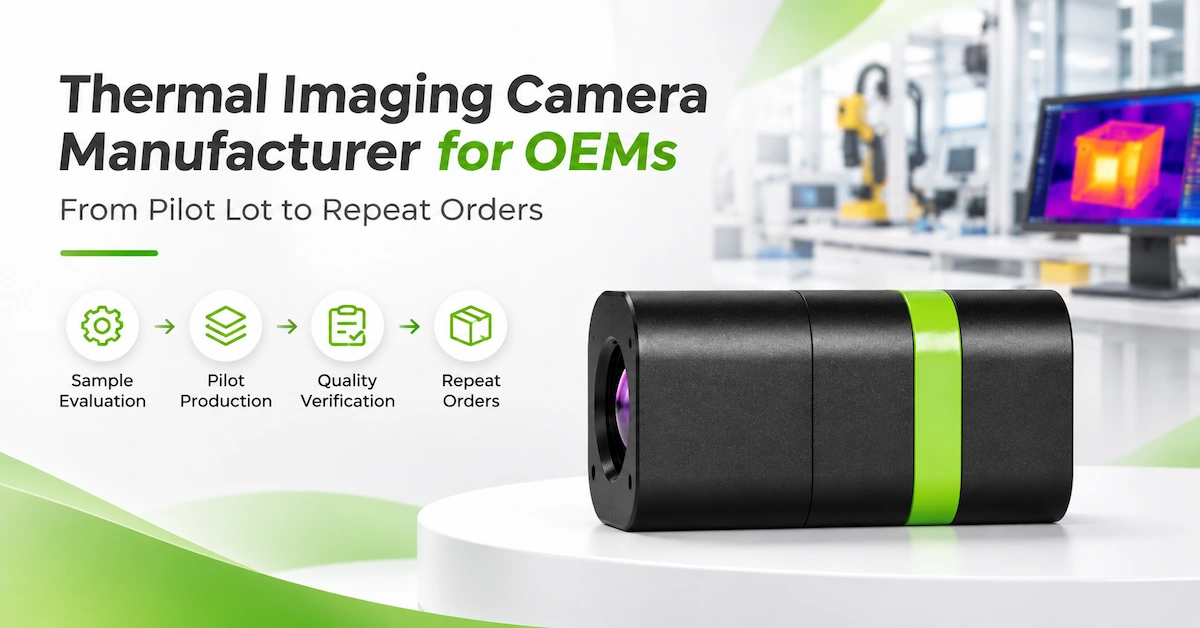
Step 4 — Build representative prototypes.
Integrate the selected core with the planned housing, optical window, electronics, and processing system.
Step 5 — Conduct reliability testing.
Evaluate image stability, environmental suitability, electrical operation, and mechanical integrity using agreed acceptance criteria.
Step 6 — Approve the production specification.
Confirm the selected hardware revision, test documentation, commercial requirements, and quality expectations.
Customization feasibility and the exact service scope should be established through technical discussion.
12. Request a Professional Thermal Imaging Camera OEM Quotation
A detailed RFQ helps suppliers identify the appropriate imaging core and clarify which functions require additional development.
| RFQ requirement | Information to provide |
|---|---|
| Application | Industrial inspection, outdoor monitoring, robotics, or professional observation |
| Operating conditions | Temperature, humidity, dust, vibration, water exposure |
| Resolution | Preferred detector resolution or target-detail requirement |
| Optical requirements | Working distance, target size, field of view |
| Video/data interface | CVBS or required host acquisition format |
| Power requirements | Available voltage and power budget |
| Mechanical requirements | Installation dimensions, mounting restrictions |
| Environmental protection | Required enclosure rating and verification |
| Measurement functions | Thermal imaging only or calibrated temperature output |
| Purchasing quantity | Samples and expected annual volume |
| Support requirements | Documentation, revision control, replacement arrangements |
Discuss Your OEM Thermal Imaging Project with EAGLET
Developing an industrial camera, outdoor observation system, or embedded professional thermal vision product?
Explore the EAGLET thermal imaging core portfolio and compare available configurations.
Then contact EAGLET with your technical requirements, intended operating environment, integration constraints, and purchasing forecast.
A focused technical review can help determine which published module is worth evaluating and what additional environmental validation or system engineering may be necessary.
13. Frequently Asked Questions About Professional Thermal Imaging Cameras
1. What is a professional thermal imaging camera?
A professional thermal imaging camera is an infrared imaging system intended to satisfy defined operational requirements. Its suitability depends on imaging performance, environmental conditions, integration, reliability, and applicable measurement functions.
2. Is a professional thermal camera always high resolution?
No. Higher resolution may provide more target detail, but professional suitability also depends on optics, environmental protection, image stability, and the intended task.
3. Can a professional thermal imaging camera work outdoors?
Yes, when the finished equipment is designed and tested for its intended outdoor environment. A bare thermal imaging core should not automatically be considered waterproof or weatherproof.
4. What environmental tests should OEM buyers consider?
Depending on the application, buyers may consider temperature-change tests, vibration tests, ingress protection verification, power stability, and long-duration operation.
5. Does an uncooled VOx detector require thermal management?
Yes. Although uncooled detectors do not need a cryogenic cooler, the complete imaging system still requires appropriate thermal design and operating-temperature verification.
6. Can thermal imaging cameras operate in complete darkness?
Thermal imaging does not require visible illumination. However, image usefulness still depends on target contrast, optics, weather, environmental conditions, and obstructions.
7. What is the difference between NETD and temperature accuracy?
NETD characterizes thermal sensitivity under specified conditions. Absolute temperature measurement accuracy requires separate radiometric calibration and measurement validation.
8. Are EAGLET thermal imaging cores complete professional cameras?
No. EAGLET's listed T-C, T256-S, T384-I, T640-S, and T640-I products are embedded infrared imaging cores intended for integration into larger systems.
9. What should buyers verify before mass production?
Verify the exact model revision, image quality, optical and electrical interfaces, environmental suitability, required test reports, acceptance criteria, and commercial terms.
10. How can OEM manufacturers request pricing and technical support?
Provide the intended application, operating environment, required resolution, optics, power, interface, dimensions, sample quantity, and expected purchasing volume. EAGLET can then discuss suitable configurations and project-specific requirements.
Conclusion
Selecting a professional thermal imaging camera for demanding environments requires a system-level evaluation of image quality, environmental protection, mechanical design, electrical compatibility, and long-term serviceability.
Detector resolution and thermal sensitivity are useful starting specifications, but they do not independently establish reliable operation under industrial or outdoor conditions.
For OEM manufacturers and system integrators, the most effective approach is to define the operating environment, shortlist appropriate infrared cores, establish measurable acceptance criteria, and validate the complete equipment before production.
EAGLET's T-C Series, T256-S, T384-I, T640-S, and T640-I provide different uncooled LWIR imaging configurations for professional equipment development. Final suitability depends on the selected optics, interfaces, integration architecture, and project-specific testing.
Looking for a professional thermal imaging solution for your next OEM project? Contact EAGLET to discuss your operating requirements, compare thermal imaging cores, and request a tailored technical quotation.