
A high resolution thermal camera is worth the upgrade when additional infrared detector pixels help an OEM system observe smaller targets, cover a wider scene without losing critical detail, or provide more useful information for machine vision. However, moving from 256×192 or 384×288 to 640×512 does not automatically improve every thermal imaging application.
For equipment manufacturers and system integrators, the real purchasing question is whether the additional resolution produces a measurable improvement in the finished device.
A 640×512 detector contains 327,680 native infrared pixels—approximately 3 times the pixel count of 384×288 and 6.7 times that of 256×192. Yet optical design, thermal sensitivity, video interfaces, and system processing still determine how much information reaches the user.
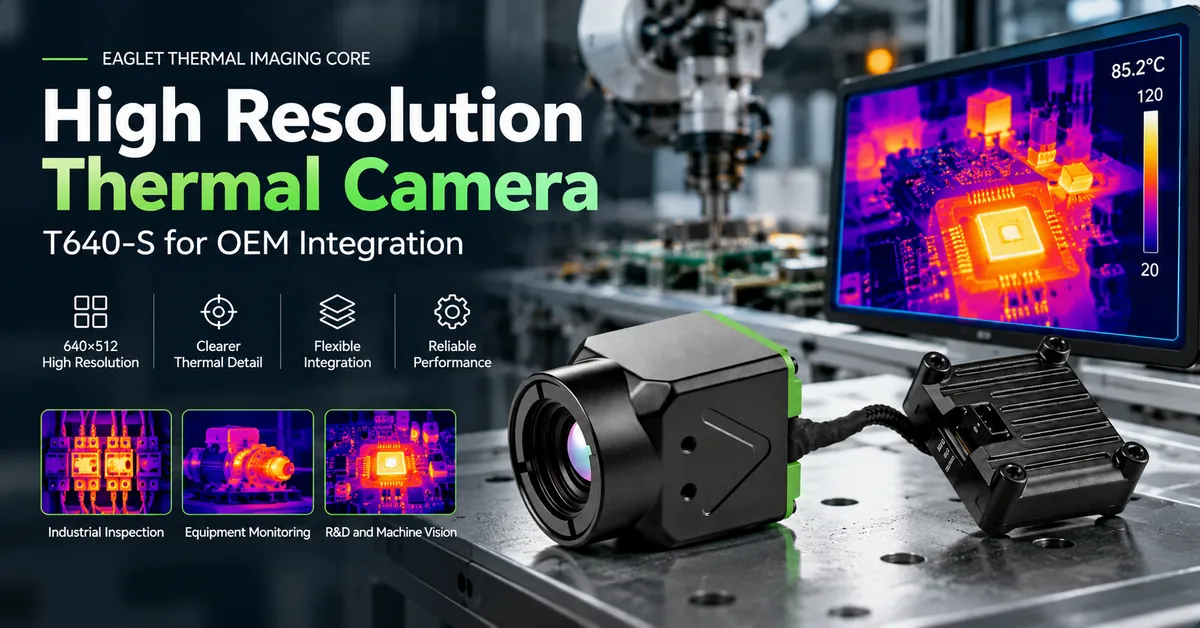
EAGLET provides uncooled LWIR thermal imaging cores, including 640×512 options for embedded equipment, industrial inspection, robotics, and customized infrared vision systems.
Quick answer: Choose a 640×512 thermal imaging core when target detail, field-of-view requirements, and downstream image processing justify the additional native pixels. Choose a lower-resolution alternative when it already meets the application’s detection requirements at a lower total system cost.
1. What Qualifies as a High Resolution Thermal Camera?
A high resolution thermal camera uses an infrared detector with enough native pixels to provide the spatial detail required by its application. In professional embedded thermal imaging, 640×512 is a widely used resolution class, although higher-resolution detectors also exist.
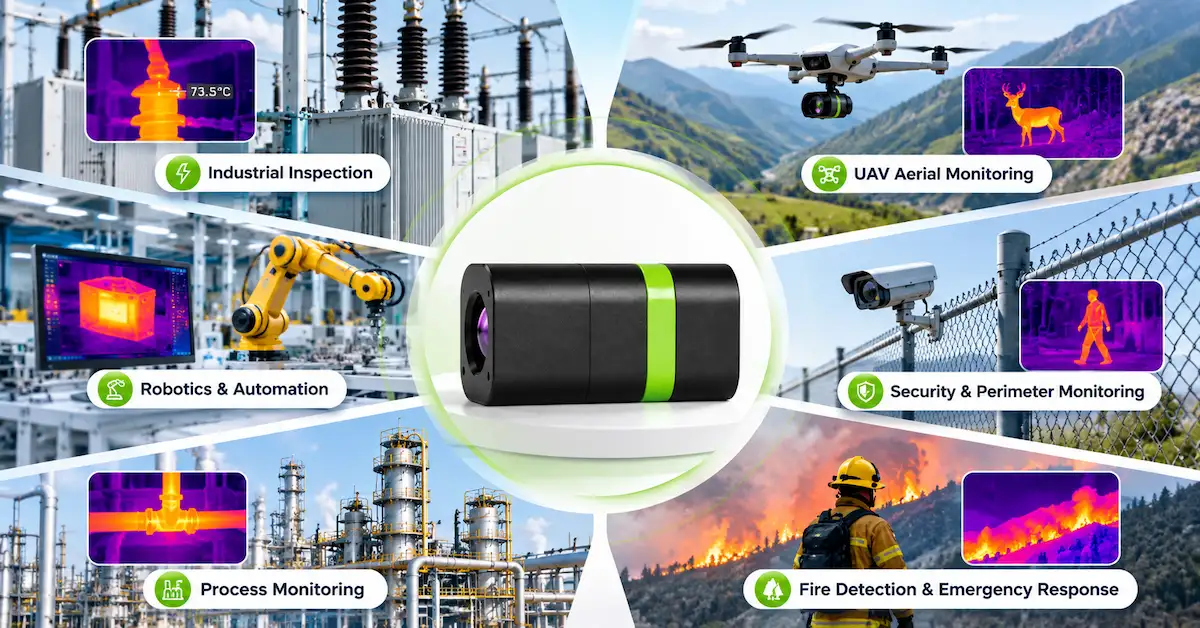
Unlike a conventional visible-light camera, a thermal camera detects infrared radiation from a scene. It can reveal thermal patterns without relying on visible illumination.
For OEM buyers, however, a high-resolution thermal camera may refer to two different products:
-
Complete thermal camera: An integrated instrument that may include a display, processing system, enclosure, connectivity, and temperature measurement functions.
-
Thermal imaging core: An embedded infrared sensing and imaging module designed to become part of a larger device.
EAGLET's main thermal imaging products are integration-oriented cores rather than universally interchangeable finished industrial cameras.
This distinction matters because an OEM thermal imaging core may require additional electronics, housing, optics, software, and testing before the final product is ready for deployment.
Who should consider 640×512 thermal imaging?
The strongest potential buyers include industrial inspection equipment manufacturers, professional optical device brands, robotics developers, machine vision system integrators, and OEM thermal camera manufacturers.
A 640×512 configuration is particularly relevant when these customers need more pixels across a target or greater scene coverage at a specified level of detail.
It may not be necessary for simple nearby hot-spot observation, basic presence detection, or applications where low power, mechanical simplicity, and minimum system cost are the primary requirements.
2. 256×192 vs 384×288 vs 640×512: How Much More Detail Do You Get?
Resolution is the total number of native detector pixels used to sample infrared radiation.
Comparing the three resolution classes reveals a significant increase in available image information.
| Thermal resolution | Native detector pixels | Relative pixel count | Potential OEM positioning |
|---|---|---|---|
| 256×192 | 49,152 | 1× | Compact, cost-sensitive thermal vision |
| 384×288 | 110,592 | 2.25× | Balanced inspection and embedded imaging |
| 640×512 | 327,680 | 6.67× | Detail-oriented and wider-coverage thermal vision |
The 640×512 detector has approximately 2.96 times as many pixels as a 384×288 detector.
Importantly, this does not mean every target becomes three times sharper or detection distance becomes three times longer.
At the same horizontal field of view, 640 pixels provide approximately 1.67 times the horizontal sampling of 384 pixels and 2.5 times that of 256 pixels.
Those distinctions matter when assessing whether the increase in resolution will improve performance.
Why pixel count alone is insufficient
Two cameras with different detector resolutions may deliver similar useful detail if one has poorly matched optics, insufficient focus, or an unsuitable field of view.
Likewise, a lower-resolution camera with a narrower lens may place more pixels on a particular distant target than a higher-resolution camera with a much wider lens.
Resolution should therefore be evaluated alongside optical coverage, thermal contrast, image quality, and output format.
3. The Pixels-on-Target Test: When 640×512 Becomes Valuable
One practical way to justify a high resolution thermal camera is to estimate how many detector pixels cover the smallest important feature.
Consider a hypothetical industrial or robotic inspection project:
-
Horizontal scene width: 12 meters
-
Target feature width: 0.24 meters
-
Camera observes the full scene without cropping
-
The comparison assumes idealized geometry and equivalent horizontal coverage
The approximate number of horizontal pixels across the target is:
Pixels on target = Detector horizontal pixels × Target width ÷ Scene width
The resulting comparison is:
| Resolution | Approximate horizontal target pixels |
|---|---|
| 256×192 | 5.1 |
| 384×288 | 7.7 |
| 640×512 | 12.8 |
These are calculated sampling values, not measured detection probabilities or guaranteed recognition performance.
A larger number of pixels can provide more detail about the target's shape or thermal distribution, potentially helping operators or image-processing algorithms distinguish it from surrounding structures.
However, achieving reliable results still requires suitable optics, adequate thermal contrast, and testing with representative targets.
Two ways to benefit from higher resolution
Option A: Improve target detail.
Maintain approximately the same field of view and use additional pixels to represent small or distant targets.
Option B: Increase scene coverage.
Select a wider field of view while maintaining an acceptable number of pixels across the critical target.
The second approach may reduce the number of camera positions needed in some inspection-system designs, but this benefit must be confirmed through actual coverage calculations.
Detection is not the same as recognition
Detecting that a thermal object exists is different from identifying its shape or understanding what it represents.
The National Protective Security Authority's Thermal Imager Technical Guidance discusses camera performance in terms of geometric coverage, spatial resolution, thermal contrast, detection behavior, image quality, and environmental factors.
Teledyne FLIR OEM also explains in its 2026 technical article VGA vs. SXGA Thermal Imaging: What Higher Resolution Means for Range, Optics, and AI that increasing native detector resolution can improve spatial sampling, but the final result depends on the entire optical and processing system.
The lesson for OEM buyers is straightforward: calculate target coverage first, then validate it with actual images.
4. How Lens Selection Determines Real Thermal Camera Resolution
The lens is one of the most important components in a high resolution thermal camera system.
A 640×512 detector cannot provide useful extra target detail if the selected optical configuration projects too little of the target onto the detector.
Three optical parameters deserve particular attention.
Field of View (FOV)
FOV defines the angular width and height of the scene observed by the camera.
A wide-angle configuration captures more surrounding equipment but may allocate fewer pixels to an individual target.
A narrower configuration concentrates available pixels on a smaller scene.
For OEM developers, the best FOV depends on the observation distance, target dimensions, and required inspection coverage.
Instantaneous Field of View (IFOV)
IFOV describes the angular sampling associated with a detector pixel.
Under a simplified optical model:
IFOV ≈ Pixel pitch ÷ Effective focal length
This approximation uses consistent units and assumes the relevant optical geometry.
A smaller IFOV generally corresponds to finer angular sampling, although the lens and overall imaging system must actually resolve the corresponding detail.
Optical quality and aperture
Focal length alone does not determine image quality.
A high-resolution infrared camera also depends on optical transmission, focus accuracy, distortion, and the lens aperture.
Thermal sensitivity should be evaluated under comparable conditions. For example, the NETD specifications published for EAGLET's T640-S and T640-I reference 25°C and F/1.0.
Important: Some published optical values for EAGLET models require confirmation against the latest model-specific datasheets. Buyers should request verified focal length, FOV, and IFOV data before using them for detection-range calculations or mechanical design.
5. What Technology Is Inside a 640×512 Thermal Imaging Core?
Understanding the basic imaging architecture helps OEM buyers avoid treating a thermal module as a complete monitoring system.
EAGLET's published 640×512 cores use uncooled vanadium oxide (VOx) infrared focal plane detectors operating in the 8–14 μm long-wave infrared (LWIR) spectrum.
The relevant components and their functions include:
| Component | Function | OEM consideration |
|---|---|---|
| VOx infrared detector | Converts incoming LWIR radiation into electrical information | Native resolution and thermal sensitivity |
| LWIR optical assembly | Projects the scene onto the detector | FOV, focus, transmission, optical coverage |
| Image-processing electronics | Produces a usable thermal image | Image corrections, modes, processing behavior |
| Video output interface | Delivers thermal video to the host | Output format and acquisition compatibility |
| Control interface | Supports relevant device configuration functions | Protocol and command documentation |
| Mechanical structure | Supports the optical and electronic assemblies | Dimensions, thermal management, mounting |
A key distinction is that NETD is not absolute temperature measurement accuracy.
A core capable of producing thermal video is not automatically a calibrated radiometric camera. Temperature measurement applications require confirmation of appropriate data output, calibration, measurement range, and uncertainty.
Likewise, obtaining a sharper-looking image through digital enlargement does not create additional native infrared detector samples.
6. EAGLET High-Resolution Thermal Imaging Core Comparison
EAGLET's current portfolio offers two dedicated 640×512 core products and a multi-resolution T-C family that includes a 640×512 configuration.
The most relevant models for buyers evaluating a high resolution thermal camera are:
| Specification | T640-S | T640-I | T-C6* |
|---|---|---|---|
| Native resolution | 640×512 | 640×512 | 640×512 |
| Detector technology | Uncooled VOx | Uncooled VOx | Uncooled VOx |
| Pixel pitch | 12 μm | 12 μm | 12 μm |
| Spectral response | 8–14 μm | 8–14 μm | 8–14 μm |
| Published NETD | ≤50 mK | ≤50 mK | ≤35 mK* |
| Published frame rate | 50 fps | 50 fps | 50/60 Hz* |
| Published power | <1.5 W | <1.5 W | ≤0.5 W* |
| Video output | CVBS (PAL) | CVBS (PAL) | CVBS (PAL) |
| Mechanical layout | Separate optical and controller assemblies | Integrated structure | Compact series configuration |
The T-C6 is the 640×512 variant of the T-C Series. The listed NETD, power, and frame-rate figures are published at the series level; exact T-C6 configuration applicability and measurement conditions should be confirmed before procurement.
EAGLET T640-S: For flexible mechanical integration
The T640-S High Performance Thermal Imaging Core provides 640×512 imaging with separately specified optical and controller assemblies.
Its published mechanical dimensions include:
-
Optical module: 22×22×27.5 mm
-
Main controller: 24×24×11 mm
-
Input voltage: 9–24 V
-
Published power consumption: below 1.5 W
This makes T640-S an option worth evaluating where the OEM's mechanical architecture benefits from a separated component arrangement.
The exact cable arrangement, assembly configuration, and available optical options should be verified during integration review.
EAGLET T640-I: For compact integrated equipment
The T640-I High Resolution Multifunctional Thermal Imaging Core also uses a 640×512 uncooled VOx detector.
Its published specifications include a 35×26×44 mm structure, 63 g weight, 9–24 V input, and power consumption below 1.5 W.
The integrated format may be suitable for equipment manufacturers developing compact thermal vision products, inspection instruments, or mobile platforms.
The main consideration when comparing T640-I with T640-S is the mechanical and integration architecture—not an assumed difference in native detector resolution.
EAGLET T-C6: For low-power architecture evaluation
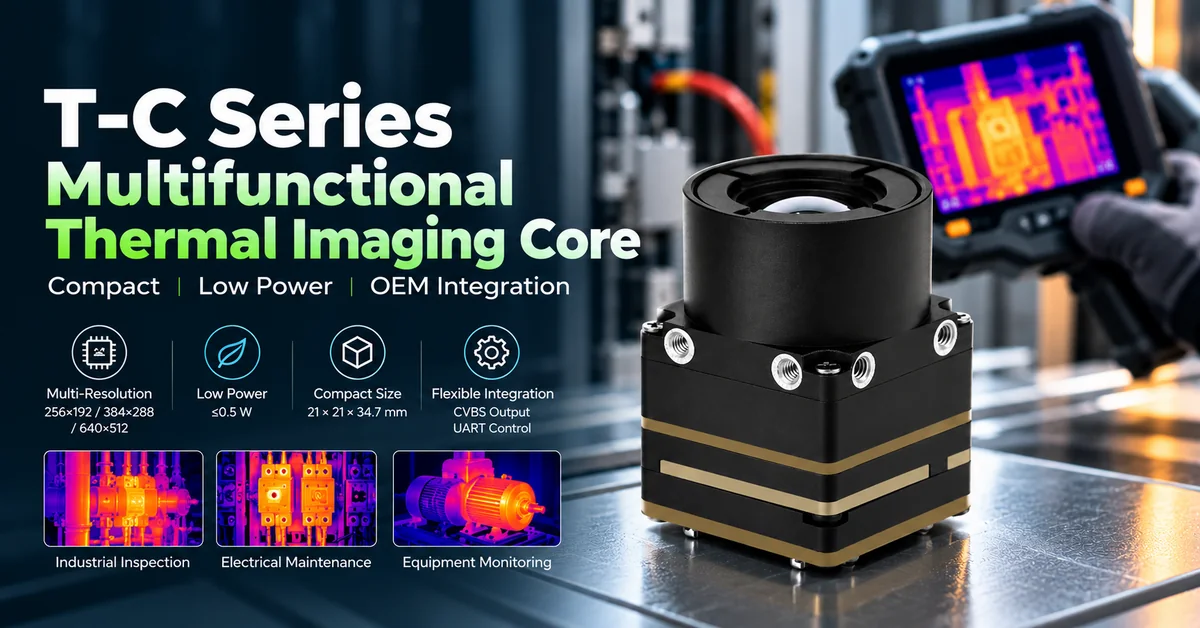
The T-C Series Multifunctional Thermal Imaging Core includes T-C2, T-C3, and T-C6 versions.
The series is advertised with compact dimensions, relatively low power consumption, CVBS output, and UART control.
For OEM teams with strict electrical or space budgets, T-C6 deserves consideration alongside T640-S and T640-I.
However, series-level figures should not replace a confirmed T-C6 datasheet or sample test.
A critical video-output question
All three published configurations above list CVBS video output.
Because CVBS is an analog video format, a 640×512 native detector does not by itself guarantee that the host receives 640×512 independent digital image samples.
If the application needs full-resolution digital thermal data, frame-by-frame machine vision analysis, or calibrated temperature values, ask EAGLET to confirm the available output capabilities for the exact model and revision.
7. Which Applications Benefit Most From Higher Thermal Resolution?
Higher resolution creates the greatest value when spatial detail directly improves the intended task.
| Application | Why additional resolution may help | Priority requirement |
|---|---|---|
| Industrial equipment inspection | More target detail or broader equipment coverage | Lens, target size, viewing distance |
| Inspection robotics | Additional image samples for navigation or visual analysis | Mechanical layout and host compatibility |
| Embedded machine vision | More spatial information for downstream algorithms | Verified image data output |
| Professional observation devices | Better target representation at a suitable FOV | Optical quality and thermal contrast |
| Thermal camera OEM products | Enables a more detailed native imaging configuration | Product differentiation and system cost |
For factory and machinery applications, see EAGLET's industrial inspection solution.
For robotics and machine vision, the value depends on how the host processing system uses the thermal information. A greater number of native pixels can support more detailed input, but does not independently establish better algorithm accuracy.
A low-light or nighttime monitoring application also needs suitable environmental testing. Rain, humidity, fog, thermal background conditions, and optical obstructions can still affect performance.
8. How to Validate Image Quality and Manufacturing Consistency
A professional high resolution thermal camera should be evaluated through a repeatable verification process.
For OEM purchasing, the following checks are more useful than comparing attractive demonstration images alone.
First, verify native resolution and the output path. Confirm the detector format, video output, and whether the required host interface preserves the information needed by the application.
Second, test target visibility. Use targets at representative distances and compare image detail with the intended lens and installation geometry.
Third, evaluate thermal sensitivity. Compare results under controlled conditions and inspect noise, image uniformity, and any correction-related artifacts.
Fourth, review optical and mechanical assembly quality. Check focus, alignment, mounting, connector integrity, and repeatability between samples.
Fifth, test the finished device in its intended environment. Validate supply-voltage behavior, thermal stability, vibration tolerance, and enclosure requirements.
For machine-condition applications, ISO 18434-1:2008 — Condition Monitoring and Diagnostics of Machines — Thermography — Part 1: General Procedures provides relevant guidance on inspection planning, interpretation, and measurement-related factors.
The existence of this standard does not mean a particular EAGLET core is certified to it.
A supplier qualification review should also request documented inspection criteria, the latest technical revision, applicable compliance evidence, and a clear procedure for handling nonconforming units.
9. When Is a 640×512 Upgrade Worth the Additional Cost?
The cost of an OEM thermal camera includes more than the detector or core.
Depending on the system, additional costs may involve optics, custom mounting, interface electronics, image acquisition, processing hardware, environmental protection, testing, and manufacturing setup.
The decision can be organized into three possible outcomes.
| Project requirement | Recommended evaluation |
|---|---|
| Existing resolution already provides adequate target pixels | Retain the lower-resolution candidate unless other advantages justify upgrading |
| Target detail is insufficient at the required scene coverage | Evaluate 640×512 with matched optics |
| High-resolution data cannot be fully used by the host | Resolve output and processing limitations before upgrading |
A high-resolution upgrade can be commercially attractive when it supports a demonstrable product benefit, such as more useful scene detail, an improved inspection workflow, or a differentiated OEM product specification.
But greater native resolution is not automatically a lower-cost solution.
Before calculating project economics, ask suppliers for model-specific quotations covering sample quantities, optical options, customization work, expected annual volume, MOQ, and delivery schedules.
Do not assume that T640-S, T640-I, and T-C6 share identical prices, minimum orders, or supply conditions.
10. OEM/ODM Integration: From 640×512 Core to Finished Equipment
For an OEM manufacturer, successful integration requires alignment between imaging performance and the complete product architecture.
EAGLET provides thermal imaging modules and discusses customized infrared vision solutions for equipment manufacturers and system integrators.
A practical development sequence includes:
-
Application definition: Identify the target, working distance, thermal conditions, and required system output.
-
Optical selection: Establish FOV, target pixel requirements, and lens specifications.
-
Core selection: Compare T640-S, T640-I, or T-C6 based on confirmed technical information.
-
Host interface validation: Test video acquisition, control, power, and data-processing requirements.
-
Mechanical integration: Check the installation space, mounting, optics, and thermal management.
-
Sample verification: Compare the prototype against agreed image and environmental acceptance criteria.
-
Production approval: Confirm the exact product revision, quality documentation, commercial terms, and approved configuration.
EAGLET's product and integration support allows customers to discuss model selection and request documentation for specific product versions.
Customization feasibility, minimum quantities, development charges, and project schedules should be confirmed individually.
11. What Should an OEM Buyer Include in a High-Resolution Thermal Camera RFQ?
A detailed request for quotation helps the supplier recommend an appropriate solution without making assumptions about the application.
Include the following information:
| RFQ field | Required information |
|---|---|
| Application | Industrial inspection, robotics, embedded vision, or other |
| Target dimensions | Smallest critical object or thermal feature |
| Working distance | Minimum and maximum observation distance |
| Scene coverage | Required horizontal and vertical field coverage |
| Resolution target | 384×288 or 640×512, if already defined |
| Imaging output | Video format, full-resolution data, or calibrated temperature data |
| Electrical requirements | Supply voltage, maximum power budget |
| Mechanical restrictions | Space, weight, mounting and enclosure |
| Operating environment | Temperature, vibration, humidity, dust |
| Commercial requirements | Sample quantity, forecast volume, project timeline |
Planning a 640×512 thermal imaging product?
EAGLET offers high-resolution thermal imaging core options for OEM integration evaluation.
Contact EAGLET for a technical review and quotation with your application, required viewing geometry, available power, host interface, and estimated purchasing quantity.
A technical requirements discussion can help determine whether T640-S, T640-I, or T-C6 is an appropriate starting point.
12. Frequently Asked Questions About High Resolution Thermal Cameras
1. Is 640×512 considered high resolution for a thermal camera?
Yes. 640×512 is a widely used professional infrared detector resolution and provides 327,680 native thermal pixels. Higher-resolution thermal sensors also exist, so the designation is relative to the product category.
2. Is 640×512 better than 384×288 for industrial inspection?
It can provide more spatial detail at a comparable field of view. Whether that improves the inspection depends on target dimensions, distance, thermal contrast, optics, and the required output.
3. Does higher thermal resolution improve temperature accuracy?
Not automatically. Spatial resolution and absolute temperature measurement accuracy are different properties. Radiometric calibration and measurement conditions must be evaluated separately.
4. Can a 640×512 thermal camera detect objects farther away?
Potentially, if the optics, target size, thermal contrast, and image-processing chain support the required performance. Resolution alone cannot establish a guaranteed detection distance.
5. What is the difference between native resolution and digital upscaling?
Native resolution represents samples acquired by the infrared detector. Digital upscaling enlarges or reconstructs an image mathematically and does not create additional independently measured detector pixels.
6. What is the difference between EAGLET T640-S and T640-I?
Both list 640×512 VOx thermal detectors, 50 fps imaging, and CVBS output. The most relevant published distinction is their mechanical configuration: T640-S specifies separate optical and controller assemblies, while T640-I uses an integrated structure.
7. Can a high-resolution thermal core connect directly to an industrial computer?
Only if the computer supports the module's actual output and control requirements. EAGLET's listed 640×512 cores specify CVBS video, so an appropriate acquisition path may be required.
8. Is higher resolution always necessary for robotics?
No. Robotics projects must balance target detail with power, weight, host processing, latency, and mechanical design. A lower-resolution core may be sufficient for some sensing tasks.
9. What should buyers verify before placing a volume order?
Confirm the exact model revision, optical parameters, electrical interface, usable image output, environmental requirements, sample acceptance criteria, quality documentation, and commercial conditions.
10. How can OEM buyers obtain a high resolution thermal camera quotation?
Provide the intended application, resolution requirements, target size, observation distance, lens and interface needs, available power, operating conditions, and projected order volume. EAGLET can use this information to discuss suitable core options and a quotation.
Conclusion
A high resolution thermal camera should be selected according to the image information the final equipment actually needs—not simply the largest available pixel count.
For OEM manufacturers, 640×512 thermal imaging can offer meaningful benefits in target detail, scene coverage, and embedded vision applications. However, those advantages depend on lens matching, sensor performance, usable output resolution, host integration, and real-world validation.
EAGLET's T640-S, T640-I, and T-C6 provide different starting points for evaluating 640×512 uncooled LWIR thermal imaging within an OEM architecture.
The most effective purchasing process is to define the target, calculate the required pixel coverage, verify optical and electrical compatibility, test representative samples, and confirm production requirements before committing to a design.
Ready to evaluate a 640×512 thermal imaging solution for your equipment? Contact EAGLET to discuss your application requirements, compare suitable core configurations, and request a project-specific technical quotation.