
How Do You Choose the Right Thermal Camera Manufacturer?
Choosing a thermal camera manufacturer for an industrial or OEM project requires evaluating more than detector resolution, image appearance, or the lowest quotation. A suitable manufacturing partner should provide the imaging hardware, technical documentation, integration support, quality verification, and long-term product consistency needed for your application.
For B2B buyers, the most important question is not simply, "Which manufacturer offers the best thermal camera?" It is "Which supplier can deliver an imaging solution that works reliably within our actual product, operating environment, and commercial requirements?"
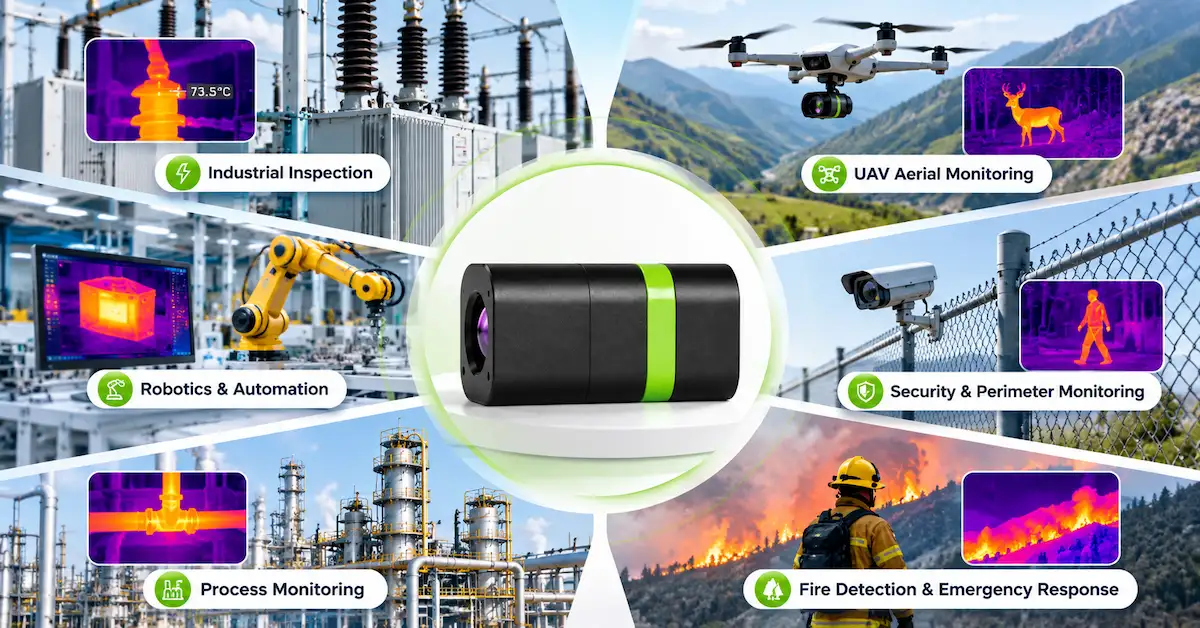
A thermal imaging system designed for industrial equipment inspection may have completely different requirements from one intended for drone integration, perimeter monitoring, or embedded robotic vision.
An industrial inspection system may prioritize thermal sensitivity, repeatable measurements, and compatibility with monitoring software. A drone manufacturer may prioritize weight, power consumption, imaging latency, and payload dimensions. A security integrator may need appropriate optics, nighttime target visibility, and dependable operation under changing outdoor conditions.
These differences affect nearly every purchasing decision, from detector selection and optical configuration to electronic interfaces, environmental testing, and production planning.
This guide explains how to evaluate thermal camera manufacturers, understand essential infrared imaging specifications, compare OEM-ready thermal imaging cores, assess manufacturing capabilities, and prepare an effective request for quotation (RFQ).
It also examines practical options within the EAGLET thermal imaging product portfolio, helping engineering and procurement teams identify a suitable starting point for their projects.
1. What Does a Thermal Camera Manufacturer Actually Provide?
Not every thermal camera supplier offers the same engineering capabilities, manufacturing responsibilities, or product scope.
Some companies specialize in finished handheld thermal cameras. Others manufacture infrared detectors, supply OEM thermal imaging cores, assemble imaging modules, or develop application-specific systems.
Understanding these differences prevents buyers from selecting a supplier whose product portfolio does not match their intended project.
Finished Thermal Camera Manufacturers
These suppliers focus on complete thermal imaging devices with integrated optics, processing electronics, displays, housings, and user interfaces.
Typical products include handheld inspection cameras, fixed thermal monitoring devices, and portable observation systems.
They are generally suitable for organizations that need ready-to-operate equipment rather than components for incorporation into their own products.
However, purchasing a finished camera may offer less flexibility when a customer needs a custom housing, proprietary software integration, unusual mounting geometry, or a specific embedded interface.
Thermal Imaging Core and Module Manufacturers
Thermal imaging core suppliers focus on the components responsible for infrared image capture and processing.
A typical module integrates an infrared detector, imaging electronics, optical components, and supporting interfaces.
Manufacturers developing their own thermal equipment can integrate these components into proprietary products.
This approach is particularly relevant to:
-
Thermal camera OEM brands
-
Industrial inspection equipment manufacturers
-
UAV payload developers
-
Robotics and automation companies
-
Security equipment manufacturers
-
Specialized optical system integrators
For these buyers, the thermal imaging core is not necessarily the final product. It is the technical foundation of a larger system.
Customized Thermal Vision Solution Providers
Some companies connect thermal sensing, image processing, electronics, optics, and system integration into customized solutions.
Customization may involve selecting a different detector resolution, adapting the optical configuration, adjusting electronic connections, or integrating thermal imaging with other sensing technologies.
EAGLET focuses on infrared thermal imaging cores, embedded imaging hardware, and intelligent vision integration.
According to its company profile, its technical direction spans infrared sensing, image processing, image transmission, multispectral observation, and customized vision solutions.
For OEM manufacturers and system integrators, this integration-oriented approach is especially relevant when standard off-the-shelf products do not fully satisfy the project's requirements.
Buying recommendation: Before requesting a quotation, establish whether your project requires a complete thermal camera, an embedded imaging module, or a customized optical system. This decision determines which manufacturing capabilities and technical documents you should evaluate.
2. Start With Application Requirements, Not Product Specifications
One of the most expensive procurement mistakes is selecting a thermal camera based on its advertised specifications before defining the application.
A camera that performs well in a product demonstration may deliver insufficient target detail, require unexpected interface changes, or consume too much power once integrated into the final equipment.
A professional supplier evaluation should begin with an application requirements document.
Identify the Target and Imaging Task
Start by defining what the system must detect, display, or measure.
For example:
-
Does an industrial inspection device need to identify unusual heat patterns?
-
Does a security camera need to detect the presence of people or vehicles at night?
-
Does a UAV payload need to observe equipment from a particular altitude?
-
Does a robotic system need real-time thermal images for navigation or inspection?
-
Does an electrical monitoring system need calibrated temperature measurements?
These tasks are not interchangeable.
Thermal detection, target recognition, and quantitative temperature measurement are different capabilities. A camera suitable for one task may not meet the requirements of another.
Define the Working Conditions
Next, establish the intended installation and operating environment.
| Project requirement | Questions buyers should answer | Purchasing impact |
|---|---|---|
| Detection target | What object, component, or heat source must be observed? | Determines required image detail |
| Working distance | How far is the camera from the target? | Influences lens and resolution selection |
| Field of view | How much area must be visible? | Affects optical configuration |
| Operating environment | Indoor, outdoor, mobile, or industrial? | Determines environmental validation |
| Motion | Is the camera or target moving? | Influences frame rate and latency requirements |
| Installation space | What dimensions are available? | Determines mechanical compatibility |
| Power supply | What voltage and power budget are available? | Affects electronics integration |
| Video interface | What input does the host system support? | Determines signal compatibility |
| Temperature measurement | Are calibrated temperature readings required? | Determines radiometric requirements |
| Expected quantity | Prototype, pilot production, or recurring volume? | Influences commercial planning |
The output should be a measurable technical specification, not a collection of general preferences.
For example, "high-resolution thermal camera" is too vague for effective sourcing.
A more useful requirement would identify the intended target, observation distance, installation dimensions, host electronics, available power, required image output, and operating conditions.
The more accurately these inputs are defined, the more effectively a manufacturer can recommend a suitable thermal imaging architecture.
3. Seven Thermal Imaging Specifications Every OEM Buyer Should Understand
Technical specifications should be evaluated as an interconnected system rather than isolated performance claims.
The following parameters have the greatest influence on imaging performance, integration complexity, and purchasing decisions.
3.1 Infrared Detector Resolution
Infrared resolution describes the number of detector pixels available to capture thermal information.
Common uncooled thermal imaging resolutions include:
| Infrared resolution | Detector pixels | General selection considerations |
|---|---|---|
| 256 × 192 | 49,152 | Compact embedded systems and cost-sensitive designs |
| 384 × 288 | 110,592 | Intermediate detail and integration requirements |
| 640 × 512 | 327,680 | Applications requiring greater potential image detail |
A higher detector resolution provides more pixels for representing thermal information.
However, higher resolution does not automatically guarantee better target detection or recognition.
Actual performance depends on the relationship between resolution, optical field of view, target size, distance, focus, atmospheric conditions, and thermal contrast.
For example, a 640 × 512 detector with a very wide-angle lens may provide less target detail at a specific distance than expected. Conversely, a lower-resolution sensor paired with appropriately selected optics may perform adequately in a narrower observation area.
OEM buyers should therefore evaluate resolution together with the complete optical design.
3.2 NETD and Thermal Sensitivity
NETD stands for Noise Equivalent Temperature Difference.
It indicates the detector system's ability to distinguish small temperature differences under specified measurement conditions.
A lower NETD generally indicates better thermal sensitivity when specifications are measured under comparable conditions.
This can be valuable when observing objects with limited thermal contrast relative to their surroundings.
For example, a manufacturer may publish NETD values of 35 mK or 50 mK for different thermal imaging modules.
However, such values should not be compared without examining their test conditions.
Important factors include detector operating conditions, optical aperture, integration settings, image processing, and the temperature at which the measurement was performed.
A lower NETD is not necessarily evidence of a better overall camera, particularly when the compared products have different lenses or processing configurations.
Critical distinction: NETD measures thermal sensitivity, not absolute temperature measurement accuracy.
If a project requires quantitative temperature monitoring, request separate documentation for the radiometric measurement function, calibration procedure, measurement range, and accuracy.
3.3 Lens Focal Length and Field of View
Lens selection directly affects the area visible to the camera and the amount of detail captured from a distant target.
A wide field of view helps monitor larger areas at relatively short distances.
A narrower field of view can concentrate available detector pixels on a smaller angular region, potentially improving distant target detail.
Neither configuration is universally better.
Industrial equipment monitoring often requires the camera to observe multiple components from a constrained mounting location.
A security system may need to identify thermal activity across a perimeter.
A UAV camera may alternate between observing a large landscape and inspecting individual objects.
These applications impose different optical requirements.
Ask manufacturers to provide the lens focal length, horizontal and vertical field of view, supported focus range, and relevant optical drawings for the exact proposed configuration.
Where long-distance performance matters, request a task-specific detection or recognition evaluation rather than relying on one advertised maximum distance.
3.4 Pixel Pitch and Spatial Resolution
Pixel pitch describes the physical spacing between detector pixels, commonly expressed in micrometers.
For example, EAGLET's published thermal imaging core specifications include 12 μm pixel-pitch configurations.
Pixel pitch influences detector dimensions and the relationship between the sensor and optical system.
However, it does not independently determine image quality.
Spatial resolution also depends on the optical system and how many detector pixels represent the target.
The term IFOV, or Instantaneous Field of View, describes the angular portion of a scene associated with an individual detector pixel.
For practical procurement, buyers should verify whether the target occupies enough pixels to support the intended task.
A thermal object occupying only a few pixels may be detectable without providing sufficient detail for reliable classification.
This distinction is especially important in UAV and perimeter security projects.
3.5 Frame Rate and Image Latency
Frame rate describes how frequently the imaging system updates its image output.
A higher frame rate can improve the presentation of moving targets and support applications involving moving platforms.
Some professional thermal modules offer 50 fps operation, making them relevant to UAV, robotics, and real-time observation applications.
However, image update frequency is only one part of system responsiveness.
Imaging latency and end-to-end video latency are not the same measurement.
A complete video chain may include:
-
Infrared image acquisition
-
Image processing
-
Video signal conversion
-
Encoding
-
Wired or wireless transmission
-
Decoding
-
Display rendering
Each stage can add delay.
A supplier's published imaging latency should therefore not be treated as the guaranteed end-to-end latency of an entire drone or remote monitoring system.
For time-sensitive applications, request a system-level latency test using the intended hardware and communication architecture.
3.6 Power Consumption and Electrical Compatibility
Electrical requirements are particularly important in battery-powered, embedded, and unmanned applications.
Lower power consumption may support longer operation or reduce the thermal load inside an enclosure.
However, published operating power is not always the same as peak startup demand.
Buyers should ask about:
-
Nominal input voltage
-
Acceptable voltage variation
-
Typical operating power
-
Startup current
-
Power sequencing requirements
-
Connector design
-
Electrical protection requirements
If a module will operate inside a compact enclosure, its heat dissipation characteristics should also be evaluated.
A low-power module can still face thermal management challenges when installed near motors, processors, batteries, or other heat-producing components.
3.7 Video Output and Control Interfaces
Interface compatibility is often overlooked during initial supplier selection.
A thermal imaging module may produce useful images but still be unsuitable for the host system if its output format cannot be accepted directly.
For example, CVBS is an analog composite video interface. It should not be confused with native digital video output.
A module using a 640 × 512 infrared detector may still provide an analog CVBS output.
This means infrared detector resolution and delivered video signal format must be evaluated separately.
For embedded applications, check both video and control interfaces.
A UART connection, for example, may provide control functions on supported modules, but the available commands must be confirmed using the corresponding technical documentation.
If your product requires digital image data, Ethernet, USB, MIPI, or other specialized interfaces, confirm that the selected product actually supports the required signal or that an approved conversion architecture is available.
Never assume that all interfaces are interchangeable.
4. Thermal Camera Manufacturer Comparison: How to Evaluate Real Product Options
A reliable manufacturer's product portfolio should make it possible to compare relevant imaging configurations using model-specific specifications.
EAGLET currently provides published information for several uncooled infrared imaging cores.
These products offer useful starting points for OEM engineers evaluating different resolutions and embedded hardware requirements.
EAGLET Thermal Imaging Core Comparison
| Product | Infrared resolution | Published NETD | Published power consumption | Input voltage |
|---|---|---|---|---|
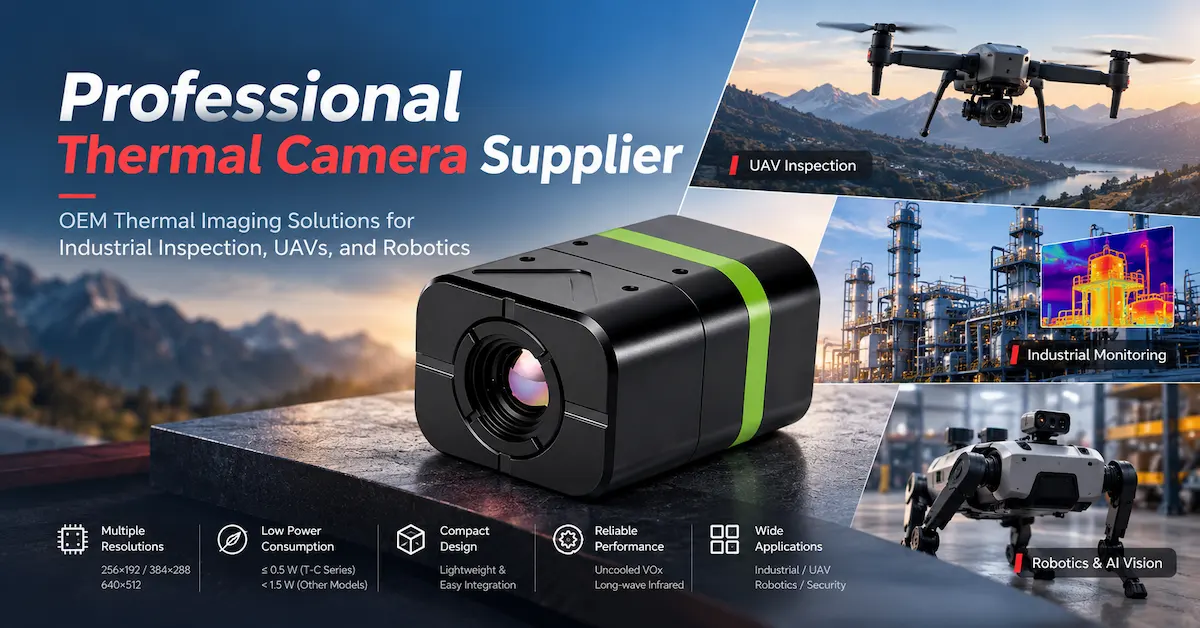
| T-C Series | 256×192 / 384×288 / 640×512 | ≤35 mK | ≤0.5 W | 4.5–18V |
| T256-S | 256×192 | ≤50 mK | <1.5 W | 9–24 V |
| T384-I | 384×288 | ≤50 mK | <1.5 W | 9–24 V |
| T640-S | 640×512 | ≤50 mK | <1.5 W | 9–24 V |
| T640-I | 640×512 | ≤50 mK | <1.5 W | 9–24 V |
Source: EAGLET's published product specifications. NETD values and power figures should be confirmed for the exact configuration, revision, and test conditions. The comparison is intended for preliminary product screening, not final system qualification.
T-C Series: Flexible Resolution and Low-Power Integration
The T-C Series provides multiple detector resolution configurations within a compact imaging-core product family.
Its published specifications include uncooled VOx technology, 8–14 μm spectral response, 12 μm pixel pitch, and CVBS video output with a UART control interface.
The series is particularly relevant when low power consumption and embedded integration are important design considerations.
A manufacturer developing compact thermal equipment may investigate this series before selecting an optical configuration.
Nevertheless, electrical requirements, actual module dimensions, and performance should be confirmed for the selected variant.
T256-S: Compact Thermal Imaging for Embedded Applications
The T256-S features a 256 × 192 uncooled infrared detector and a published 50 fps frame rate.
It is a potential starting point for portable observation devices, compact robotic systems, and UAV-related imaging designs.
For applications where the target occupies a relatively large portion of the scene, this resolution may provide an appropriate balance between system requirements and cost considerations.
However, buyers should validate the field of view and target pixel coverage rather than selecting this module solely because of its smaller resolution.
T384-I: Intermediate-Resolution OEM Development
The T384-I uses a 384 × 288 detector and is positioned for applications such as industrial inspection, robotics, and security.
For some designs, this intermediate resolution may offer a practical alternative between compact entry-level cores and more detailed 640 × 512 systems.
The suitability of the module depends on application requirements, available installation space, optical configuration, and electrical architecture.
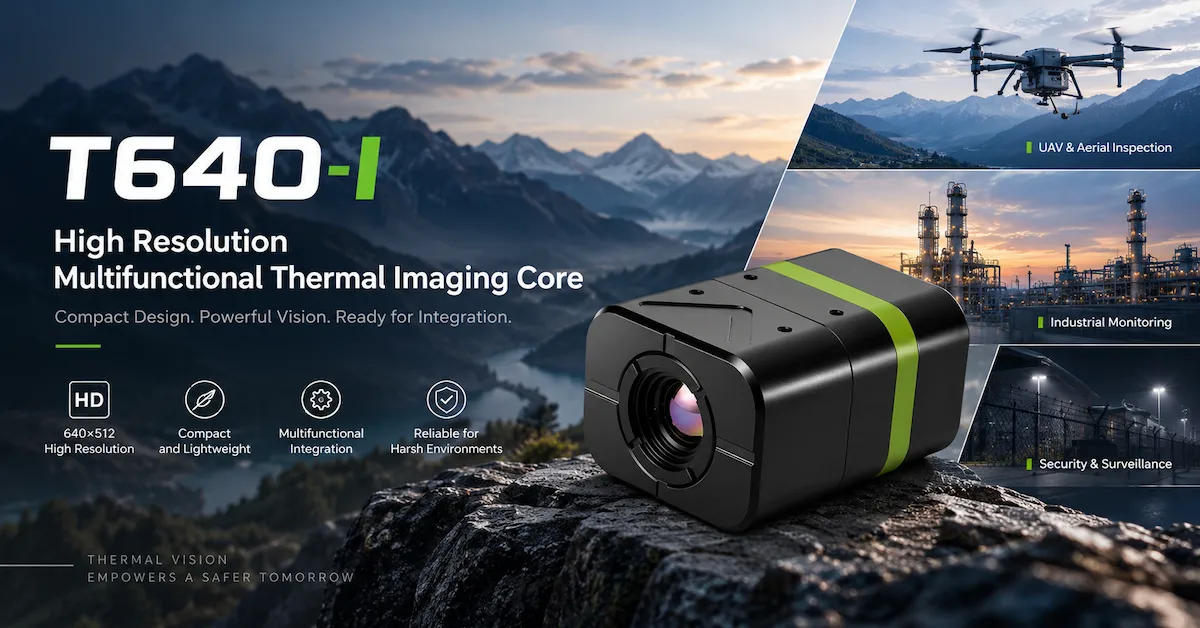
T640-S and T640-I: Higher-Resolution Imaging Options
The T640-S and T640-I use 640 × 512 infrared detectors.
These configurations may be relevant where target detail is particularly important.
The T640-S publishes separate dimensions for its lens module and main controller, making its architecture worth evaluating for projects with specific internal layout constraints.
The T640-I publishes a compact integrated form factor and a weight of 63 g.
Although both use the same detector resolution class, they should not be treated as mechanically or functionally identical.
A final comparison should include drawings, optical data, electrical interfaces, mounting requirements, and tested performance.
Procurement takeaway: Use published model information to shortlist candidates, then verify the exact configuration before committing to production. A resolution comparison alone cannot establish which core is suitable for a particular system.
5. Choosing a Thermal Camera Manufacturer for Different Applications
Thermal camera sourcing requirements change substantially across industries.
A supplier that understands these differences can help buyers identify the appropriate engineering questions earlier in the project.
Industrial Equipment Inspection and Predictive Maintenance
Industrial thermal imaging is commonly associated with electrical equipment inspection, machinery condition monitoring, and identifying abnormal heat patterns.
Potential applications include monitoring electrical connections, power distribution components, rotating machinery, and industrial equipment.
However, the ability to observe a thermal anomaly does not automatically establish its severity or the underlying failure mechanism.
A reliable inspection solution must account for operating load, target surface properties, ambient conditions, and the inspection procedure.
For quantitative thermography, factors such as emissivity, reflected apparent temperature, and intervening media affect temperature interpretation.
ISO 18434-1:2008, Condition Monitoring and Diagnostics of Machines — Thermography — Part 1: General Procedures, provides relevant guidance on the application of infrared thermography to machinery condition monitoring.
Buyers should evaluate whether the camera system is intended for visual thermal anomaly detection or calibrated temperature measurement.
For more information about application requirements, explore EAGLET's industrial inspection solutions.
EV Charging and New Energy Equipment
Thermal imaging can support inspection workflows involving charging connectors, power cabinets, electrical connections, and other energy infrastructure.
Abnormal heating may provide useful information about equipment condition.
However, a visually apparent hot area is not necessarily a calibrated temperature measurement.
For an embedded monitoring project, manufacturers and system integrators should define:
-
The intended observation area
-
Relevant operating loads
-
Thermal event or alarm criteria
-
Sensor positioning
-
Required image or temperature data
-
Integration with the host monitoring system
-
Environmental and electrical requirements
Where automatic warning thresholds are required, the system must be evaluated using appropriate radiometric capabilities and validated application logic.
EAGLET describes this market within its new energy and EV charging solutions.
Security Surveillance and Night Patrol
Conventional visible-light cameras depend on available illumination or supplementary lighting.
Thermal imaging provides a different form of scene information based on infrared radiation.
This makes thermal imaging valuable for applications that require observation in darkness or changing lighting conditions.
However, darkness and adverse weather are different challenges.
Thermal cameras do not require visible illumination, but heavy rain, dense fog, environmental attenuation, and low target-to-background thermal contrast can reduce effective observation performance.
Buyers should evaluate the intended detection task, observation distance, lens characteristics, and installation geometry.
For systems requiring both visible-light identification and thermal detection, a multisensor architecture may offer complementary information.
EAGLET discusses these requirements in its security and night patrol solutions.
UAV and Drone Thermal Imaging
Drone thermal imaging introduces additional constraints that stationary applications may not encounter.
Aircraft payload capacity, available power, mounting arrangements, vibration, and data transmission all influence system performance.
A drone manufacturer should evaluate the total imaging payload rather than focusing only on the infrared detector.
The assessment may need to include the thermal core, optics, mounting hardware, stabilization components, electronics, enclosure, and communication system.
For airborne use, target pixel coverage must be evaluated at the actual working altitude and observation angle.
The appropriate thermal resolution depends on the mission, not simply the aircraft size.
A compact module may work well for general thermal awareness, while more demanding inspection tasks may need greater image detail or a different lens configuration.
Video transmission is another consideration.
The effective latency experienced by a remote operator depends on the entire imaging and communication chain.
Explore EAGLET's UAV and low-altitude system solutions for relevant integration directions.
Robotics and Automated Inspection
Mobile robots may use thermal imaging to supplement their existing sensor systems.
Examples include indoor equipment inspection, remote visual assessment, and observation in environments with limited illumination.
Integration requirements typically involve power distribution, mechanical mounting, control communication, and video processing.
Developers should also consider the thermal influence of nearby motors, processors, and batteries.
A sensor installed close to a heat-producing component may experience a different operating environment from the same sensor tested independently on a laboratory bench.
Mechanical vibration and electromagnetic interference can also influence overall system performance.
For robotics manufacturers, a supplier's integration documentation may be as important as the detector specification.
Search and Rescue and Outdoor Observation
Thermal imaging can help operators identify thermal contrast during nighttime searches or in difficult terrain.
However, finding a heat signature does not guarantee that the system can correctly identify the object or person responsible for it.
Search performance depends on target exposure, terrain, environmental attenuation, thermal contrast, distance, and operator interpretation.
Outdoor applications may also require weatherproof enclosures, suitable optical windows, stable mounting, and dependable field power systems.
These capabilities must be validated at the complete equipment level.
For related application directions, see EAGLET's search and rescue and outdoor observation pages.
6. Why OEM and ODM Integration Support Matters
For OEM customers, purchasing a thermal imaging core is only one stage of product development.
The core must operate successfully within the final system.
This may involve electronic design, mechanical integration, optical configuration, software control, manufacturing coordination, and product validation.
A suitable supplier should be able to clarify its actual responsibility at each stage.
Hardware and Electrical Integration
The supplier should provide accurate information about input voltage, power consumption, connector arrangement, control interfaces, and supported video formats.
Engineers need this information to determine whether the thermal module can connect to the intended host platform.
Incompatibilities discovered late in development can require circuit changes, additional converters, new mechanical layouts, or software modifications.
Optical and Mechanical Integration
The module must fit the mechanical design without introducing optical obstruction, excessive vibration, or unsuitable thermal conditions.
Relevant documents may include product dimensions, mounting locations, lens geometry, connector placement, and optical alignment requirements.
The availability of such documents should be confirmed for the selected product version.
Software and Image Processing
Image processing influences how thermal information is displayed and interpreted.
Depending on the product, relevant functions may include non-uniformity correction, image enhancement, palette selection, digital zoom, or supported control commands.
Buyers should request the actual command documentation and supported functions rather than assuming these capabilities are available on every thermal imaging module.
The required output also matters.
A project that needs raw radiometric data has different software requirements from one that only needs to display a thermal image.
Standard Modules Versus Customized Solutions
A standard module may reduce initial engineering complexity when its specifications already satisfy the application.
Customization becomes relevant when the available mechanical envelope, optics, electronic interfaces, or application requirements cannot be met by standard configurations.
However, customization can introduce additional development cost, validation requirements, and production dependencies.
Before beginning an OEM/ODM project, clarify the scope of modifications, engineering deliverables, prototype approval process, and responsibilities for maintaining the final design.
EAGLET's product and integration support page provides a starting point for requests involving technical documentation and exact product revisions.
7. What Manufacturing and Quality Control Capabilities Should Buyers Verify?
A thermal camera manufacturer should be evaluated not only by the performance of one demonstration sample but also by its ability to provide consistent products.
For professional OEM customers, manufacturing consistency can influence the reliability of the entire finished device.
A camera that works in an early prototype may still create commercial problems if later batches show differences in image performance, interface behavior, or mechanical characteristics.
Component and Configuration Traceability
Ask how the supplier manages component revisions and approved product configurations.
Relevant questions include whether detector types, optics, electronic assemblies, and firmware versions can change during the product lifecycle.
A controlled revision process helps engineering teams understand the effect of product changes on their own equipment.
Production Inspection and Testing
Quality control should be appropriate to the imaging product and its intended application.
Potential inspection categories include:
| Quality control area | What should be evaluated |
|---|---|
| Visual and mechanical inspection | Assembly condition, dimensions, connectors, mounting |
| Electrical testing | Supply compatibility, power behavior, startup |
| Imaging performance | Image stability, detector response, image defects |
| Interface verification | Video output, control communication |
| Optical inspection | Focus and field performance |
| Environmental testing | Performance under specified operating conditions |
| Firmware control | Approved version and configuration consistency |
| Final acceptance | Agreed inspection results and release criteria |
These are recommended supplier-evaluation categories, not claims that every manufacturer performs an identical test sequence.
A buyer should request evidence of the tests relevant to the product and project.
Factory Audit and Certification Verification
If a project requires a certified quality management system, request the certificate and confirm its validity, issuing body, legal entity, and scope.
For example, ISO 9001 may be relevant to quality management system evaluation.
However, an ISO 9001 certificate does not independently establish the imaging performance of a specific thermal camera.
Likewise, product-level environmental protection or electromagnetic compatibility must be evaluated using the standards and test evidence relevant to the complete equipment.
Do not assume that a board-level thermal module automatically has the same ingress protection or EMC performance as the final enclosed product.
Supplier selection principle: Require documentary evidence for any certification, performance claim, or manufacturing capability that affects your project's acceptance criteria.
8. How to Validate Thermal Camera Samples Before Bulk Purchasing
A sample is useful only when it is tested against measurable requirements.
Simply powering on a thermal module and observing a clear image is not enough to establish suitability for industrial production.
A structured sample evaluation should include the following stages.
Step 1: Confirm the Exact Sample Configuration
Record the product model, hardware revision, firmware version, lens, and supplied accessories.
A sample should correspond to the configuration that the supplier intends to deliver during production.
Step 2: Verify Electrical Requirements
Measure actual operating behavior with the intended power supply.
Include startup conditions and operating modes relevant to the application.
For battery-powered products, power behavior should be evaluated in the complete system.
Step 3: Confirm Interface Compatibility
Connect the module to the intended host electronics.
Verify that the video output, control commands, and signal conversion arrangements operate correctly.
Any required additional hardware should be included in the final bill of materials.
Step 4: Evaluate Imaging Performance
Test the product against representative targets at realistic working distances.
Use the intended optical configuration and operating conditions.
Evaluate image detail, thermal contrast, stability, and the required observation task.
Where quantitative temperature measurements are necessary, use an appropriate calibrated evaluation method.
Step 5: Assess Environmental and Mechanical Behavior
Test performance under expected operating conditions, including relevant thermal, vibration, and installation constraints.
The applicable test scope should reflect the project.
A stationary indoor module and an outdoor drone payload do not necessarily require identical qualification procedures.
Step 6: Evaluate Extended Operation
Where continuous operation is required, assess image stability, startup behavior, system temperatures, and any changes in performance over the intended operating period.
The acceptance duration should be defined by the project rather than assumed from generic marketing specifications.
Step 7: Approve the Production Reference
Once the sample satisfies the agreed requirements, record the approved configuration and acceptance criteria.
This reference can support subsequent production inspections and future engineering changes.
A professional sample approval process reduces uncertainty before purchasing larger quantities.
9. What Is the Real Cost of Buying from a Thermal Camera Manufacturer?
The lowest quoted camera or module price does not necessarily produce the lowest project cost.
For OEM manufacturers, purchasing decisions should consider the total cost of developing, integrating, validating, and maintaining the thermal imaging subsystem.
Initial Hardware Cost
The initial unit price may be influenced by detector resolution, optics, processing electronics, product architecture, and order quantity.
Different configurations should be compared using equivalent scope.
A quotation that excludes required lenses, interface boards, cables, or supporting components may appear less expensive than the complete solution.
Integration and Engineering Cost
Engineering costs can include electronic modifications, software adaptation, mechanical redesign, optical alignment, and debugging.
If a module requires an additional video conversion board or custom controller, this should be accounted for in the total project budget.
Prototype and Validation Cost
Prototype testing requires engineering time and, depending on the application, specialized fixtures or test equipment.
If samples fail to satisfy essential requirements, the resulting redesign can affect both budget and launch schedule.
Manufacturing and Supply Risk
Future cost is influenced by product availability, component changes, configuration management, and the need for repeat qualification.
A lower unit price may be less attractive if product revisions are poorly documented or technical support is insufficient.
Commercial Cost Comparison
| Cost category | Questions to ask |
|---|---|
| Unit price | What exact configuration is included? |
| Optical accessories | Are lenses and mounting parts included? |
| Development cost | Is customization or engineering work charged separately? |
| Sample cost | What is included in prototype supply? |
| Testing | Which tests are covered by the quotation? |
| Documentation | Are required integration documents available? |
| Logistics | What delivery terms apply? |
| Warranty and support | What responsibilities and conditions are agreed? |
| Lifecycle | How are revisions and supply changes communicated? |
A well-prepared RFQ should define these elements before competing quotations are compared.
10. How to Evaluate a Thermal Camera Manufacturer's Long-Term Reliability
Thermal imaging products may remain embedded in industrial equipment for years.
Consequently, supplier evaluation should extend beyond initial availability.
Product Lifecycle Management
Ask whether the selected model has an established lifecycle policy.
The buyer should understand how the supplier handles firmware changes, component substitution, product discontinuation, and technical document updates.
These issues matter when a small initial project grows into recurring production.
Engineering Communication
Communication quality is an important indicator of supplier suitability.
A supplier should be able to discuss precise technical requirements, acknowledge limitations, and explain which specifications apply to the proposed model.
Responses that rely only on promotional statements may not provide enough information for engineering decisions.
Production and Delivery Planning
Order quantities, production schedules, inventory arrangements, and lead times should be agreed for the actual commercial project.
Avoid assuming that a supplier can guarantee a particular delivery time without confirming the product configuration, manufacturing schedule, and purchasing conditions.
After-Sales Technical Support
For embedded products, technical support can involve documentation, firmware questions, troubleshooting, or evaluation of a product revision.
The buyer should identify how technical inquiries are handled and what support commitments are included in the purchasing agreement.
Long-term purchasing value depends on consistent hardware, clear engineering communication, and manageable integration risk—not simply the cost of the first sample.
11. Thermal Camera Manufacturer Evaluation Scorecard
When comparing multiple suppliers, a weighted evaluation matrix can make purchasing decisions more transparent.
The following example is intended for professional OEM sourcing teams.
| Evaluation category | Suggested weight | Assessment criteria |
|---|---|---|
| Imaging performance and suitability | 25% | Resolution, NETD, optical requirements, application fit |
| Integration capability and documentation | 25% | Electrical interfaces, control information, mechanical compatibility |
| Quality and production consistency | 20% | Testing evidence, configuration control, sample consistency |
| Commercial and supply conditions | 15% | Pricing scope, quantities, scheduling, commercial terms |
| Technical support and lifecycle | 15% | Engineering communication, revision support, documentation |
The weighting is an illustrative purchasing framework, not an industry certification or universal scoring standard.
Assign each supplier a score from 1 to 5 for each category, multiply by its weighting, and compare the weighted totals.
However, some requirements should remain mandatory regardless of the overall score.
For example, a supplier should not pass qualification if its module lacks a required interface or fails an essential operating condition.
A high commercial score cannot compensate for a critical technical incompatibility.
For safety-related or regulated applications, project-specific compliance requirements should also be treated as mandatory acceptance conditions.
12. Common Mistakes When Choosing an Infrared Thermal Camera Manufacturer
Several purchasing mistakes repeatedly create unnecessary engineering and commercial risk.
Comparing Only Resolution
Higher resolution can improve the amount of available image information, but image usability also depends on lens design, thermal contrast, target size, and processing.
A resolution specification cannot replace a target-based imaging test.
Assuming NETD Represents Measurement Accuracy
NETD indicates thermal sensitivity under specified conditions.
It does not establish the absolute accuracy of temperature readings.
Projects requiring quantitative thermography need separate measurement and calibration evidence.
Ignoring Video Interface Requirements
A sensor's infrared resolution does not determine the format of its output connector.
Confirm compatibility with the host electronics before committing to a module.
Treating Published Detection Distance as Universal
Detection performance depends on the target, optical system, background, atmospheric conditions, and criteria used to define detection.
Ask suppliers to explain the assumptions behind published distance figures.
Assuming All OEM Services Are Included
Customization scope varies by supplier and product.
Clarify whether the quotation includes standard configuration selection, electrical changes, mechanical adaptation, firmware work, or complete system development.
Skipping Representative Sample Testing
A laboratory demonstration is not equivalent to performance inside the final device.
Testing should reproduce important operating conditions before a production commitment is made.
Focusing Only on the Initial Quotation
A low module price can be offset by interface changes, integration problems, extra electronics, or additional qualification work.
Compare complete project cost, not just the base unit price.
Accepting Unsupported Supplier Claims
Factory capabilities, certifications, test results, and production promises should be supported by current evidence.
Professional procurement requires transparent technical and commercial documentation.
13. Why Consider EAGLET for OEM Thermal Imaging Projects?
EAGLET focuses on infrared thermal imaging products and intelligent vision systems intended for professional integration.
Its published product direction covers thermal imaging cores, image processing, image transmission, multispectral observation, and customized vision applications.
This makes EAGLET a relevant supplier to evaluate when the purchasing requirement involves embedded thermal imaging hardware rather than only a finished consumer camera.
A Product Range Supporting Different Integration Needs
EAGLET's current published core products include the T-C Series, T256-S, T384-I, T640-S, and T640-I.
These products cover multiple detector resolution classes and mechanical configurations.
For OEM customers, the portfolio provides starting points for evaluating compact imaging modules, intermediate-resolution systems, and higher-resolution designs.
The correct model still depends on the actual application, optical configuration, interfaces, and integration requirements.
Application-Oriented Engineering Direction
EAGLET identifies industrial inspection, new energy infrastructure, security, UAV systems, search and rescue, and outdoor observation as application areas.
Its integration-oriented approach connects imaging hardware with the intended operating environment.
This is relevant to project teams that need to discuss more than a single detector specification.
Technical Requirement Review
EAGLET's documented inquiry process begins with the intended application, integration requirements, and performance targets.
The team can then review the requirements and identify a potential product family or customization route.
For an OEM customer, this provides a practical starting point for technical discussions.
The exact engineering scope, product configuration, deliverables, and commercial terms should be confirmed during the inquiry process.
To learn more about the company's technology direction and integration focus, visit About EAGLET.
14. What Information Should You Include in a Thermal Camera RFQ?
An effective request for quotation allows suppliers to understand the technical requirement before discussing price.
For custom thermal camera projects, incomplete inquiries often lead to unclear proposals or quotations that cannot be compared fairly.
Use the following RFQ checklist.
| RFQ information | Recommended details |
|---|---|
| Company and project | Company name, project type, intended product |
| Application | Industrial inspection, UAV, security, robotics, or another use |
| Imaging objective | Observation, detection, recognition, or quantitative measurement |
| Resolution requirement | Preferred resolution or acceptable alternatives |
| Target and distance | Target dimensions, working distance, required image detail |
| Lens requirement | Field of view, focal length, focus requirements |
| Electrical requirements | Available input voltage, power budget |
| Communication interface | Required video and control connections |
| Mechanical restrictions | Available installation dimensions and weight limit |
| Operating conditions | Temperature, vibration, exposure, expected operating duration |
| Customization | Optical, electronic, mechanical, or software changes |
| Purchasing information | Estimated sample quantity, production quantity, target schedule |
If a particular specification is undecided, explain the application objective instead of inventing a requirement.
A technical supplier may be able to recommend alternative configurations once the intended task is clear.
Example RFQ Message
Subject: OEM Thermal Camera Module Inquiry for Industrial Inspection
Dear EAGLET Team,
We are developing an industrial inspection device requiring an integrated infrared thermal imaging module.
Our application involves observing equipment heat patterns at a defined working distance within an industrial operating environment.
We would like to evaluate suitable thermal imaging cores based on resolution, lens configuration, electrical interface, power consumption, mechanical dimensions, and image performance.
Please advise on relevant product configurations, available integration documentation, sample evaluation requirements, and the information needed to prepare a quotation.
We can provide additional technical details regarding our host system and expected production quantities.
Best regards,
OEM Project Team
This type of inquiry provides a useful starting point without making unsupported assumptions about the manufacturer's available services.
For project-specific recommendations, use EAGLET's technical inquiry and quotation form.
15. Frequently Asked Questions About Thermal Camera Manufacturers
1. What is the difference between a thermal camera manufacturer and a thermal imaging core supplier?
A thermal camera manufacturer may produce complete devices that include the infrared detector, optics, processing electronics, enclosure, and user interface.
A thermal imaging core supplier focuses on the imaging component used inside a larger system.
Some companies support both core products and customized system integration.
For OEM buyers, the distinction affects design flexibility, required engineering resources, and the scope of the purchasing agreement.
Before selecting a supplier, identify whether you need a finished camera, an embedded core, or a customized thermal imaging system.
2. How do I choose a reliable thermal camera manufacturer for OEM projects?
Start by confirming that the supplier provides hardware suitable for your application.
Compare model-specific technical specifications, integration documentation, sample performance, manufacturing controls, and product lifecycle support.
Ask for evidence supporting important claims and define measurable sample acceptance criteria.
A reliable partner should be able to explain both the capabilities and limitations of the proposed product.
Price matters, but it should be considered alongside technical compatibility and long-term supply requirements.
3. Is a 640 × 512 thermal camera always better than a 256 × 192 model?
No.
A 640 × 512 detector provides more imaging pixels, but practical performance depends on optics, target size, distance, thermal contrast, and the application's required level of detail.
A 256 × 192 core may be adequate for compact systems with short working distances or less demanding imaging tasks.
A higher-resolution option may be more suitable where additional target detail is required.
Buyers should compare the number of usable pixels on the target under the intended operating conditions.
4. What does NETD mean when comparing thermal imaging manufacturers?
NETD measures the thermal imaging system's ability to distinguish small temperature differences under defined conditions.
Lower values generally indicate better thermal sensitivity when compared using equivalent test methods.
However, NETD is not the same as absolute temperature measurement accuracy.
Manufacturers should specify the conditions under which the value was obtained.
For applications requiring calibrated temperature readings, buyers must evaluate separate radiometric measurement specifications.
5. Can a thermal imaging core measure accurate temperatures?
Not necessarily.
A thermal imaging core may provide images showing relative thermal contrast without supplying calibrated temperature data.
Quantitative temperature measurement requires appropriate radiometric functionality, calibration, and consideration of measurement conditions.
Important variables include emissivity, reflected radiation, viewing geometry, and atmospheric effects.
If accurate temperature measurement is essential, request explicit documentation for the selected system's measurement range, accuracy, calibration, and data output.
Do not assume that a visually detailed thermal image is sufficient evidence of measurement accuracy.
6. What interfaces should an OEM thermal camera support?
The required interfaces depend on the host electronics and intended system architecture.
Some thermal imaging cores provide analog CVBS video and separate control interfaces such as UART.
Other products may use different digital connections.
Before purchasing, confirm the exact output signal, supported commands, connectors, electrical levels, and any required conversion components.
If a project requires direct digital image data, verify that the selected module supports that requirement rather than assuming every thermal camera has the same interface options.
7. What should I verify before integrating a thermal camera into a drone?
The most important factors include payload weight, available electrical power, module dimensions, optical requirements, mounting stability, and video transmission compatibility.
You should also evaluate imaging performance at the intended observation altitude and distance.
A low-latency camera module does not automatically guarantee low-latency remote video.
The entire capture, processing, transmission, and display chain should be tested.
Environmental conditions and the overall payload architecture must also be considered before production approval.
8. Can thermal camera manufacturers provide OEM and ODM customization?
Many professional thermal imaging suppliers offer some level of OEM or ODM support, but the scope varies.
Potential customization areas include optics, product configuration, embedded electronics, mechanical integration, and software control.
Not every supplier can modify every component.
Buyers should confirm which modifications are supported, what engineering work is required, and whether custom development affects unit pricing or production schedules.
The terms of intellectual property ownership, confidentiality, and technical documentation should also be clarified where relevant.
9. How much does a custom thermal camera cost?
The cost depends on detector resolution, optical design, processing hardware, electrical interfaces, environmental requirements, order quantity, and customization scope.
A standard embedded core and a fully developed thermal imaging device may have very different cost structures.
Custom engineering, tooling, testing, and supplementary electronics can affect total project expenditure.
For meaningful pricing, suppliers need a clear technical requirement and expected purchasing quantity.
Comparing quotations without equivalent specifications may lead to misleading conclusions.
10. What is the best way to request a thermal camera manufacturer quotation?
Provide the intended application, required imaging function, target size, working distance, preferred resolution, lens requirements, electrical conditions, interfaces, installation dimensions, and expected quantities.
Include any mandatory environmental or compliance requirements.
If you are uncertain about a technical parameter, explain the functional objective and ask the supplier to recommend a suitable configuration.
EAGLET accepts thermal imaging and customized vision project inquiries through its contact page, where buyers can share technical requirements for review.
Conclusion
Selecting the right thermal camera manufacturer requires more than comparing resolution, sensitivity, and price. For successful OEM and industrial projects, buyers should prioritize application suitability, interface compatibility, verified performance, manufacturing consistency, and long-term integration support.
A structured requirements document and representative sample testing can reduce procurement risk before bulk purchasing.
EAGLET provides thermal imaging cores and integration-oriented vision solutions for professional applications. If you are developing an industrial inspection device, UAV payload, robotic vision system, or customized infrared product, contact EAGLET to discuss your technical requirements and request a suitable thermal imaging solution.