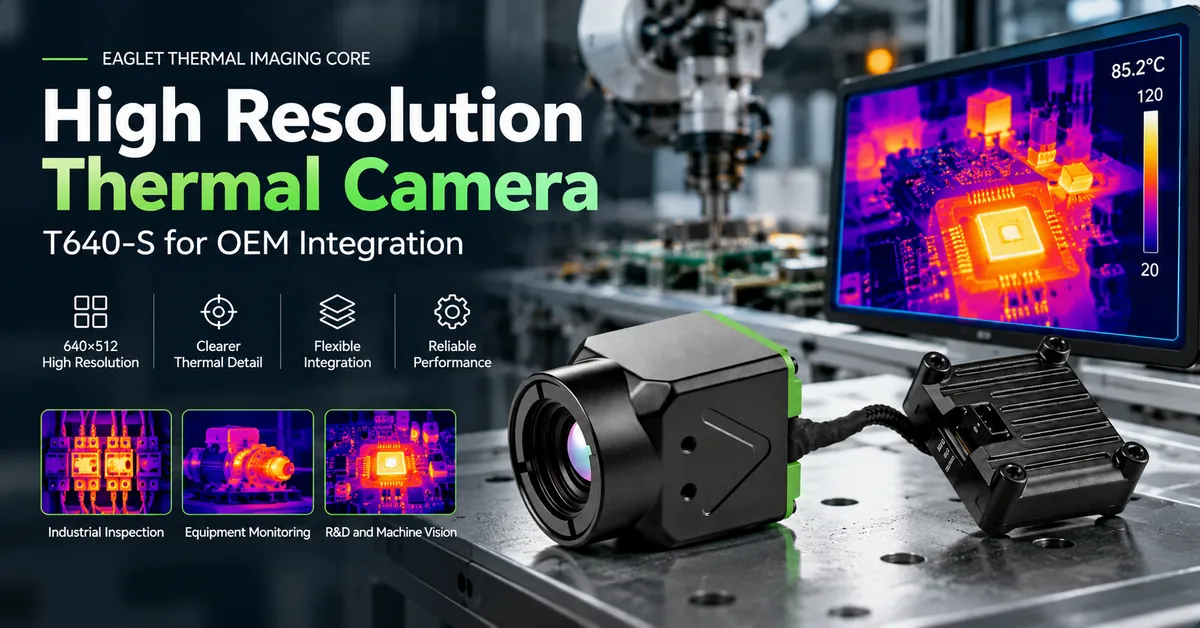

TL;DR: Choosing an infrared camera manufacturer for EV charging equipment requires matching the thermal imaging core to the actual monitoring task. OEM engineers should evaluate target visibility, detector resolution, optical coverage, video interfaces, environmental protection, and whether calibrated temperature data is required. A suitable infrared module can support thermal anomaly visualization, but it should not be treated as a complete temperature measurement or electrical protection system without additional engineering and validation.
Electric vehicle charging equipment contains electrical connections, power conversion components, cables, and other parts whose thermal behavior can provide useful information during operation.
However, designing an infrared monitoring system is more complicated than installing a camera inside a charging cabinet.
The manufacturer must consider viewing angles, reflective surfaces, optical windows, electrical compatibility, and long-term operating conditions.
EAGLET provides uncooled LWIR thermal imaging cores for OEM equipment and embedded vision integration.
This guide explains how EV charging equipment manufacturers can evaluate infrared camera modules and prepare a practical technical specification before requesting samples or a production quotation.
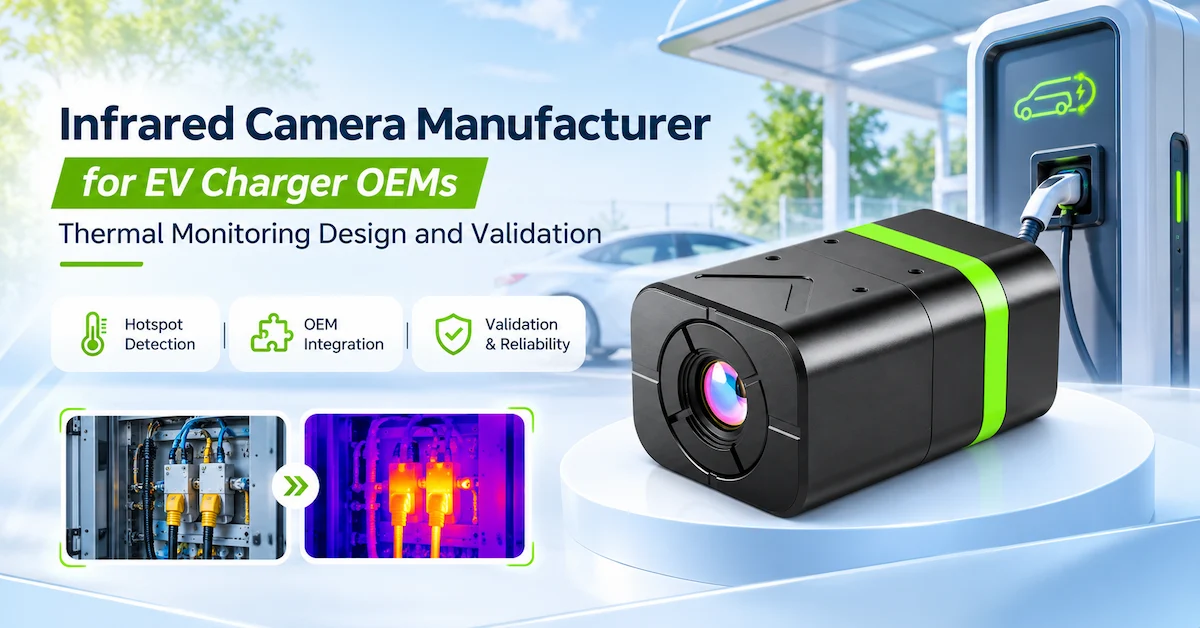
1. Key Takeaways for EV Charging OEMs
-
Define the monitoring objective first. Visualizing abnormal thermal patterns is different from measuring calibrated temperatures.
-
Verify the actual field of view. Detector resolution alone cannot determine whether a small charging connector will be adequately represented.
-
Consider enclosure materials. Ordinary glass and opaque metal panels cannot provide a usable LWIR view of components behind them.
-
Validate the complete imaging system. Camera cores, optics, electronics, software, housing, and operating conditions all affect performance.
-
Keep electrical protection independent. Infrared imaging may support inspection or condition monitoring, but it does not replace established electrical protection functions.
For EV charger OEMs, the best purchasing decision is based on a verified application requirement rather than the highest advertised detector resolution.
2. Why Are Infrared Cameras Used in EV Charging Equipment?
Infrared thermal imaging can help engineers observe spatial patterns of emitted infrared radiation from visible component surfaces.
In charging infrastructure, potential inspection targets include cable connections, power modules, distribution equipment, and accessible cabinet components.
EAGLET identifies new energy infrastructure and EV charging as application areas for its imaging technology.
Its New Energy & EV Charging solution covers connector inspection, power equipment monitoring, compact infrared imaging, and preventive inspection workflows.
Application comparison
| Application | What infrared imaging may support | Main technical requirement |
|---|---|---|
| Charging connector inspection | Observation of localized thermal patterns | Sufficient optical detail and target visibility |
| Power module monitoring | Comparison of visible component thermal behavior | Appropriate camera placement |
| Electrical cabinet inspection | Thermal visualization of accessible surfaces | Safe enclosure integration |
| Charging station maintenance | Inspection documentation and image review | Consistent acquisition conditions |
| OEM embedded monitoring | Thermal image delivery to the host system | Verified electrical and video interfaces |
Who should consider embedded infrared imaging?
This approach can be relevant to EV charger manufacturers, power equipment OEMs, industrial monitoring system developers, and companies building specialized inspection devices.
It may be less suitable for buyers who only require a conventional temperature sensor at a single known location.
The correct sensing approach depends on whether the project needs a thermal image, temperature measurements, or both.
3. Thermal Visualization vs. Temperature Measurement: What Should You Buy?
One of the most important questions to ask an infrared camera manufacturer is whether the proposed product provides thermal imaging, calibrated temperature measurement, or both.
These functions are related but not interchangeable.
| Requirement | Thermal imaging core | Calibrated radiometric system |
|---|---|---|
| Display thermal patterns | Yes, with suitable imaging output | Yes |
| Show relative differences within a scene | Generally possible under controlled imaging conditions | Yes |
| Provide calibrated temperature values | Not automatically | Requires supported measurement capability |
| Support temperature threshold decisions | Requires appropriate additional measurement capability | Possible after system-specific validation |
| Provide a complete protective shutdown system | No | No; separate safety architecture is necessary |
Why NETD is not temperature accuracy
NETD, or Noise Equivalent Temperature Difference, describes thermal sensitivity under specified test conditions.
A lower NETD can indicate an ability to distinguish smaller thermal contrast under those conditions.
However, NETD does not define absolute temperature accuracy.
Temperature measurement depends on calibration, emissivity, reflected radiation, optics, measurement distance, and other factors.
For EV charger manufacturers, this distinction is critical.
If the product specification requires an alarm when a connector reaches a defined temperature, confirm the availability and accuracy of calibrated radiometric data before selecting the camera core.
A visual-only thermal output is insufficient evidence of that capability.
4. EAGLET Infrared Camera Core Specifications for OEM Integration
EAGLET's publicly listed thermal imaging cores use uncooled vanadium oxide (VOx) detectors operating in the 8–14 μm long-wave infrared range.
The following models provide potential starting points for EV charging equipment development.
| EAGLET model | Native resolution | Published NETD | Supply voltage | Published power |
|---|---|---|---|---|
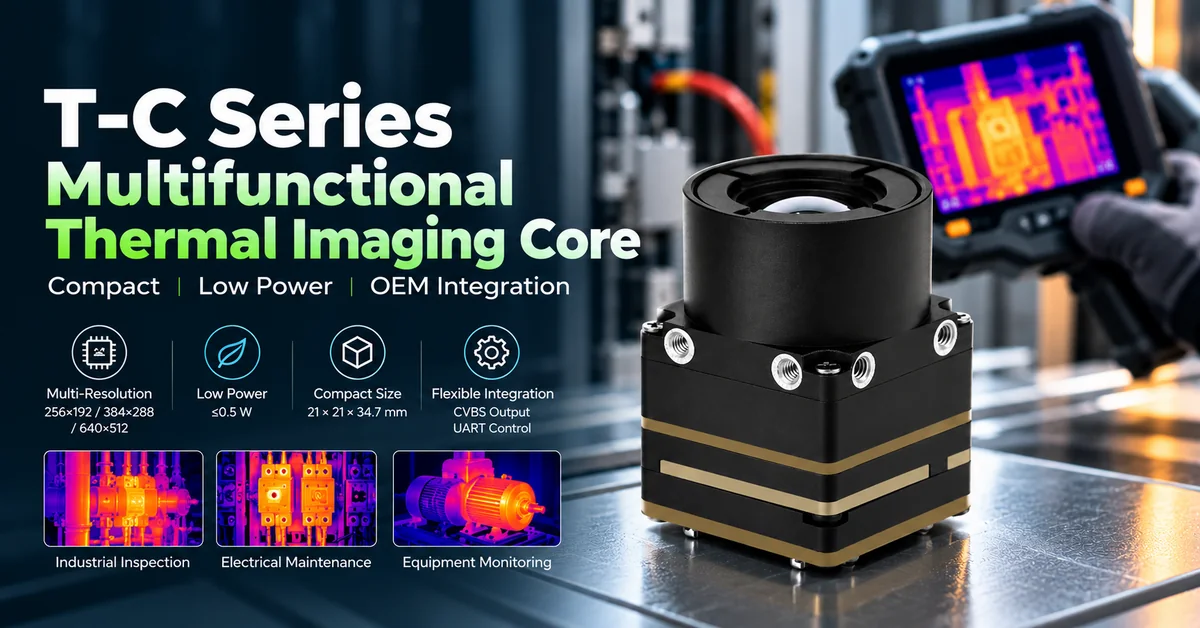
| T-C Series | 256×192 / 384×288 / 640×512 | ≤35 mK* | 4.5–18 V | ≤0.5 W* |
| T256-S | 256×192 | ≤50 mK | 9–24 V | <1.5 W |
| T384-I | 384×288 | ≤50 mK | 9–24 V | <1.5 W |
| T640-S | 640×512 | ≤50 mK | 9–24 V | <1.5 W |
| T640-I | 640×512 | ≤50 mK | 9–24 V | <1.5 W |
The T-C Series specifications are published at the product-family level. Their applicability to a specific configuration should be confirmed. Published NETD values should not be treated as directly comparable unless test conditions are equivalent.
The listed cores specify CVBS (PAL) video output, while T-C Series also lists UART control.
An OEM should verify the exact output and host acquisition requirements rather than assuming that native detector resolution equals available digital video resolution.
Which model is worth evaluating?
| Model | Potential integration advantage | OEM evaluation direction |
|---|---|---|
| T-C Series | Multiple resolution choices and low published power | Compact embedded monitoring equipment |
| T256-S | 256×192 imaging configuration | Systems with modest image-detail requirements |
| T384-I | Integrated 384×288 module | Industrial charging equipment and inspection devices |
| T640-S | 640×512 core with separately specified optical and controller assemblies | Higher-resolution systems with layout flexibility |
| T640-I | Integrated 640×512 configuration | Equipment requiring greater native detector detail |
These are candidate applications, not guaranteed EV charger monitoring performance.
Final product selection requires verification of the lens, viewing distance, integration architecture, and measurement requirements.
5. How Much Infrared Resolution Does an EV Charger Need?
Resolution selection should start with the smallest relevant inspection target.
A 640×512 detector contains more image pixels than a 256×192 detector, but the target's representation also depends on the lens and viewing distance.
A practical optical planning example
Consider a hypothetical charger inspection system with:
-
Camera-to-target distance: 1 meter
-
Horizontal field of view: 45°
-
Target width: 20 millimeters
-
Detector horizontal resolution: 384 pixels
At this distance, the horizontal scene width is approximately:
Scene width = 2 × Distance × tan(Horizontal FOV ÷ 2)
This gives a horizontal scene width of about 0.83 meters.
The target's approximate geometric representation is:
Target pixels ≈ 384 × 0.020 ÷ 0.83 ≈ 9 pixels
This calculation illustrates basic image geometry. It does not establish guaranteed detection, measurement accuracy, or usable thermal detail.
Actual performance also depends on optical quality, thermal contrast, detector response, focus, processing, and test conditions.
Why higher resolution is not always necessary
A larger detector may improve the representation of small targets when the optical configuration is appropriate.
However, increasing resolution without defining the field of view can create unnecessary component cost and integration complexity.
OEM recommendation: Specify the target dimensions, working distance, and required image detail before asking suppliers to recommend a detector resolution.
6. Why Camera Placement and Enclosure Design Matter
An infrared camera's ability to observe a charging component depends on having a usable optical path.
This is particularly important inside electrical cabinets.
Ordinary glass can block LWIR observation
A standard transparent glass window may transmit visible light while preventing the camera from imaging the intended object in the long-wave infrared spectrum.
An engineer could see the charging connector through the window with the naked eye but fail to obtain its thermal image.
Any viewing window must be evaluated for the required infrared transmission range and the safety requirements of the finished equipment.
Metal cabinets are not transparent
An infrared module cannot image internal electrical connections through a closed metal panel.
The OEM must design an appropriate viewing arrangement or select another inspection location.
Reflective connector surfaces complicate interpretation
Charging equipment can contain metallic surfaces with low or variable emissivity.
Reflections from nearby objects may affect the thermal image and any temperature calculation.
For quantitative measurement, engineers should address emissivity and reflected apparent temperature using an appropriate measurement methodology.
Practical enclosure questions
Before integration, determine:
-
Which component surfaces must remain visible?
-
Does the installation require a dedicated optical opening?
-
Can the camera be mounted safely without disturbing electrical insulation?
-
How will ambient temperature, condensation, dust, and vibration affect the system?
-
What protection must the finished enclosure provide?
A bare infrared module's electrical specifications do not establish the environmental or safety ratings of the complete charger.
7. How Should OEM Manufacturers Integrate the Video and Control Interfaces?
Electrical compatibility is another key supplier-selection requirement.
An infrared imaging core must operate correctly with the host controller, power supply, and acquisition system.
Integration checklist
| Integration factor | Questions for engineering review |
|---|---|
| Input voltage | Does the system provide the module's required supply? |
| Power consumption | Is adequate power available during startup and operation? |
| Video output | Can the host capture the specified signal correctly? |
| Control protocol | Are the required commands and settings supported? |
| Connector arrangement | Does the interface match the wiring design? |
| Mechanical mounting | Does the selected configuration fit the available space? |
| Thermal management | Can the completed assembly operate within its verified conditions? |
| Processing functions | Does the host receive the image data needed for the application? |
Analog video does not automatically provide temperature data
EAGLET's published core specifications identify CVBS (PAL) video output for its main thermal imaging modules.
A CVBS image can be useful for monitoring or visualization, but it does not automatically provide calibrated per-pixel temperature values.
If the EV charger requires temperature-based control decisions, confirm the necessary data format and measurement capability before committing to the hardware design.
8. How Can Infrared Monitoring Reduce False Interpretations?
A thermal image can be influenced by operating conditions.
For example, component heating varies with charging current, ambient temperature, equipment duty cycle, and cooling behavior.
An apparent change in displayed colors may also reflect automatic image processing rather than a measured temperature change.
Therefore, a reliable monitoring system requires more than reading colors from a thermal image.
Recommended validation approach
| Potential problem | Engineering response |
|---|---|
| Different charging loads | Evaluate representative operating conditions |
| Changes in ambient temperature | Record environmental conditions during testing |
| Reflective surfaces | Evaluate emissivity and reflected radiation |
| Automatic display gain | Do not interpret color changes directly as temperature changes |
| Limited target pixels | Review optical coverage and image quality |
| Camera drift or image artifacts | Test stability under defined operating conditions |
| Unavailable calibrated data | Use a suitable temperature measurement technology if required |
Do not replace electrical safety protection with thermal video
Infrared monitoring may complement existing diagnostic systems.
However, protective functions such as electrical fault detection, current protection, and thermal cutoffs should be engineered according to the applicable finished-equipment requirements.
A non-radiometric imaging module should not serve as the sole basis for a safety-critical overtemperature shutdown.
9. How Should an Infrared Camera Manufacturer Validate OEM Samples?
Sample testing should reflect the intended charging equipment rather than relying only on a laboratory demonstration.
A useful program includes three evaluation stages.
Stage 1: Technical compatibility
Confirm the product model, optical configuration, mounting arrangement, electrical supply, and video interface.
Ensure that the host can acquire usable images under representative conditions.
Stage 2: Application testing
Install the candidate core in a representative equipment configuration.
Evaluate relevant target surfaces under defined operating scenarios, including different load states and ambient conditions where appropriate.
Do not assume a camera can observe components hidden behind opaque barriers.
Stage 3: Production-oriented acceptance
Define repeatable checks for the approved configuration.
| Test area | Recommended acceptance evidence |
|---|---|
| Optical performance | Required targets visible with the approved lens |
| Video output | Stable acquisition by the intended host |
| Electrical behavior | Conformance to agreed operating requirements |
| Mechanical fit | Compatibility with approved drawings |
| Image stability | Performance under controlled test conditions |
| Measurement function | Calibration and uncertainty evidence, if applicable |
| Environmental suitability | Project-relevant system-level test results |
| Configuration control | Model and applicable revisions identified |
The buyer should agree on pass/fail limits before the samples are evaluated.
EAGLET describes application-oriented validation and product development capabilities, but its public website does not establish specific test results for every charger configuration.
10. What Should Buyers Verify About Manufacturing and Quality Control?
The role of an infrared camera manufacturer in an OEM project should be defined clearly.
Depending on the commercial arrangement, responsibilities may include module assembly, optical configuration, image processing, integration support, and product inspection.
However, supplying infrared camera cores does not necessarily mean manufacturing the detector semiconductor.
Quality control questions for supplier discussions
Ask how the supplier handles:
-
Incoming verification of critical optical and electronic components
-
Assembly and focus-related inspection
-
Electrical and video-output testing
-
Product version identification
-
Nonconforming units and corrective actions
-
Customer-specific acceptance requirements
-
Component and firmware changes
Request supporting documentation that applies to the selected model.
Quality certificates, environmental qualifications, or manufacturing-system certifications should only be considered verified when valid evidence is supplied.
Capacity and delivery planning
For commercial evaluation, distinguish engineering samples from pilot orders and recurring production quantities.
MOQ, lead times, customization costs, and after-sales terms can differ by model and configuration.
Do not assume that an advertised product family has a universal MOQ, fixed lead time, or guaranteed production capacity.
11. OEM/ODM Thermal Imaging: What Can Be Customized?
EV charger OEMs may require imaging hardware that fits a specific cabinet, host controller, or inspection arrangement.
EAGLET describes customized vision solutions and integration-oriented thermal imaging products.
Potential discussion areas include optical selection, mechanical integration, electrical compatibility, image processing, and host interface requirements.
Actual customization availability must be confirmed for the chosen model.
What should the buyer provide?
A useful project brief includes the following information.
| RFQ information | Example of what to specify |
|---|---|
| Finished equipment | DC charger, charging cabinet, or inspection device |
| Thermal monitoring purpose | Pattern visualization or calibrated temperature measurement |
| Target surfaces | Connectors, visible electrical contacts, modules |
| Working distance | Actual camera-to-target distance |
| Target dimensions | Smallest feature requiring observation |
| Optical requirements | Field of view and available mounting position |
| Electrical requirements | Supply voltage, power budget, host interface |
| Environmental requirements | Ambient range, protection and installation conditions |
| Project phase | Prototype, validation, pilot, or production |
| Purchasing requirements | Sample quantity, estimated volume, target schedule |
Request an OEM Infrared Camera Technical Evaluation
Looking for an infrared camera manufacturer for EV charging or industrial power equipment?
Explore EAGLET's thermal imaging core portfolio and identify the detector resolution and physical configuration that may fit your project.
For engineering documentation, see the EAGLET technical support page.
Then contact EAGLET to discuss your OEM infrared camera project.
Include the intended charging equipment, target dimensions, imaging objectives, electrical requirements, sample quantity, and expected production volume to support a more specific technical and commercial discussion.
12. Frequently Asked Questions About Infrared Camera Manufacturers
1. What should EV charger OEMs look for in an infrared camera manufacturer?
Buyers should evaluate relevant infrared core products, optical and electrical compatibility, available technical documentation, engineering support, quality requirements, and the ability to discuss project-specific supply terms.
2. Can infrared cameras detect abnormal heating in EV charging equipment?
They can help visualize thermal patterns from suitable visible surfaces. Reliable interpretation requires appropriate optics, operating conditions, and validation of the intended monitoring method.
3. Can a thermal imaging core measure the exact temperature of a connector?
Not automatically. Accurate temperature measurement requires suitable radiometric hardware, calibration, and compensation for factors such as emissivity and reflected radiation.
4. Which infrared resolution is better for EV charging cabinet inspection?
The suitable resolution depends on the target size, camera distance, optical field of view, and required detail. Compare actual target representation rather than detector resolution alone.
5. Can an LWIR camera monitor electrical equipment through standard glass?
Ordinary glass generally blocks the relevant long-wave infrared radiation. Any infrared viewing window requires appropriate optical and system-level evaluation.
6. Are EAGLET infrared camera cores complete EV charger monitoring systems?
No. EAGLET's listed products are embedded imaging cores. A complete monitoring system may require additional optics, processing, software, housing, measurement capability, and electrical integration.
7. Does CVBS output include calibrated temperature measurements?
CVBS is a video interface. Its presence does not establish that calibrated temperature measurements or full-resolution digital thermal data are available.
8. How should an OEM validate an infrared camera sample?
Test the exact optical and electrical configuration in representative equipment, using defined operating conditions and measurable acceptance criteria. Confirm any required temperature measurement functions separately.
9. What determines infrared camera OEM pricing and lead time?
Pricing and delivery depend on the selected model, configuration, engineering scope, quantity, testing requirements, and purchasing conditions. These details require a project-specific quotation.
10. How do I request an infrared camera OEM quotation from EAGLET?
Provide your application, target surfaces, working distance, required resolution, optical and interface constraints, measurement needs, sample quantity, and expected purchasing volume through the EAGLET contact page.
Conclusion
Selecting an infrared camera manufacturer for EV charging equipment requires a clear understanding of what the thermal imaging system must observe, measure, and communicate.
For EV charger OEMs, important purchasing considerations include target visibility, detector resolution, optical design, video interface compatibility, enclosure integration, and practical engineering validation.
The distinction between thermal visualization and calibrated temperature measurement is especially important. A module capable of displaying thermal images should not be assumed to provide accurate temperature readings or standalone electrical safety protection.
EAGLET offers uncooled LWIR thermal imaging cores, including T-C Series, T256-S, T384-I, T640-S, and T640-I, as potential integration components for industrial equipment and customized thermal vision projects.
A well-defined technical specification helps OEM buyers reduce integration uncertainty, compare suitable configurations, and prepare more effective purchasing discussions.
Developing EV charging equipment with infrared monitoring requirements? Contact EAGLET to discuss thermal imaging core selection, application validation, OEM integration, and a project-specific quotation.