
A portable infrared camera should deliver useful thermal images wherever technicians need to work, without creating unnecessary weight, battery limitations, or complicated operating procedures. For OEM manufacturers developing handheld inspection equipment, the challenge is not simply finding a small infrared detector. It is integrating thermal imaging, optics, power management, display electronics, and a durable housing into one practical product.
A portable thermal imaging device may be used for electrical inspections, machinery maintenance, building diagnostics, or outdoor observation. Each application introduces different requirements for image detail, temperature measurement, battery runtime, and environmental protection.
EAGLET provides uncooled LWIR thermal imaging cores for OEM integration, including compact T-C Series and T256-S modules that equipment developers can evaluate for portable thermal vision products.
Quick answer: For a successful handheld infrared camera, select a thermal core based on the smallest inspection target, viewing distance, required measurement capability, and available power. Then validate the complete device's battery life, ergonomics, optical performance, and environmental reliability before approving production.
1. What Is a Portable Infrared Camera?
A portable infrared camera is a compact, mobile device that detects infrared radiation and converts it into a thermal image. Unlike conventional cameras, which capture reflected visible light, thermal cameras visualize differences in infrared radiation emitted and reflected by objects.
This allows technicians to observe thermal patterns without needing visible illumination.
However, the term portable infrared camera covers different equipment types.
| Camera type | Main characteristics | Typical users |
|---|---|---|
| Handheld thermal inspection camera | Integrated display, battery, thermal optics, and controls | Maintenance technicians, field inspectors |
| Pocket infrared camera | Compact design with an emphasis on portability | Service engineers, mobile inspection teams |
| Professional portable thermal camera | Advanced inspection functions and application-specific accessories | Industrial and specialist equipment users |
| OEM thermal camera core | Infrared sensing module requiring external electronics and housing | Equipment manufacturers and system integrators |
Important distinction: EAGLET's publicly listed T-C, T256-S, T384-I, and T640-I products are thermal imaging cores, not complete battery-powered handheld cameras. OEM customers must develop or source the remaining components of a finished instrument.
For companies launching their own portable thermal camera products, a suitable core can provide the foundation for a differentiated design.
2. Who Should Choose an OEM Portable Thermal Imaging Solution?
An OEM approach is most relevant to companies that want to develop, customize, or integrate their own thermal imaging products.
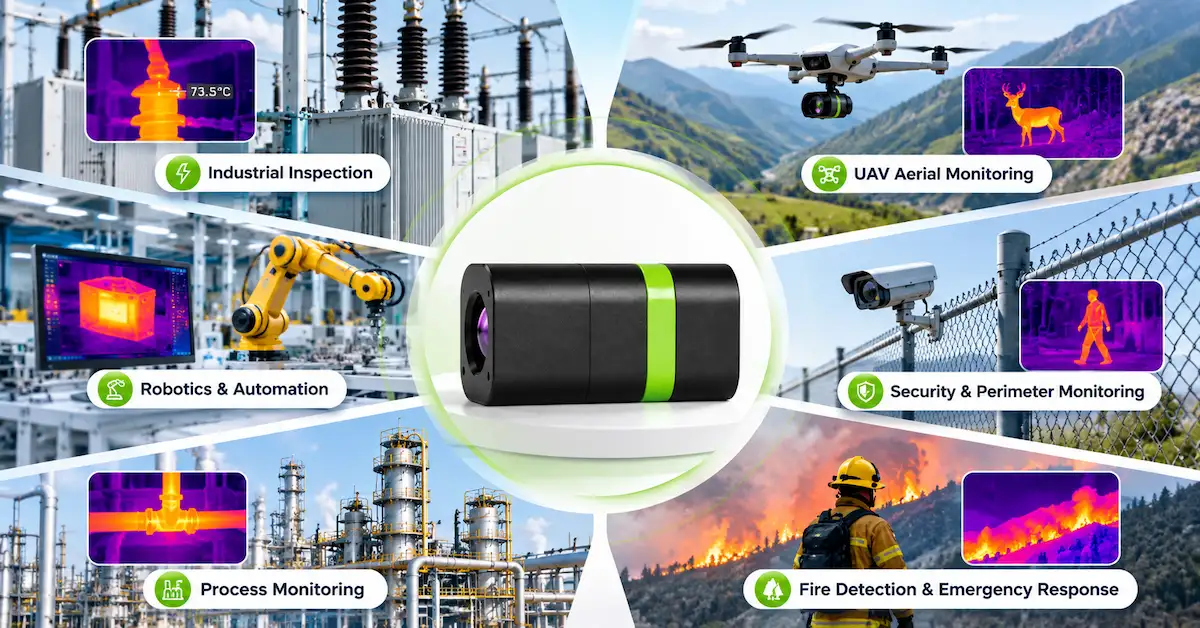
Industrial inspection equipment manufacturers may need handheld infrared instruments for maintenance technicians, electricians, and equipment service teams.
Professional tool brands may want compact thermal imaging products with their own user interface, housing, software features, and brand identity.
Embedded electronics developers may need a small thermal sensing system that fits within existing portable equipment.
Outdoor observation equipment manufacturers may prioritize battery life, low-light operation, viewing ergonomics, and environmental protection.
An OEM thermal core is less suitable for a buyer who simply needs one finished handheld thermometer or a ready-to-use inspection camera without product development.
For those buyers, an appropriately specified finished instrument may be the more practical choice.
3. Common Applications for Portable Infrared Cameras
Portable thermal imaging can support inspection tasks across different working environments.
Electrical equipment inspection
Maintenance teams use infrared imaging to investigate unusual heating around electrical connections, distribution components, and operating equipment.
A handheld design should enable safe positioning, clear image viewing, and repeatable inspection records.
If the application requires temperature values rather than visual thermal patterns, calibrated radiometric capability must be specified separately.
Mechanical maintenance
Portable thermal cameras can help technicians observe changes in heat distribution around motors, bearings, pumps, and machinery.
Thermal observations should be interpreted alongside equipment load, maintenance history, and other diagnostic information.
For broader equipment applications, see EAGLET's industrial inspection solutions.
Building and facility inspection
A portable infrared camera can help investigate thermal differences around insulation, heating systems, and building envelopes.
A thermal pattern alone does not prove moisture intrusion, insulation failure, or a particular construction defect. Interpretation requires appropriate conditions and supporting inspection methods.
Outdoor observation
Portable infrared imaging is also relevant to professional observation equipment and field operations where visible illumination is limited.
See EAGLET's outdoor observation solutions for the broader application direction.
Environmental conditions, lens selection, and target contrast strongly influence performance, and thermal imaging cannot see through every obstacle.
4. Essential Specifications for a Portable Infrared Camera
The most useful specification is not always the highest detector resolution. Portable devices must balance image performance with system size, power consumption, and intended operating conditions.
| Technical parameter | What it means | Why OEM buyers should care |
|---|---|---|
| Infrared resolution | Number of native detector pixels | Influences target detail and scene coverage |
| Detector technology | Type of infrared sensing element | Affects design architecture and integration |
| Spectral response | Infrared wavelength range | Determines compatible optics and sensing applications |
| NETD | Thermal sensitivity under defined conditions | Helps evaluate small thermal-contrast differences |
| Frame rate | Rate at which thermal frames are acquired | Affects moving-image presentation |
| Lens / FOV | Optical scene coverage | Determines target size within the image |
| Power consumption | Electrical demand of the thermal core | Contributes to battery and heat-management budgets |
| Module dimensions | Space occupied by the core | Influences internal enclosure design |
| Video and control interfaces | Communication with host electronics | Determines integration requirements |
| Operating temperature | Permitted module operating range | Helps assess environmental design |
For handheld equipment, these parameters should be evaluated as a connected system rather than separate marketing specifications.
Why NETD matters
NETD stands for Noise Equivalent Temperature Difference. It describes a thermal imaging system's sensitivity to small thermal differences under specified testing conditions.
A lower NETD can be advantageous when the application requires observation of subtle thermal contrast.
However, NETD is not the same as absolute temperature measurement accuracy.
A core that produces clear thermal video does not automatically support calibrated temperature readings.
Why resolution matters
A 256×192 infrared detector has 49,152 native pixels, while a 384×288 detector has 110,592.
The additional pixels may provide more spatial information, but image usefulness still depends on optical focus, field of view, distance, and the relevant target.
For a portable device intended to inspect nearby machinery, a lower-resolution configuration may satisfy the intended task.
For more demanding optical detail, buyers should evaluate the higher-resolution option against their actual target.
5. EAGLET Thermal Imaging Cores for Portable OEM Cameras
EAGLET offers several uncooled VOx thermal cores that can be considered for compact imaging systems.
The following comparison uses published specifications and should be confirmed against the exact product revision before engineering approval.
| Product | Resolution | Published power | Published dimensions | OEM consideration |
|---|---|---|---|---|
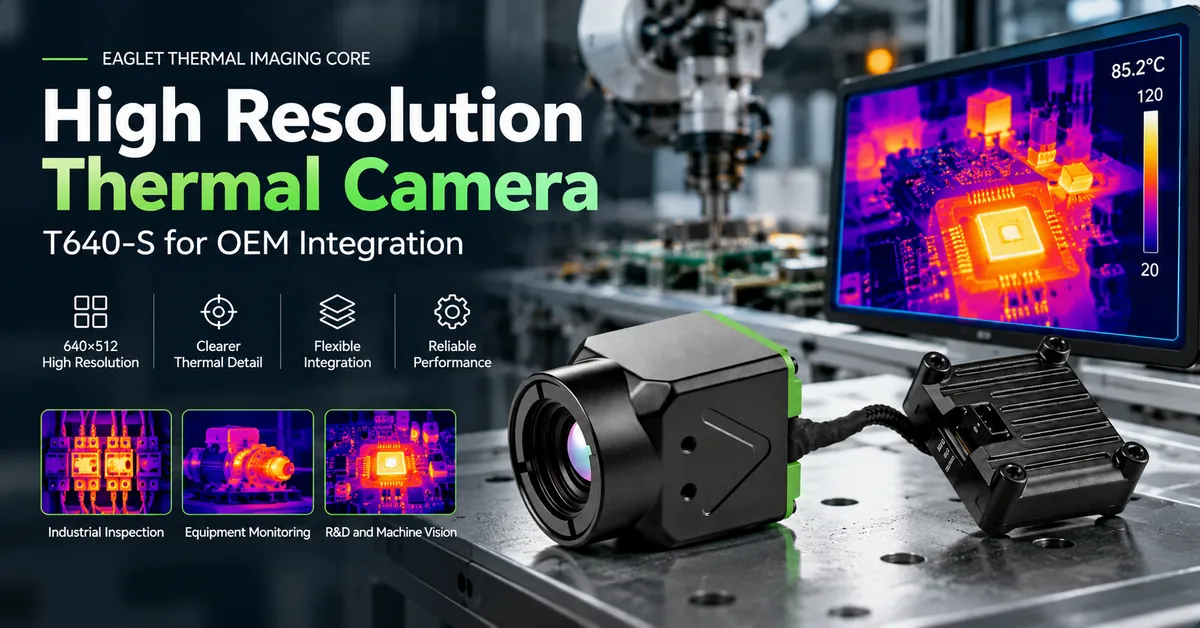
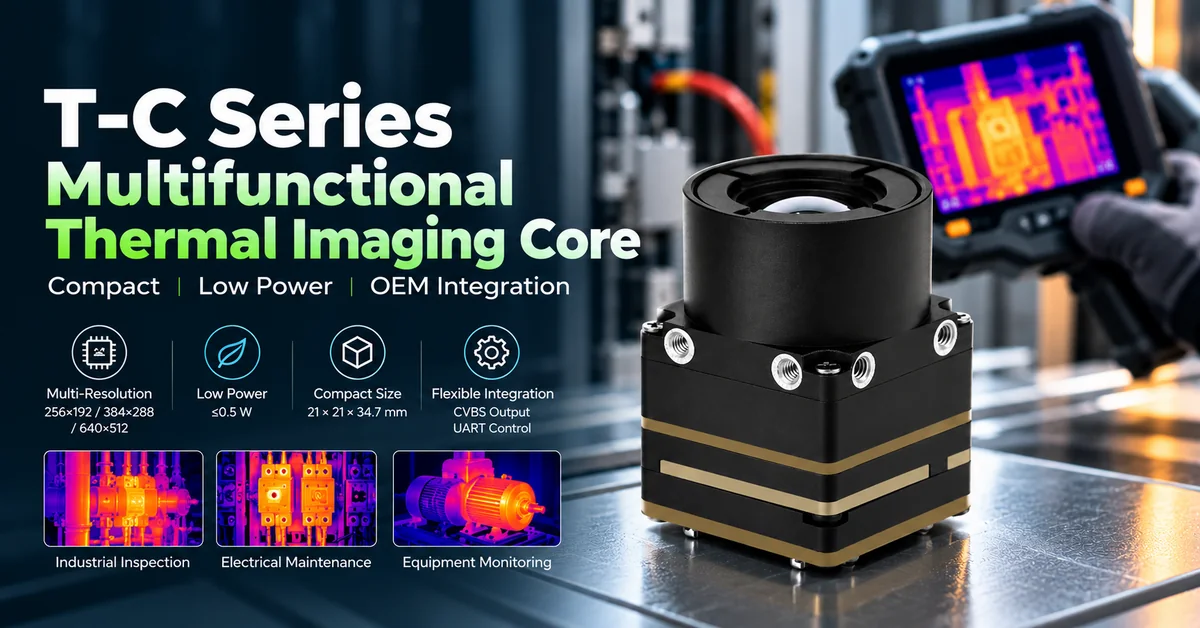
| T-C Series | 256×192 / 384×288 / 640×512 | ≤0.5 W* | 21×21×34.7 mm* | Low-power, compact design |
| T256-S | 256×192 | <1.5 W | Optical and control parts specified separately | Compact handheld integration |
| T384-I | 384×288 | <1.5 W | 35×26×49 mm | Higher pixel count for portable equipment |
| T640-I | 640×512 | <1.5 W | 35×26×44 mm | Detail-oriented professional designs |
The T-C figures are published for the product family. Confirm their applicability to the specific resolution and lens configuration.
T-C Series: A starting point for low-power designs
The T-C Series uses uncooled VOx technology with 8–14 μm spectral response.
Published series specifications include 12 μm pixel pitch, CVBS video output, UART control, a 4.5–18 V input range, and the power and dimension figures shown above.
Its three resolution configurations allow OEM developers to explore different performance requirements within the same product family.
For battery-focused applications, the published low-power specification is worth investigating, provided the exact configuration is confirmed through documentation and sample testing.
T256-S: Compact thermal imaging for handheld equipment
The EAGLET T256-S thermal imaging core is explicitly positioned for portable thermal equipment and compact infrared cameras.
Published specifications include:
-
256×192 infrared resolution
-
Uncooled VOx detector
-
8–14 μm spectral response
-
50 fps imaging
-
NETD ≤50 mK at 25°C, F/1.0
-
Power consumption below 1.5 W
-
9–24 V input
-
CVBS (PAL) video output
Its separately listed optical and controller dimensions are useful when planning a compact enclosure.
T384-I and T640-I: Options for more image detail
The T384-I and T640-I offer 384×288 and 640×512 imaging respectively, with published power consumption below 1.5 W.
They can be considered for professional handheld equipment that needs more native image samples, although additional processing and display requirements must be evaluated.
Selection recommendation: Start with T-C or T256-S when compactness and power are primary considerations. Evaluate T384-I or T640-I when representative image tests demonstrate a need for additional spatial information.
This is a preliminary engineering recommendation, not a guarantee of final suitability.
6. What Components Are Needed to Build a Handheld Infrared Camera?
A thermal imaging core is only one part of a finished portable device.
An OEM handheld camera typically needs the following components:
Infrared sensing assembly: Thermal detector, compatible optics, core electronics, and verified image output.
Main processing board: Video capture, user-interface logic, device settings, storage, and communications as required.
Display: An LCD, OLED, or other suitable screen with enough brightness and contrast for the intended work environment.
Battery and power electronics: Rechargeable battery cells, protection circuitry, charging management, voltage conversion, and appropriate power distribution.
Enclosure and controls: Housing, buttons, protective window, seals, connectors, and a suitable grip arrangement.
Software: Imaging controls, palettes, menus, image capture, file handling, and any measurement or reporting features supported by the hardware.
EAGLET's listed thermal cores provide imaging components; the remaining finished-camera functions must be designed, integrated, and validated for the particular OEM project.
Enclosure materials and optical protection
Portable devices commonly require mechanically durable housing materials and suitable environmental seals.
The optical window is especially important. Ordinary visible-light window glass is generally unsuitable for transmitting the 8–14 μm LWIR radiation used by the listed EAGLET cores.
Window material, coating, thickness, transmission, sealing, and optical calibration should be addressed during engineering development.
7. How to Calculate Battery Life for a Portable Infrared Camera
Battery runtime is a critical difference between portable thermal equipment and stationary monitoring systems.
A common purchasing mistake is to estimate battery life from the thermal core's power consumption alone.
A finished handheld camera may also consume power through its display, processor, video circuitry, wireless functions, storage, and power-conversion electronics.
A useful preliminary formula is:
Estimated runtime (hours) = Usable battery energy (Wh) ÷ Average system power (W)
For example, consider a hypothetical OEM design with:
-
Nominal battery energy: 20 Wh
-
Assumed usable fraction: 75%
-
Average complete-device power: 5 W
The estimated runtime would be:
20 Wh × 0.75 ÷ 5 W = 3 hours
This is an illustrative calculation, not a tested EAGLET product runtime or a universal battery-efficiency figure.
Actual performance depends on battery discharge behavior, temperature, display brightness, processing load, and conversion losses.
Power supply compatibility
EAGLET's T-C Series lists a 4.5–18 V input range, while T256-S, T384-I, and T640-I list 9–24 V.
A single-cell lithium-ion battery therefore cannot be assumed to power these modules directly.
The system may require a suitable DC-DC converter and regulated supply.
For OEM buyers, the correct requirement is not merely low power consumption but validated battery runtime at the complete-device level.
8. Ergonomics, Optical Design, and Field Reliability
A professional portable infrared camera must remain practical during repetitive inspections.
One-handed operation
Technicians may need to carry tools, record inspection results, or operate in restricted spaces.
Button placement, screen readability, balance, and grip design should be evaluated using realistic working procedures.
A smaller thermal core can create more internal design flexibility, but it does not automatically produce an ergonomically superior finished device.
Display and optical alignment
The display should present thermal images clearly, while the optical system should cover the required target area at normal working distances.
An OEM developer should verify:
-
Target visibility across the intended working range
-
Actual field of view and focus
-
Image orientation and display scaling
-
Viewing performance under bright ambient light
-
Alignment between the optical axis and any visible-light camera, if included
Protection against field conditions
Portable equipment may encounter dust, moisture, handling shocks, vibration, and changing ambient temperatures.
The finished-camera design must address those conditions through appropriate materials, sealing, mounting, and verification.
A thermal core's operating-temperature rating does not establish the IP rating or drop resistance of the completed camera.
If a product requires an IP54, IP65, or other protection level, the OEM should test the final assembled enclosure against the relevant requirements.
9. Quality Control and Compliance for Portable Thermal Equipment
Before volume procurement, buyers should establish acceptance criteria for both the core and the finished handheld device.
A practical quality-control plan includes:
| Test category | Recommended verification |
|---|---|
| Infrared image quality | Uniformity, noise, target visibility, image artifacts |
| Optical assembly | Focus, FOV, window transmission, mechanical alignment |
| Electrical performance | Startup, supply stability, current consumption |
| Battery system | Charging, protection functions, runtime, temperature behavior |
| Mechanical reliability | Buttons, connectors, housing, repeated handling |
| Environmental protection | Agreed ingress, temperature, vibration, and drop tests |
| Software stability | Startup, image capture, controls, data handling |
| Radiometric performance | Calibration and measurement uncertainty, when applicable |
For machinery inspection, ISO 18434-1:2008, Condition Monitoring and Diagnostics of Machines — Thermography — Part 1: General Procedures, provides relevant guidance on thermal inspection procedures, interpretation, and reporting.
That industry standard is a reference for inspection practice, not evidence that any particular EAGLET module is certified.
The complete portable camera may also require market-specific electrical, electromagnetic compatibility, battery transportation, and environmental compliance assessments.
These requirements should be confirmed according to the finished product and destination market.
10. Cost, MOQ, and Production Lead-Time Considerations
The price of a portable infrared camera depends on more than its thermal detector resolution.
For OEM projects, the total product cost may include:
-
Infrared core and optical configuration
-
Display and main processing electronics
-
Battery, charging circuit, and power management
-
Enclosure tooling and protective components
-
Firmware and application software
-
System integration and engineering validation
-
Quality testing, packaging, and documentation
A lower-cost imaging core can still produce an expensive final device if it requires extensive interface development or custom electronics.
Likewise, a higher-resolution detector may add cost without improving the intended inspection task.
What should an OEM purchasing manager request?
Obtain a quotation that separates sample pricing, production-unit pricing, non-recurring engineering costs, customization, and testing.
Confirm MOQ, expected production capacity, sample availability, production lead time, and product revision management in writing.
EAGLET's published core specifications do not establish universal MOQ, price, lead time, or finished-device certification commitments. These must be confirmed for the actual project.
11. OEM/ODM Development and Manufacturing Workflow
A structured product-development process helps reduce technical changes after tooling and production commitments.
Step 1 — Define the product positioning. Identify whether the final device is a compact inspection tool, professional maintenance camera, or outdoor thermal observation instrument.
Step 2 — Select the thermal core. Compare resolution, optics, dimensions, power requirements, video interface, and measurement capabilities.
Step 3 — Develop the system architecture. Establish battery, processing board, display, enclosure, controls, and required software functions.
Step 4 — Build and evaluate prototypes. Test image quality, runtime, handling, electrical stability, and environmental performance.
Step 5 — Confirm the production configuration. Freeze component revisions, drawings, test requirements, quality criteria, and commercial terms.
EAGLET offers technical support for product selection and integration, including discussions covering optical requirements, interfaces, power, and mechanical constraints.
The exact scope of customization and manufacturing services should be agreed upon for each project.
12. How to Request a Portable Infrared Camera OEM Quotation
A detailed RFQ makes it easier to evaluate the correct thermal imaging core and identify required development work.
When contacting EAGLET, include:
| RFQ field | Information to provide |
|---|---|
| Target product | Handheld inspection camera, compact thermal tool, or another portable device |
| Application | Electrical inspection, mechanical maintenance, building diagnostics, outdoor observation |
| Detector requirement | Preferred resolution and thermal sensitivity |
| Working distance | Typical and maximum inspection distance |
| Optical requirements | Field of view, target size, focus requirements |
| Display and software | Screen, capture, controls, reporting functions |
| Battery specification | Target runtime, battery architecture, charging method |
| Housing requirements | Size, handling, environmental protection |
| Temperature measurement | Whether calibrated readings are required |
| Commercial information | Prototype quantity, expected annual volume, target project schedule |
Developing a portable infrared camera under your own brand?
Explore EAGLET's infrared thermal imaging core portfolio to compare potential OEM components.
Then contact EAGLET for a technical discussion and project quotation.
Share your required imaging performance, battery and enclosure constraints, and estimated purchasing quantity to help identify a suitable integration approach.
13. Frequently Asked Questions About Portable Infrared Cameras
1. What is a portable infrared camera used for?
It is used to visualize thermal patterns during mobile inspection and observation. Applications include electrical maintenance, machinery inspection, building diagnostics, and professional outdoor observation.
2. What is the difference between a handheld thermal camera and a thermal imaging core?
A handheld camera is a finished portable device with the necessary power, display, controls, and housing. A thermal imaging core is an embedded component requiring further system integration.
3. Which resolution is best for a portable thermal camera?
The best resolution depends on the target size, working distance, required detail, and product budget. A 256×192 core may serve basic tasks, while 384×288 or 640×512 configurations provide more native pixels.
4. How long does a portable infrared camera battery last?
Runtime depends on usable battery energy and the total power consumed by the finished device. Thermal core power alone cannot determine battery life.
5. Can a portable infrared camera measure accurate temperatures?
Only when the finished camera includes appropriately calibrated radiometric measurement capabilities. Thermal image contrast and NETD specifications do not independently establish measurement accuracy.
6. Can EAGLET thermal cores be used in custom handheld equipment?
EAGLET describes its T-C Series and T256-S as suitable for portable and embedded thermal imaging applications. Final suitability depends on optics, power, interface, housing, and prototype validation.
7. Do EAGLET thermal cores include a display and battery?
The publicly listed core products are embedded imaging modules, not complete handheld instruments. The display, battery, housing, user interface, and other system components require separate integration.
8. Are portable thermal cameras waterproof and drop-resistant?
Only when the finished device has been designed and tested to meet the required protection and durability criteria. A bare module's operating-temperature specification does not establish those ratings.
9. What documents should an OEM buyer request before ordering?
Request the exact model datasheet, optical specifications, interface details, mechanical drawings, applicable test reports, product revision information, and confirmed commercial terms.
10. Can EAGLET support OEM/ODM customization and bulk purchasing?
EAGLET offers thermal core integration and customized imaging solution discussions. Buyers should confirm the requested customization, sample quantities, MOQ, production capacity, lead time, and acceptance requirements for their specific project.
Conclusion
Selecting a portable infrared camera for professional field inspection requires balancing imaging capability with the practical demands of a handheld device.
Resolution, NETD, and lens selection determine how useful thermal images may be, while battery management, ergonomics, enclosure protection, and interface compatibility influence the actual user experience.
For OEM manufacturers, compact uncooled LWIR modules such as EAGLET's T-C Series and T256-S provide potential starting points for custom portable thermal imaging equipment. T384-I and T640-I offer additional native resolution options when justified by the intended application.
Successful product development depends on defining the inspection task, validating the thermal core, designing the complete system, and testing representative prototypes before production.
Planning a new portable thermal camera product? Contact EAGLET to discuss suitable thermal imaging cores, integration requirements, and an OEM quotation based on your project specifications.